










































Priya's Shakti and Priya's Mirror
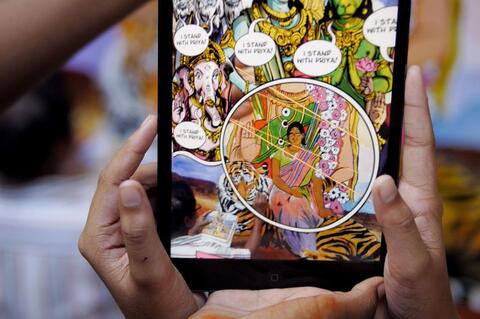
"...shatters the taboos around gender based violence through art, education, and a strong identifiable female character who is a rape survivor and superhero."
With an eye to broadening awareness and action against gendered violence in India and around the world, Priya's Shakti and Priya's Mirror are comic books part of a larger entertainment-education (EE) initiative to highlight the threat of sexual harassment and violence that women face on a daily basis unless deeply rooted patriarchal norms are challenged. Rattapallax, a literary publishing house and film production company based in New York City, United States (US), and New Delhi, India, is producing the project, which uses the augmented reality application (app) Blippar to make animation, videos, real-life stories, and other interactive elements come to life on any mobile device. The comic books are meant to be a form of "cultural education", hopefully reducing instances of sexual violence and acid attacks against women around the world. In addition to encouraging attitude change to help alleviate the stigma and shame that survivors face, the comics show and celebrate the resilience of survivors and ultimately hope to foster solidarity among them.
The Priya's Shakti storyline focuses on Priya, a human woman and ardent devotee of the Hindu Goddess Parvati who has experienced a brutal rape and the social stigma and isolation resulting from it. The Goddess Parvati is horrified to learn about the sexual violence that women on Earth face on a daily basis and is determined to change this disturbing reality. Inspired by the Goddess, Priya breaks her silence. She sings a message of women's empowerment that enraptures thousands and moves them to take action against gender-based violence (GBV) around the world. Co-written by Ram Devineni and Vikas K. Menon with artwork by Dan Goldman, the comic book uses augmented reality and image recognition, using various media to tell the story of fighting back against sexual assault. It is available for free in English, Portuguese, Spanish, Italian, and Hindi on the Priya's Shakti website and in print.
Priya's Shakti was released at the Mumbai Comic Con in December 2014 and became viral, and came to life in May 2015 in an ongoing "walk-in comic book" exhibition at Manhattan (New York)'s City Lore Gallery. Using Blippar, the free visual discovery app, any reader or gallery goer can turn Priya's Shakti into an interactive, 3D experience. The app uses image recognition and augmented reality to animate everyday objects and images. Its developers built algorithms around specific markers, rendering images "blippable," which any device enabled with the app can pick up. For the art exhibition, viewers can scan the various pages of the comic book, and videos and 3D animation will pop out. But there are even more layers of social awareness included: Users will find additional information on gender-based sexual violence, audio interviews with real rape survivors, and an option to insert themselves into an image with the protagonist and share it with the words "I Stand With Priya." The team is also creating murals across the city of Mumbai, allowing those close to the issue to "stand with Priya," too.
The second chapter in the Priya series, Priya's Mirror, along with an accompanying exhibition, premiered at Lincoln Center in New York on September 30 2016 as part of the New York Film Festival. Inspired by ancient mythological tales, the comic book tells the story of Priya joining forces with a group of acid attack survivors as they fight against the demon-king, Ahankar, and his tyrannical hold on them. Created by and featuring acid attack survivors from New York City, Bogota, Colombia, and New Delhi, the comic book was set to officially launch in India at Mumbai Comic Con on October 22 and 23 2016, and is available for free download in English, Spanish, Italian, Portuguese, and Hindi on the Priya's Mirror website and in print.
In doing interviews prior to the comic book's creation, its creators found that acid attack survivors went through the same cultural problems that rape survivors went through - with the exception that they were not only internally traumatised, but physically traumatised as well. Considering the fact that telling these deeply traumatic and personal stories of violent attacks can get tricky, there was also the challenge of sensitively illustrating each survivor's physical appearance. In Priya's Mirror, real-life acid attack survivors are turned into superheroes as an integral part of the story. The survivors worked closely with Goldman on what their illustrated versions would look like. The artwork went through several rounds of editorial changes, ensuring the survivors were represented responsibly. Acknowledging that telling these deeply traumatic and personal stories of violent attacks can get tricky, Devineni says it was crucial for survivors to vet their own representations in creating the narrative for Priya's Mirror. "We make sure when we write the comic book that it is reviewed by the survivors," he says. "They are part of the review process, making sure they are represented with respect and dignity."
While readers can experience Priya's Mirror as a standard comic book, the augmented reality component allows them to interact with it further. Powered through Blippar, users can hold their phones or tablets up to the comic's pages to unlock videos and animated content. In so doing, viewers can see acid attack survivors tell their own stories, similar to the tech used for Priya's Shakti. Users can also participate in an awareness campaign inspired by activist and acid attack survivor Natalia Ponce de León. In 2014, a man Ponce de León had never spoken to poured a liter of sulfuric acid on her in Bogota. Her story was highly publicised in the country, encouraging her to fight for policy changes that would help prevent acid attacks. Her campaign, called The Last Mask, gained mass attention in 2014, when Ponce de León sent out clear masks mimicking acid burns to media and celebrities around the country. She encouraged them to take photos and share them on social media in an effort to change Colombian law - specifically, legislation that would make it harder to get acid over the counter and increase penalties against aggressors. Through Blippar, readers of Priya's Mirror can continue a version of the campaign by virtually wearing a digital mask and posting it to social media to show their support. Those who scan the cover of the comic book will be able to take the mask and put it on their face - almost like Snapchat. Ponce de León adds, "Priya's Mirror not only portrays the courage and beauty of us acid attack survivors, but it also serves as a highly creative tool to educate younger generations about gender equality."
Though the comic book and augmented reality features aim to empower survivors, organisers say teenage boys are the true audience they seek to reach. The idea is that young boys are the next generation of potential aggressors, and they are essential in the fight to shift a culture that normalises gendered violence. That is one of the main reasons they choose comic books, as opposed to a fictional or a nonfiction book. The additional tech component of augmented reality is meant to be an addition incentive for teenagers to pick it up. Founder and CEO of Blippar, Ambarish Mitra said, "The augmented reality elements allow the readers to feel more connected with the survivors. Technology is being used here as the vehicle of engagement driving impactful social-change and this is extremely powerful."
Women, Gender, Rights, Health
Filmmaker and artist Ram Devineni launched this initiative as a way to speak out after Nirbhaya, when a young woman (widely known as Nirbhaya, meaning "fearless") in New Delhi was gang-raped on a bus in December 2012, making international headlines. While marching in the streets alongside other protesters, Devineni asked a Delhi police officer what he thought about the young woman's assault. The officer told him, "No good girl walks home alone at night," implying that she either provoked the rape or, worse, deserved it. His words reflected the misguided, patriarchal view that permeates much of Indian society, silencing women even further with social stigma. "I realized at that moment that this was not a legal issue, but a cultural problem."
According to project organisers, GBV in India and around the world is deeply rooted in patriarchal views. The World Health Organization (WHO) estimates that over 1 billion women worldwide have experienced or will experience either intimate partner violence or non-partner sexual violence in their lifetime. A lot of GBV is not reported due to fear and shame.
Though acid attacks have been reported globally, they are extremely prevalent in South Asia. India, specifically, has some of the highest rates of acid attacks in the world, though reliable statistics are difficult to obtain due to stigma and underreporting by authorities. According to Acid Survivors Foundation India, there were at least 249 acid instances of acid attacks in India in 2015, up from 225 incidents in 2014.
Devineni says the inspiration for Priya's Mirror came when he met with acid attack survivors in New Delhi in December 2015. He listened to their personal experiences of violence and stigma and quickly learned that their stories directly mirrored those he heard from rape survivors while researching for Priya's Shakti.
Priya's Shakti was honoured by UN Women as a "gender equality champion" and had over 500,000 downloads and hundreds news stories written about it, reaching millions of readers worldwide.
Assieh Khamsi, global marketing manager at Blippar, says this isn't the company's first foray into social good. For example, it worked with the British Heart Foundation to allow users to scan any pack of cigarettes, and the app would tell them how much money they can save by quitting smoking.
The comic book was funded by the World Bank's WEvolve Global Initiative, which seeks to change attitudes and behaviours that lead to gender inequities, including gender violence. Priya's Mirror is co-produced with Mahendra Singh Foundation in New York and India, and Fundacion Natalia Ponce de Leon in Bogota (both non-governmental organisations (NGOs) provide support to victims of physical and sexual abuse and acid attacks for rebuilding their confidence and strength on their journey to becoming survivors. The project's non-profit engagement partner is Apne Aap Women Worldwide, an NGO supporting at-risk girls and women in India and the US by ensuring them access to their rights and working for policy and social change.
C4D Network Twitter Trawl: 3 - 9 October 2016, "New augmented reality comic book shows the resilience of acid attack survivors", by Katie Dupere, Mashable, October 2 2016, New 'walk-in comic book' uses augmented reality to show sexual assault survivors as heroes", by Matt Petronzio, Mashable, May 7 2015, Priya's Mirror website - all accessed on October 11 2016; and Ram Devineni to The Communication Initiative on October 14 2016. Image credit: Mashable/Heather Martino
- Log in to post comments