










































Virtual Reality Films Bring New Dimension to Polio Fight
"When you open your eyes and see a different environment around you, you relate to the subject on a visceral, personal level." - Vincent Vernet, direct of digital and publishing with Rotary's communications team
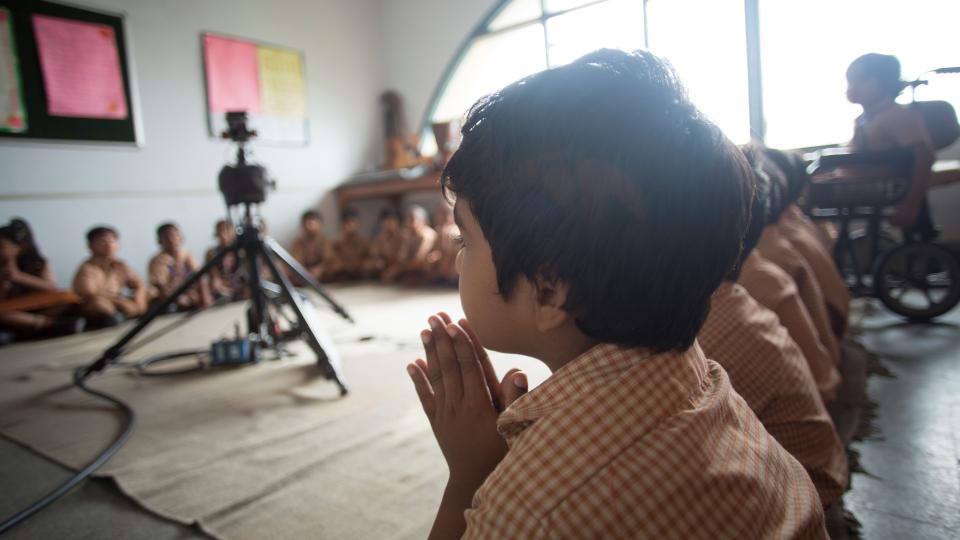
At the 2016 World Polio Day celebration, Rotary debuted 2 films that harness the power of virtual reality (VR) technology in an effort to build empathy and inspire action in the global fight to eradicate polio. The films use technology developed by the United Nations Children's Fund (UNICEF), explained briefly in the video above and available at the UNICEF 360 website. UNICEF has worked with VR since 2015, recognising that immersive experience can be a powerful advocacy tool. UNICEF uses a specialised, custom camera rig to create a 360° experience in an effort to bring the viewer close to the field. A person downloads the free UNICEF 360° App and then secures his or her iPhone or Android smartphone in the cardboard viewer, putting in headphones and then starts watching. "Turn your head in all directions and you'll feel like you're actually there," according to UNICEF.
In one film, actress and polio ambassador Archie Panjabi introduces the viewer to Alokita, who is affected by polio, and the doctors working to provide corrective surgery to children like her. "Viewers are transported to India as soon as they put on the virtual reality headset, which transmits the 360-degree mix of sights and sounds. In this interactive environment, viewers roam the streets of Delhi and the halls of St. Stephen's Hospital, home to India's only polio ward, where Alokita takes her first steps in 11 years." Narrated by actor and goodwill ambassador Ewan McGregor, another film, the 5-minute-long "You are there: On the road to making polio history", takes the viewer to a Kenyan village to meet a 9-year-old boy infected with polio and a vaccinator working to spare other children his fate.
After their October 24 2016 debut at the Atlanta, Georgia, United States (US) headquarters of the US Centers for Disease Control and Prevention (CDC), where facilitators will walk newcomers through the individual viewing process, the 2 films will travel to San Diego, California, US for an audience with Rotary leaders at the International Assembly in early 2017 and will be available to the public later in the year.
Experiences with other VR films produced with UNICEF involvement demonstrate how the UN is strategically rolling out these films with impact in mind, bringing them to high-level meetings where policymakers, for example, are present. "Clouds Over Sidra" follows a 12-year-old girl named Sidra in the Za'atari camp in Jordan - currently home to 84,000 refugees. Instead of having audiences passively watch Sidra in school or at the market, "Clouds Over Sidra" enables them to actually walk alongside her through the camp, an immersive experience designed to foster compassion for someone perhaps very different from the viewer. Created by UN adviser Gabo Arora and filmmaker Chris Milk using VRSE.tools, the film was produced by Samantha Storr and is a collaboration between the UN Millennium Campaign (UNMC) and UNICEF Jordan in an effort to support the United Nations Secretary-General's MDG [Millennium Development Goals] Advocacy Group's call for partnerships to build resilience in vulnerable communities. The UNMC rolled out a strategy to ensure that the films were well placed in forums so as to influence both decision makers and the general public. For example, it was screened at the World Economic Forum in Davos, Sundance, SXSW, TED, the Third International Humanitarian Appeal for Syria in Kuwait, the World Education Forum, and the World Education Summit. At the UN's summit on global sustainable development in New York City at the end of September 2015, the film served as the centrepiece for an interactive hub (organised by Arora), open to delegates, foreign ministers, and heads of state.
To get "Clouds Over Sidra" from decision makers to the people, Milk and Arora translated their films into several different languages and then partnered with UNICEF. Through the Translating Empathy to Action programme, UNICEF fundraisers in 40 countries hit the streets with a combination of Google Cardboard and Samsung Gear headsets cued up to play the documentary. "A lot of people have a very emotional reaction to it,” says Christopher Fabian, the co-lead of UNICEF's Innovation Unit. "I can't even count the number of times someone has taken off the headset and the goggles are filled with tears."
Milk sums up the strategy behind these VR films by saying that this is, fundamentally, "a technology that removes borders....Anything can be local to you."
"Virtual Reality Films Bring New Dimension to Polio Fight", by Sallyann Price, Rotary News, October 21 2016; UNICEF 360 website; Sustainable Development Goals Action Campaign website; "How the United Nations is Using Virtual Reality to Tackle Real-World Problems", by Blake J. Harris, October 12 2015; "UN Launches Powerful, First Ever, VR Film following Syrian Refugee Girl", by Mike Butcher, January 23 2015 - all accessed on October 24 2016. Image credit: Rotary
- Log in to post comments