











































Stories of Land, Rights, and Culture: Indigenous Community Leaders Document Their Efforts to Protect Human Rights and Preserve Traditions
"Dominant narratives about the 'development agenda' often fail to consider the needs and desires of indigenous communities, who face disproportionate threats to their rights and cultural traditions as a result of land grabs, climate change, and pressures to adopt 'modern' farming practices and ways of life."
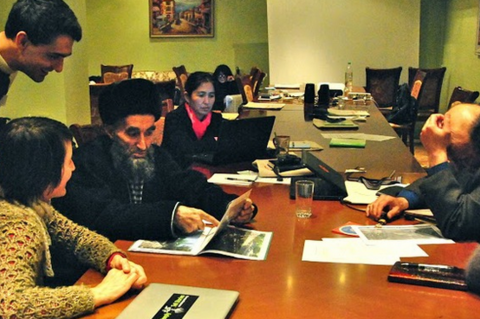
From 2013-2015, StoryCenter's Silence Speaks initiative collaborated with the Christensen Fund and its regional partners in the Rift Valley region of Africa, Northwestern Mexico, and Central Asia, on a series of storytelling and participatory media workshops (in Ethiopia, Kenya, Mexico, and Tajikistan) with local indigenous leaders. The goal of the project was two-fold: to build the capacity of participants for sharing their own stories and to garner increased coverage by local media of the challenges faced by indigenous communities.
The indigenous leaders were selected from among Christensen grantee groups in each country, working at local levels on issues of indigenous rights and biodiversity. The approach varied from country to country, taking into consideration the specific political, cultural, and linguistic contexts as well as the desires expressed by participants for technical skill-building. In each workshop, organisers led storytellers through the process of sharing and recording their own narratives, taking and selecting photos and video clips, and assisting with the editing of these materials into short digital videos. In some workshops, participants were provided with training on photography, audio recording, and photo ethics so they could continue documenting stories within their communities.
Following the workshops, organisers polished the stories, provided language-appropriate versions to participants from each workshop, and made the collections available online (watch videos from Ethiopia, Mexico, Tajikistan, and Kenya).
They also developed a set of story distribution recommendations, to support impactful approaches for the storytellers and members of their local communities to use in publicly screening the videos. For example, regional partners and storytellers are encouraged to:
- build relationships with local schools and explore ways to integrate stories into classroom curricula on environmental protection, sustainability, traditional culture, and indigenous rights;
- coordinate community screening events to bring members of local communities together to view stories and discuss ways they can mobilise around the issues portrayed - involving storytellers where possible;
- incorporate stories into training activities to raise awareness and skills for addressing the range of issues touched on in the narratives;
- reach out to local and national news media to explore opportunities for airing stories on regional television and on community radio;
- contact the media to ask them to write news pieces about the workshops, stories, and screenings to bring visibility to the narratives and the issues they raise;
- publish stories on organisation websites, together with supplemental contextual / background information and suggestions for how viewers can get involved in supporting the protection of indigenous rights and biodiversity; and
- share stories in meetings with key leaders, government officials, and policymakers to highlight the need for enforcement of existing laws related to indigenous rights and advocate for needed new policies and legislation. Develop "take away" sheets that summarise the stories and identify appropriate policy / enforcement remedies.
Indigenous Rights, Biodiversity
The United States (US)-based StoryCenter has worked with nearly 1,000 organisations around the world and trained more than 15,000 people in hundreds of workshops to share stories from their lives. Since 1999, StoryCenter's Silence Speaks initiative has worked to foster healing for individuals, to build solidarity within communities, and to provide training and advocacy for health and human rights promotion. Through intensive, hands-on participatory media workshops, they support people in sharing first-person narratives in the form of videos, radio pieces, and photo essays.
A nonprofit, non-governmental organisation funded in 1957, the Christensen Fund takes a holistic approach to supporting indigenous communities in regions around the world in their efforts to maintain a connection to their lands, preserve their languages and cultural practices, and pursue legal and political channels to protect their human rights. "We focus on backing the efforts of locally-recognized community custodians of this heritage, and their alliances with scholars, artists, advocates and others....Christensen works primarily through grant making, as well as through capacity and network building, knowledge generation, collaboration and mission-related investments."
StoryCenter, Christensen Fund
Emails from Amy Hill to The Communication Initiative and Soul Beat Africa on April 11 2017; and Storycenter website and Christensen Fund website, both accessed on April 18 2017.
- Log in to post comments