










































Keynote Address - Senator Ayesha Raza Farooq - 2018 International Social and Behavior Change Communication (SBCC) Summit featuring Entertainment Education
Prime Minister's Focal Person for Polio Eradication, Government of Pakistan
Ayesha Raza Farooq is a member of Pakistan's Senate and has been the prime minister's point person on the nation's polio eradication programmes since November 2013. At the time, Pakistan - one of three nations where polio remained endemic - was seen as a threat to global eradication efforts. Working closely with polio spearheading partners and the prime minister, Senator Farooq helped lead the country's polio programme out of a crisis situation. In this keynote address, she shares "Pakistan's story of resilience, courage and resolve" in achieving a 97% reduction in polio cases, from 306 cases in 2014 to a low of just 8 cases in 2017.
To understand how Pakistan got to the present point, Senator Farooq looks at the history of the effort, starting from the launch of the Polio Eradication Programme in 1994 by the Government of Pakistan, in collaboration with Global Polio Eradication Initiative (GPEI) partners. The challenges were numerous and varied. There were prevailing religious and socio-economic barriers to vaccination, as well as inconsistent campaign performance under the backdrop of low routine immunisation coverage. Notably, security challenges constrained the work environment for frontline workers, with a number of them being killed in attacks fuelled by unfounded anti-polio vaccination rumours. (On the latter, Senator Farooq points to the support of Pakistan's law enforcement agencies to frontline workers in the backdrop of threats and attacks in 2013-4, which has enabled a safe working environment today.)
Three interlinked approaches were developed to tackle these challenges:
- Large-scale commitment and coordination by the Government of Pakistan and local and GPEI partners - The prime minister declared polio eradication as one of the top three priorities of the Government of Pakistan. Chief ministers, the health minister, chief secretaries, commissioners, and deputy commissioners are all fully involved and committed to the cause. Polio eradication also enjoys broad-based support across Pakistan.
- Operational changes - Emergency Operation Centres (EOCs) led by the Government and with support of the partners were created as nerve centres across the country that, among other things, facilitate implementation of the National Emergency Action Plan, which brings all provinces and partners together in articulating clear common goals. Operational changes have also helped foster progress from operating with decentralised and unconsolidated data towards a data-driven programme, with information reaching decision makers and frontline staff in a timely manner and in a format that helps drive programme priorities, performance, and accountability. Furthermore, "Pakistan has the largest polio Surveillance network in the world - helping us track the virus and detect where it is. This has played a critical role in providing insight into the transmission dynamics of the poliovirus in Pakistan."
- Innovative communication strategies to encourage positive behavioural change towards polio vaccination amongst parents, caregivers, and communities nationwide. Examples:
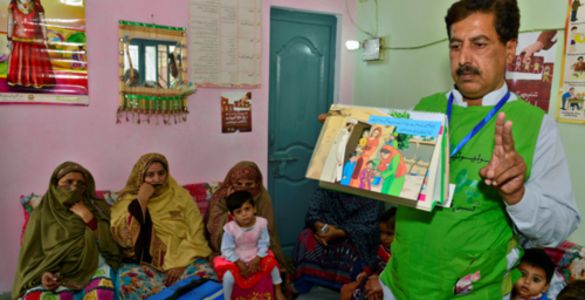
- After social data indicated that frontline vaccinators were key to reaching caregivers and parents in households, Pakistan made a paradigm shift and put vaccinators at the centre of programme communications as Sehat Muhafiz – Guardians of Health. This was followed by investments in their recruitment, training, and supportive supervision. Sehat Muhafiz comprise 260,000 frontline workers, and more than two-thirds are empowered female vaccinators who help drive vaccination efforts on the ground. Beginning in 2015, three communication campaigns were developed to promote Sehat Muhafiz and to foster greater acceptance for them and their work: (i) 'We Are All Intertwined', which was designed to present vaccination as a social norm amid the interconnectedness of family, children, and the traditions that define a place and culture. (ii) 'Strangers No More', which sought to build trust for the Sehat Muhafiz by presenting them as not just vaccinators but mothers, fathers, and members of the community with full lives, talents, and skills not limited to their role in the polio programme. (iii) a 2017-18 campaign to illicit community ownership and peer pressure while maintaining the Sehat Muhafiz as the key driving force. The reinforced approach of "I too am a Guardian of Health" offers every individual of the community the ownership of the programme and supports frontline health workers.
- To enhance engagement with communities, the programme introduced the community-based vaccinator (CBV) initiative, which was key to reaching every single child, even those who are very young, on the move, or visiting or sleeping in the house. (More broadly, the programme has dedicated much energy to registering, mapping, and vaccinating families on the move.) Most of the CBVs are female, and they are a critical asset in communicating effectively with parents and caregivers.
- To create an enabling environment for the programme, mass media campaigns remain tightly aligned to the operational coverage areas of the initiative, with a primary focus on core reservoirs, high-risk areas, and outbreak zones. Key mass media outlets include TV, radio, print, web, and social media, which consistently promote localised content in national and provincial languages on key messages pertaining to repeated vaccinations, vaccine efficacy and safety, and disease awareness. All mass media materials also bear the Sehat Muhafiz brand.
- To get communities themselves to proactively inform parents and guardians about the safety of vaccines, work was conducted hand in hand with community influencers, such as doctors, tribal elders, media groups, and religious scholars nationwide. Over 2,100 social mobilisers and 1,000 religious support persons assist the network of key influencers in "advancing targeted, localised communications approaches, especially amongst caregivers and parents that repeatedly refuse vaccines. This emphasis on local ownership of the programme has helped to ally misconceptions and in turn allowed for community ownership. Such community engagement has also been instrumental in helping parents and caregivers appreciate that vaccines can help overcome inequalities in access to healthcare, and give their children a better chance at a healthy future."
Senator Farooq says, "I hope that we continue to sustain the gains we have made from this polio eradication programme. This programme epitomizes Pakistan's capacity for collective action, hard work, commitment and resolve to reach the final goal of zero polio. There are so many things we can all learn from this initiative and use to advance large-scale sustainable development the world over."
Editor's note: The above is a summary of a keynote address delivered by the Honorable Senator Ayesha Raza Farooq, Focal Person on Polio Eradication, Pakistan, at Shifting Norms, Changing Behaviour, Amplifying Voice: What Works? The 2018 International Social and Behavior Change Communication (SBCC) Summit featuring Entertainment Education, held April 16-20 2018 in Nusa Dua, Indonesia.
Emails from Payam Akram to The Communication Initiative on April 17 2018 and April 20 2018. Image credit: Ayesha Raza Farooq
- Log in to post comments