











































mMom Thai Nguyen
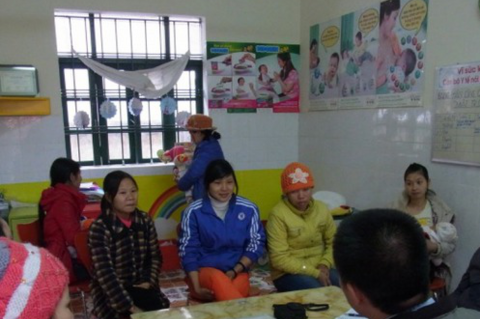
mMom is an integrated mHealth (mobile health) system designed to improve maternal and infant health knowledge and behaviour among ethnic minority women in northern Vietnam. In the remote and mountainous Thai Nguyen province, where ethnic minorities make up 27% of the 1.3 million people in the region, ethnic minority women are isolated from mainstream maternal, newborn, and child health (MNCH) services. Geography, language, education, and poverty are linked to the disproportionately higher mortality rates among the ethnic minority women living here as compared to the majority Kinh population of the region and the general Vietnamese population. The purpose of the mHealth intervention is to deliver timely and necessary MNCH information directly to ethnic minority women via mobile phone.
In the mMom project, expectant and new mothers receive short message service (SMS, or text) messages with health information and reminders. The priority is providing accurate, useful, and simple information in a timely manner, which involves adapting messages to the mother's situation (period of pregnancy and post-birth, specific risk factors, etc.).
The mMom software and its operation were developed and managed by Vietnam electronic health Medical Investment and Communication. The project built a new mHealth component as part of the existing health management information system for maternal and child health. The mMom database was created as an integrated component of the system by using each patient's unique identity code. The platform aimed to:
- coordinate and support health workers' existing efforts to monitor women in the community during and following pregnancy; and
- strengthen data collection and monitoring to support future MNCH programming.
This 3-year pilot study began with ethnographic fieldwork conducted by researchers from Vietnam's Institute of Population, Health and Development. The research identified gaps in current MNCH approaches and informed the intervention in the Dinh Hoa district of Thai Nguyen, Vietnam. Focus group discussions and in-depth interviews revealed that distance and lack of time prevented pregnant women in Thai Nguyen from accessing health centres (in some cases, women indicated that the prospect of visiting a health centre was intimidating). Surveys also showed that health providers did not have the time to thoroughly explain pre- and post-natal care to patients, and when they were able to provide information, it rarely corresponded with the woman's stage of pregnancy.
The research team established a Maternal and Child Health Information Centre to address these problems. It provides women with crucial information about pregnancy, prenatal care, birth, and infant care. During the implementation phase, some 820 pregnant women and new mothers in eight communes (each with a health centre serving 7-12 remote villages), participated in the project. Prior to the project's implementation, women in these communes had received minimal pre- and post-natal care.
Each woman who participated in mMom received 75 text messages during her pregnancy (2-3 times per week) and in the year following birth (1-2 times per week). One-way messages provided prompts for vital health information, including reminders to take iron supplements and about free immunisations for babies at local health centres. The text-messaging system is also designed to enhance communication between the women and their health centre caregivers by facilitating questions about health and well-being, the side effects of pregnancy, and the health of their infants. Not a single woman dropped out of the programme because the commune health centres conducted personal follow-ups with women who failed to respond to messages.
The mMom pilot project was completed in late 2016, but it is continuing with the financial and technical support of the Thai Nguyen provincial health department, which co-managed the intervention. Lessons from mMom will inform efforts to scale up maternal eHealth efforts across Vietnam. Vietnam's Institute of Population, Health and Development also plans to involve future fathers by sending them information via text message. The Ministry of Health has shown strong interest and commitment in introducing the model to other provincial health departments. One young mother from Thai Nguyen said, "I still want to participate next time [next pregnancy], because I may forget the information after raising my child for a while." Most are even willing to pay for the service, despite their economic constraints.
Maternal, Newborn, and Child Health (MNCH)
Although categorised as a low-income country, the proportion of Vietnam's population with mobile phones is higher than that of many developed countries. At the beginning of 2016, an estimated 93% of Vietnamese owned a mobile phone. The country's high level of mobile phone ownership contributed to the pilot's success, and only 80 mobile phones needed to be distributed during the 3-year project. However, despite ready access to mobile phones, mHealth applications tend to be underused in contrast to other regions in Asia.
mMom researchers chose to work in Thai Nguyen because a health management information system had recently been implemented that integrates all hospitals and 181 communes into an electronic record management system. In addition, all commune health centres were connected to district and provincial health centres by high-speed cable and health officials, and staff at the province, district, commune, and village levels were reportedly on board with the project.
Limited access to quality health care and education, lower income levels, and living in sparsely populated remote areas have negatively affected prenatal and antenatal care among Thai Nguyen's significant ethnic minority population, especially when compared to the ethnic majority (Kinh). Determinants influencing higher infant mortality rates and substantially poorer MNCH among ethnic minority women and their newborns are:
- limited access to information;
- low reproductive health knowledge;
- poor MNCH behaviours;
- poor access to and uptake of perinatal and postnatal care services;
- language barriers; and
- uneven distribution of health facilities throughout Vietnam, with fewer and lower-capacity facilities and staff in remote regions.
Specific contributing factors include the relatively low rate of tetanus vaccinations among ethnic minority women during pregnancy and the low uptake of modern contraceptives.
Participants across the 8 communes said the text messages delivered valuable information during critical periods of pregnancy and early infanthood. The most valued information was about vaccinations, nutrition, ultrasounds, breastfeeding, and when to start feeding babies solid foods. Women said that receiving information via mobile phones was convenient and often eliminated the need for a trip to the health centre. When a trip was made, women's increased confidence in their knowledge of pregnancy and new motherhood improved their interactions with health workers. Many health workers reported that women phoned more frequently about their own health and that of other children or family members. mMom also played a role in changing family dynamics: Many women shared and discussed the messages with their husbands, which is uncommon in a society where maternal and infant health have traditionally been considered women's domain.
Community health workers stated that mMom had improved their ability to monitor pregnancies and infant health, and had enhanced their technical and health knowledge.
Editor's note: Read an evaluation of mMom called "Improving Health Equity for Ethnic Minority Women in Thai Nguyen, Vietnam: Qualitative Results from an mHealth Intervention Targeting Maternal and Infant Health Service Access", by B. McBride, J.D. O'Neil, Trinh T. Hue, R. Eni, C. Vu Nguyen, and L.T. Nguyen. Journal of Public Health, Volume 40, Issue suppl_2, 1 December 2018, Pages ii32-ii41.
Institute of Population Health and Development (PHAD), Thai Nguyen Provincial Health Department (TNHD), Simon Fraser University, International Development and Research Centre (IDRC).
Emails from Liane Cerminara to The Communication Initiative on January 18 2019 and February 11 2019; and IDRC website, January 29 2018, PHAD website, "Using Technology to Improve Health-Care Access in Vietnam", by Tiffany Hoang, Dartmouth Geisel School of Medicine, July 22 2014, Global South eHealth Observatory, Simon Fraser University website, February 26 2015, and "Development of a Maternal, Newborn and Child mHealth Intervention in Thai Nguyen Province, Vietnam: Protocol for the mMom Project", by Bronwyn McBride, Liem Thanh Nguyen, David Wiljer, Nguyen C Vu, Cuong K Nguyen, and John O'Neil, JMIR Research Protocols 2018 Jan; 7(1): e6 - all accessed on January 22 2019. Image credit: Observatoire de la e-santé
- Log in to post comments