










































Empowering Women and Building Community Ownership: Community Mobilisation Coordinators
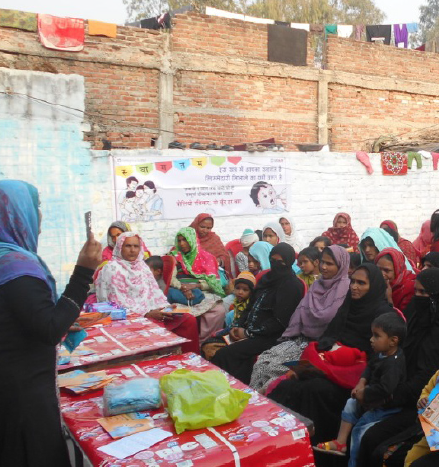
This chapter from the document Influencing Change (see Related Summaries, below) describes the role of Community Mobilisation Coordinators (CMCs) within the CORE Group Polio Project (CGPP)'s social mobilisation activities and the polio campaign as a whole. It looks at how these personnel, many of whom were women, used communication strategically to overcome the challenges of resistance and lack of immunisation coverage. Using one-to-one and group meetings as the main tools for behaviour change, the CMCs addressed parental concerns, built faith in the polio programme, created trust between polio eradication personnel and local residents, and helped identify and track missed children.
Over the years, the CMCs' role underwent many modifications owing to the changing epidemiological situation, the evolving polio eradication programme, and lessons learned along the way. This evolution is the focus on the chapter.
At the start of the initiative, male CMCs' were recruited; however, it was hard for male mobilisers to engage or communicate with women for cultural or religious reasons. Thus, non-governmental organisation (NGO) partners and CGPP workers approached the homes of potential CMCs to convince the household heads to allow their daughters/sisters/wives to work with the programme. CGPP explains that ensuring the support of local influencers, such as religious leaders, was important for CMCs to make inroads into the community and households. Once recruited, there were additional challenges related to CMCs that had to be overcome; they are outlined in the chapter.
As the polio programme relied on CMCs for social mobilisation, they were required to be effective communicators with sound knowledge of polio eradication and the social and cultural norms that existed in the community. A cascade model of training was developed wherein the CMCs received training, coaching, and supportive supervision from Block Level Mobilisation Coordinators (BMCs), who in turn were guided and supervised by District Level Mobilisation Coordinators (DMCs). The training of CMCs was based on adult learning principles, where trainers adopted a participatory approach to a mix of lectures, games, role plays, and field visits. Periodic training needs assessments and refresher training helped address gaps and reinforce interpersonal communication (IPC) skills. (In addition, special events such as day-long jamborees were introduced to boost CMCs' morale, and they were awarded certificates and trophies to honour their hard work and contributions to polio eradication in their communities.)
Each CMC was provided with a monthly stipend and was responsible for the immunisation status of all children below 5 years of age in about 300 to 500 households in her assigned community/area. When no immediate polio campaign activities were taking place, CMCs:
- prepared detailed maps of their communities and visited their assigned households once a month or more, providing information about vaccination, addressing myths and misconceptions about oral polio vaccine (OPV), and collecting detailed information in a field book;
- prepared "child maps" to identify all eligible and missed children and collected additional data for microplans;
- held regular meetings with mothers' groups to advocate for repeated polio immunisation;
- identified and organised meetings with local leaders and influencers to seek their support in allaying the fears of families who were reluctant to immunise their child/ren;
- prepared a mobilisation plan, which would, for example, identify areas for placing posters;
- worked closely with schools and madrassa (schools attached to a mosque for the study of Islam) to engage children in polio eradication efforts (e.g., though children's brigades (Bulawwa Tolie), fun classes (Masti ki kaksha), and Rooster or cock-a-doodle-doo (Kukuru-ku) rallies);
- worked with key informants such as brick kiln owners and barbers to help locate and reach migrant workers; and
- counselled pregnant women on the importance of exclusive breastfeeding and colostrum feeding, and helped to integrate newborns into the routine immunisation (RI) system.
During the polio campaigns/booth days, CMCs helped vaccinators set up and decorate the vaccination booths to attract families and children. They organised mosque/temple announcements by the local priests and rallies with children to encourage families to bring or send their children for vaccination. CMCs also went from house to house with the government vaccination team, using their field book to ensure that no child was missed. CMCs involved their network of influential local people to accompany them to the 'X' houses with the vaccination teams to help persuade those refusing to vaccinate.
The chapter goes on to look at the achievements of CMCs in terms of creating trust and improving outcomes. As reported here, acting as a single point of contact for the community on all issues related to polio, combined with house-to-house counselling and regular monthly meetings, helped the CMC build trust and faith amongst the people. They built relationships with their community that earned them respect as dedicated health workers. The acceptability of the CMC, which was aided by the fact that she was part of the community in which she sought to create positive change, was key to the success of the SMNet. Many CMCs described their involvement in the programme as life changing, as it gave them access to a platform for growth and learning. They expressed pride in contributing to improving the health of the children in their communities and the country. They also reported gaining valuable life skills and self-confidence. As a secondary result of the intervention, women were empowered and became active decision makers in their households. Some community mobilisers discussed how the polio programme helped spark broader social changes, such as bringing religious communities together.
The effectiveness of the awareness raising and mobilisation efforts of the CMCs was linked to the increase in the number of children immunised at booths in Uttar Pradesh (UP). Research showed that booth coverage in CMC areas was clearly higher than in non-CMC areas (see Figure 7). Furthermore, an assessment of reasons for missed vaccination during SIA campaigns in CMC areas in 2012 showed that only 0.5% of households resisted vaccination (see Figure 8).
CGPP observes that working with such a large workforce at the community level is a resource-intensive effort. If programmes have limited resources, careful thought and planning is needed to adapt/replicate this effort.
Editor's note: This is Chapter 4 in the document Influencing Change: Documentation of CORE Group's Engagement in India's Polio Eradication Programme, which is a collaborative effort of the CGPP and The Communication Initiative. Please see Related Summaries, below, to access it in its entirety.
Image credit: CGPP
- Log in to post comments