










































Between Individualism and Social Solidarity in Vaccination Policy: The Case of the 2013 OPV Campaign in Israel
Tel Aviv University (Boas); Ben-Gurion University of the Negev (Rosenthal, Davidovitch)
"In the various public health ethical codes, solidarity is one of the foundations of public health practice, in the context of understanding humans as interdependent within communities - both at the national and global levels..."
This article examines the communication elements of Israel's intensive national oral polio vaccine (OPV) campaign of summer 2013 as a case study of the tension between individualism and social solidarity in seeking the cooperation of the public. The researchers conducted a qualitative study in order to unravel the ways in which self-interest, community, and solidarity were conceived by different agents during the vaccination campaign.
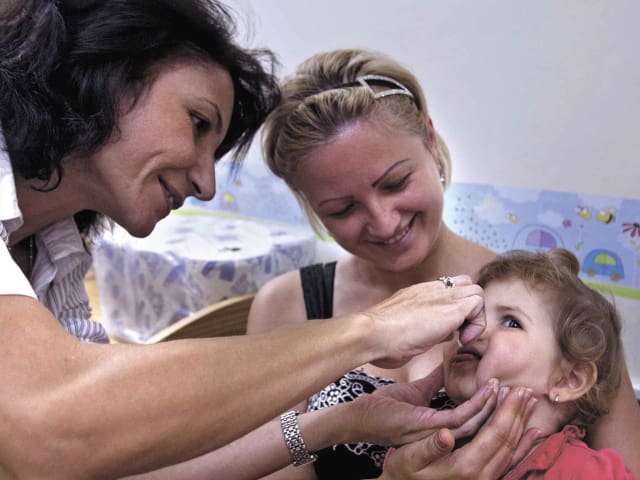
In response to the wild polio virus (WPV) importation to Israel in 2013, the Ministry of Health decided to take preventive action by giving the OPV to all children born after January 1 2004 who had received at least one dose of inactivated polio vaccine (IPV) in the past. With not a single case of infantile paralysis and with a population already highly protected with IPV, the goal was to foster collective immunity so that at-risk populations could also be protected. This, however, entailed a challenge: persuading parents whose children already received an IPV to re-vaccinate their children, now with a live yet attenuated version of the virus. The challenge therefore was a call for social solidarity - asking parents to vaccinate their children mainly for the sake of protecting unknown at-risk populations and to take part in the larger goals of the Global Polio Eradication Initiative (GPEI). From that perspective, solidarity had a much more global meaning.
As part of the campaign, the intended population for vaccination was children up to 9 years old. For reasons unearthed by the qualitative study, described below, public health policymakers introduced the family as a reference unit for health concerns - the "circle of solidarity" - rather than conveying a broader environmental message, or an altruistic message based on the welfare of a broad group of others. This was bolstered by the fact that scholars have long indicated the central role of family in the sociological and political landscape of Israeli society. "Two drops and the family is protected" became the campaign slogan used on television, ads, and social media. Also, the Ministry of Health sought to gain the trust of the professions so that all health professionals would convey the same message to the public. Gaining the trust of the health professions first was one of the lessons learnt from a previous pandemic influenza campaign.
Data collection was conducted during the summer and fall of 2013, while campaign activities were ongoing, and the winter of 2014, after the campaign's conclusion. It involved participant observation, document reviews, and 16 interviews with policymakers, parents, journalists, public health experts, and community leaders. Results are shared in narrative form, featuring quotations from interviewees. Some of the salient findings:
- The individual, the community, and the Israeli state: The researchers explain that the particularities of Israeli society shaped the local patterns of acceptance and refusal on the one hand, and of the campaign methods, on the other. For instance:
- Through processes they describe, social forces emphasising individualism as well as a push toward the privatisation of health services led to an erosion of trust between the state and its citizens. In such a context, personal survival becomes paramount, and self-interest - not social solidarity - becomes the main orientation of practice.
- The initial outbreak was reported within Bedouin communities. As a result, polio control efforts were first rolled out within these communities, and only later extended to the rest of the country. Bedouin communities' limited access to health services, especially in unrecognised Bedouin villages, and their tense relationship with the Israeli state, made trust an even more important issue. A nurse who was interviewed for the study recounted that "Parents came to ask me if this is the disease they are talking about on TV. They asked if the Jews are also being vaccinated, or just the Bedouins...because some people were spreading rumors that they (the government) want to kill Bedouins." The researchers suggest that the campaign showed that even trust was individualised and in some cases no longer resided in the state, but in specific trustworthy individuals working for it (like the nurse).
- Balancing individual risks and collective benefits:
- The researchers discuss the "paradox of success, namely that successful eradication campaigns change the profile of diseases, and thus make them less threatening to the population, and the campaigns to combat them less crucial."
- Public cooperation was also phrased in terms of the risks of an outbreak versus the risk associated with the vaccine.
- While varying perceptions of risk were an issue, interviewees addressed the sense of urgency that accompanied the vaccination campaign. A mayor of a southern Israeli town said, "I used everything [to get the word out about the campaign], media, text messages, mosques, local media and journalists. The ministry of health published ads and distributed flyers to people....we met with physicians in town and we had like a war, like the military sets up for a new war, a war room and all those things. We had one enemy called polio, so we have to overcome it."
- Reflecting on this, the researchers suggest that, "Metaphors of military operations, state mechanisms, and duties not only evoke the familiar toolkit of Israeli citizenship as shaped by militarism, but also the rigid dichotomy between the state's apparatus of coercions, and the citizens who feels threaten by uncertainty and thus foster practices of individual self-interest."
- This is why the decision was made to make the family the centre of the campaign. A public health physician who was interviewed said, "Maybe 20-30 years ago when social solidarity in the cultural context was greater, this would have been the right thing to say - come get vaccinated like you join the Army. Get vaccinated and protect the homeland. But somehow we didn't think such a message would work." According to this physician, the decision to feature paediatricians in the campaign instead of public health physicians was intentional, due to their relationship with families.
Looking at the meaning of family in the Israeli context, the researchers suggest that "the family" stands for community. In other words, "the family" remains a reference unit for society in an era of individualism. "Bonds of solidarity within Israeli society could only be tied by presenting it through the prism of the family in contemporary Israeli society. By doing so, the ministry of health sought public compliance, which cannot be reduced to the level of individualistic utilitarian motives."
Discussing the applicability of their research to contexts beyond this particular campaign in this particular country, the researchers assert that "the understanding of the ethical consideration embedded in the polio campaign must take into account not just individuals facing the state, or even individual families - it should also be considered within the broader social and political context, and mostly...the social standing of the family i.e. as a metaphor bridging individualism and society....Polio campaigns worldwide, as well as other vaccination efforts, are facing opposition that is far more complex than the mere individual decision to refuse vaccinations. These oppositions are tightly linked to both local historical contexts and global policy making processes and their implementation."
In conclusion, "Identifying intermediate agencies, such as the family in our case, that bridge individual and collective identities, can help encourage the public to move beyond self-interest and advance public health objectives. Such agencies vary between different cultural contexts and can be the research objective of further investigation..."
Editor's note: You may also be interested in a commentary on the above-summarised article, "Individualism and social solidarity in vaccination policy: some further considerations", by Fiona M. Sim, also published in the Israel Journal of Health Policy Research, on April 6 2017.
Israel Journal of Health Policy Research2016 5:64. https://doi.org/10.1186/s13584-016-0119-y. Image credit: Moti Milrod
- Log in to post comments