










































Not Up for Debate: US News Coverage of Hunger in Africa
Temple University
"What does the interplay of emphasis and information with regard to causal interpretation or treatment recommendation communicate to U.S. audiences about how to engage politically with the issue, or how to understand their own position, or the position of the suffering other, in the social order of things?"
Coverage of human suffering is part of the news media's watchdog role. However, literature on the role of the media in the public sphere does not offer an accepted understanding of the role of media in covering foreign suffering (that does not directly impact United States (US) interests). Rather, foreign suffering is assumed by most scholars to be covered because of its deviance from the norm (and, thus, perhaps of interest to audiences) or the moral anguish it elicits. There is, according to author Lauren Kogen, a gap in the literature regarding whether foreign suffering merits a particular treatment in the news based on the role of the press in a democracy, rather than on purely moral grounds. The present study seeks to begin to fill this gap by examining how the US news media construct the topic of hunger in Africa for US audiences. Specifically, through a framing analysis and critical discourse analysis (CDA) of randomly sampled newspaper stories, the article addresses how news frames define and delimit: the relationship between US citizens and foreign sufferers, US public sphere discussion of foreign humanitarian crises, and citizens' political engagement with the issue.
Framing focuses on how political issues are presented in the news or by political figures, as well as how audiences interpret them and form opinions about them. Framing analysis is usually conducted quantitatively, based on more reliably identifiable items within a media piece, and followed by a statistical analysis of results. CDA, on the other hand, is more aligned with concepts of culture, class, and power, and is often conducted by letting themes emerge from the text as the investigator conducts the research. It is a particular form of discourse analysis that attempts to understand how everyday discourse constructs our social world and affects social and cultural practice. By using both here, Kogan can investigate not only whether the news media, in its coverage of hunger in Africa, include politically actionable information that would allow readers to engage with the issue, but also how such framing defines us in relationship to the rest of our global social world.
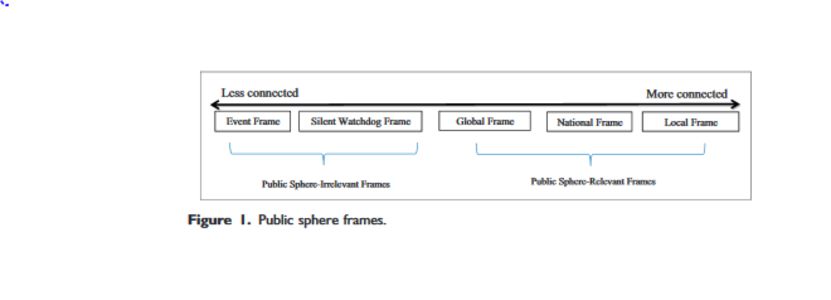
The first step in the framing analysis was to separate articles into "public-sphere-relevant", or PSR (those that explicated a politically actionable causal condition or treatment recommendation) and "public-sphere-irrelevant", or PSI (frames that did not). For PSR articles, whether the article placed the issues as having a local, national, or global solution (3 subframes) was relevant to how the piece constructed the reader's position. For PSI articles, an additional 2 subframes emerged: "event frames" excluded causal interpretations and treatment recommendations entirely, while "silent watchdog" frames included causal interpretation and/or treatment recommendations, but framed those causes and solutions as outside the scope of US politicians or individuals. These 5 subframes thus represent a continuum of weak to strong connection to the public sphere, as depicted above.
One hundred and sixty-eight articles were included in the analysis, randomly sampled from 43 newspapers (42 states plus Washington, DC) between January 2008 and May 2011. There were 163 unique pieces and 5 pieces that appeared more than once in the sample. Eighty-nine articles addressed domestic hunger, and 79 addressed hunger in Africa. Kogen more deeply interrogated the findings from the CDA by speaking with the journalists and editors responsible for the stories in the sample. In all, she conducted 42 interviews with 26 journalists from 19 papers, 8 foreign correspondents, and 15 editors. Nine additional interviews were conducted before the analysis began.
Kogan found that while news articles covering hunger in the US usually frame the problem as pertinent to the public sphere, the victim as worthy of political action, and the reader as political agent, articles covering hunger in Africa frame the issue as irrelevant to the public sphere, the victim as removed from political action, and the reader as politically impotent.
Put another way: While Africa stories were almost evenly split between stories that were relevant/irrelevant to the public sphere, no domestic stories were PSI. More specifically:
- Event frames [PSI], which focus on the description of a problem only, took one of two forms: (i) They did not address causes or solutions that could be used for US public sphere discussion or political engagement (suggesting, by exclusion, that there is no political debate to be had, and there are no political options to be discussed), or (ii) they did address such solutions, but indicated that the solutions were not actually feasible (not offering the reader much fuel for public sphere, or internal, debate).
- Silent watchdog frames [PSI] focus exclusively on foreign political actors.
- Global frames [PSR] appear in stories that cover the way the international community was involved or connected to the issue, such as those that discussed international bodies or organisations that were addressing hunger, including the United Nations, the World Bank, and non-governmental organisations (NGOs). These made up a small number of the articles on hunger in Africa (about an eighth) and were spread relatively evenly across the local papers, national papers, and newswires.
- National frames [PSR] appear in stories covering the role (potential or actual) of the US in the problem. These frames made up about a third of the articles on African hunger.
- Local frames [PSR] gave audiences information on how they could engage with the topic of hunger in Africa on a very local level, such as by taking part in a food drive or in a walk to raise money. These frames made up a large segment of both coverage of domestic and African hunger, but they were the chief frames used for domestic coverage.
Kogan's interviews with journalists help explain the differences between domestic and foreign coverage: (i) Journalists have different ideas about why it is important to cover domestic versus African hunger, such that information on addressing the issue is frequently considered an important element of the story for domestic stories, but not for foreign stories (a frequent lament was that getting readers to read about, and care about, what was going on in the rest of the world was enough of a challenge); (ii) coverage of issues is dictated by actions and discussions within Congress; and (iii) journalists do include such information, but it gets cut from the story by editors with limited newspaper space, and who therefore include a description of the problem only.
Kogan concludes: "What American citizens are left with, then, is a public sphere that not only does not nurture a productive discussion on solutions to extreme poverty and suffering in Africa, but makes the discussion itself seem outside the geographic scope of relevant public sphere-appropriate issues for American news audiences. This construction of the news lets the U.S. government off the hook when it comes to the role of U.S. foreign policy in alleviating suffering in Africa, and denies American citizens the ability to judge for themselves how they think U.S. policy ought to reflect, if at all, the existence of suffering elsewhere in the world." Her contention is that US citizens have the right to weigh in on their government's role when it comes to foreign affairs just as much as they do when it comes to domestic affairs.
International Communication Gazette 2015, Vol. 77(1) 3-23. DOI: 10.1177/1748048514556973gaz.sagepub.com.