










































How Unsponsored, Online User-Generated Content Impacts Consumer Attitudes and Intentions toward Vaccinations
California Polytechnic State University (Weber); Washington State University (Muehling); University at Albany, State University of New York (Kareklas)
"...unsponsored, often anonymous posts may have the ability to change public opinion on health behaviors like vaccinations."
Perhaps at least in part as a consequence of the spreading of misinformation online, vaccination rates have been dropping in many countries. Considering research indicating that 80% of adults with internet access report searching on the internet for health information, ensuring that online information leads consumers toward accurate conclusions is important to the efficacy of the healthcare system and related health outcomes. In light of research finding that using scientific sources to persuade those choosing not to vaccinate themselves and their family may be fruitless, it is possible that peer-to-peer electronic word of mouth (eWOM) might be a more persuasive path for persuading individuals hesitant towards vaccinating.
One route for consumers to communicate in this fashion is by posting user-generated content (UCG), such as memes, on social media sites, where they also have the ability to post comments expressing their feelings, thoughts, and opinions on a story, article, picture, or video posted by other users. In the context of the problem of vaccine hesitancy, the 3 empirical investigations in this paper ask: To what extent are consumer attitudes and intentions influenced by the interactive effect of exposure to unsponsored UGC and comments posted in response to that content, particularly when the consumer may lack the expertise to evaluate the content's credibility?
Having provided background on information-seeking online, vaccination hesitancy, eWOM in the twenty-first century, source credibility of online health communications, the persuasion knowledge model, and manipulative intent, the paper goes on to outline the 3 empirical studies. The researchers chose Facebook as the platform, and the context of the research was the United States (US).
- Study 1: Respondents (129) recruited from Amazon's Mechanical Turk (M-turk) viewed an anti-vaccination meme, ostensibly created and posted by a Facebook user, as well as comments posted in response to the announcement by fictional individuals with gender-neutral names either supporting or opposing the meme's stated position (i.e., anti-vaccination in this study). Participants were found to have perceived anti-vaccination comments to be much less credible than pro-vaccination comments. However, observed mean values indicated a greater intent to vaccinate among those who saw anti-vaccination comments (as opposed to pro-vaccination comments), implying a potential reactance effect. Participants who perceived the comments to be more credible were significantly more likely to hold more favourable attitudes toward vaccines and more likely to indicate they would vaccinate themselves and their family when exposed to pro-vaccine comments, as opposed to anti-vaccine comments. The findings of Study 1 indicated that when a meme has no identified sponsor, the position and perceived credibility of the comments posted in response to the meme interacted to predict viewers' attitudes and intentions toward the advocated position of the meme (i.e., anti-vaccination in Study 1).
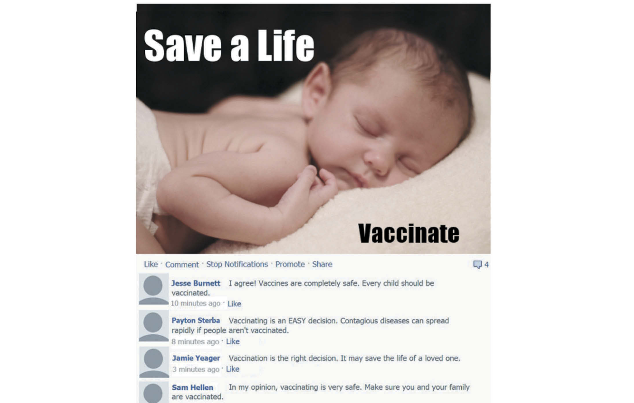
- Study 2 sought to determine whether the same pattern of effects would be observed for memes advocating a pro-vaccination position. Participants (125), again recruited through M-turk, were exposed to a pro-vaccination meme with corresponding comments either supporting or opposing the meme's advocated position. Similar to the results of Study 1, pro-vaccination comments were seen as more credible than anti-vaccination comments. However, in contrast with Study 1 findings, pro-vaccination comments resulted in greater vaccination intentions than did anti-vaccination comments. This signals that the persuasive effect of comments likely differs based on the valence of the meme with which they are associated. Results suggest that comments in support of the meme's advocated position (i.e., pro-vaccination in the present study), combined with higher levels of perceived credibility, led to greater attitudes toward and intentions to vaccinate oneself and one's family, whereas comments that were perceived to be less credible led to reactance against the position advocated in these comments.
- Study 3 examines the relative impact of pro- and anti-vaccination memes (directly comparing the persuasiveness of the 2 opposing memes), as well as the interactive effects of the perceived credibility of the corresponding comments. Participants (339) were recruited from a large US public university. Pro-vaccination comments were perceived as more credible and had a greater influence on consumers' attitudes and intentions to vaccinate, whereas anti-vaccination comments were viewed as less credible and had a lesser effect on consumers' vaccination attitudes and intentions. Finally, consistent with Study 2 results, when participants are exposed to a pro-vaccination meme, they are more likely to hold favourable attitudes and intentions toward vaccinations when they are also exposed to accompanying pro-vaccination (as opposed to anti-vaccination) comments.
Contributions of the investigation to theory and practice in marketing that may interest digital marketers and health practitioners, according to the researchers:
- Unsponsored memes appearing on social media sites and related comments posted in response to them may affect viewers' subsequent attitudes toward and intentions to engage in health-oriented behaviours - specifically, vaccination behaviours. These patterns of persuasion may help guide regulation of social media sites.
- The research highlights a significant role played by manipulative intent in explaining how consumers respond to online UGC: When consumers believe that persuasive attempts directed at them are affected by the communicator's ulterior motives, the result can be behaviour the opposite of that which was intended.
- Internet users' evaluation of comments posted in response to unsponsored USG (i.e., their perceptions of the credibility of these responses) is likely to have a significant moderating impact on their health-related attitudes and intentions. As such, to address the ongoing misinformation epidemic, regulators and media sites are advised to focus on devising means of enhancing the perceived credibility of commenters whose positions are in concert with scientifically endorsed consumer behaviours.
- Given the finding (Study 3) that participants exhibited the most favourable attitudes and highest intentions to vaccinate themselves and their family when they were exposed to an anti-vaccination meme accompanied by pro-vaccination comments, one could conclude that some level of reasonable open debate online might help consumers come to scientifically supported positions.
Journal of Marketing Communications, DOI: 10.1080/13527266.2019.1671479