










































Constrained Choices: Exploring the Complexities of Adolescent Girls' Voice and Agency in Child Marriage Decisions in Ethiopia
Gender and Adolescence: Global Evidence (GAGE)/Overseas Development Institute (Jones); independent researcher (Presler-Marshall); Addis Ababa University (Kassahun); GAGE Ethiopia (Kebedi)
"[P]otential change strategies must simultaneously invest in integrated intervention approaches at different levels, weaving together policies and programming that support girls, their families and their communities while also working to effect system-level change."
Ethiopia has made progress toward meeting the government's commitment to eradicate child marriage by 2025 and Sustainable Development Goal (SDG) 5.3 to end the practice by 2030. However, aggregate national figures mask a more complex reality, given Ethiopia's socio-cultural, religious, and economic diversity. Based on qualitative data from the Gender and Adolescence: Global Evidence (GAGE) longitudinal baseline study, this paper draws on the literature on social norms and on the capabilities approach to explore these questions: (i) How do the patterning and drivers of child marriage differ across regions in Ethiopia? (ii) How do adolescents' broader individual and collective capabilities impact their vulnerability in relation to child marriage? (iii) How does child marriage affect adolescents' broader individual and collective capabilities? and (iv) What entry points exist to tackle and mitigate individual adolescent girls' risks and to promote their agency and collective capabilities?
The article begins with an overview of the conceptual framing. Research suggests that social norms that situate marriage and motherhood as central to girls' "value" and that see their sexual purity as key to family honour are critical to understanding child marriage. As the authors explain, social norms are commonly understood to be perpetuated because people believe they will suffer sanctions, including social ostracisation, if they fail to conform. Compliance or noncompliance is seen as an active choice. However, sociological approaches to understanding and accelerating norm change observe that, because of the way gender socialisation begins at birth and permeates every aspect of our daily lives, gendered practices (e.g., child marriage) move into the realm of "doxa", or ideas and actions that are taken for granted and are beyond questioning. In this conceptualisation, compliance or noncompliance is not a true choice, so rendering doxa visible - so that people can imagine options - is seen as the first step in creating social change.
GAGE's broader conceptual framework focuses on six core adolescent capabilities. Because of the ways social norms can work to limit agency at the individual level, the authors recognise the need to consider adolescent girls' collective capabilities, which are forms of cognitive and practical agency that can ultimately challenge doxa and open space for people to imagine options, such as not marrying in childhood. Thus, the framework "envisions that collectively empowering girls means that adolescent girls - and the discriminatory gender norms that curtail their voice and agency - are made more visible on policy and programming agendas and that leaders (formal and informal) engage with girls and their families to address their age- and gender-specific needs in order that girls can develop their full capabilities and be entitled to do so."
Working in rural and urban sites in three regions (Afar, Amhara, and Oromia), GAGE undertook individual interviews with 240 young people aged 10-19 (140 girls and 100 boys) and their siblings, 200 caregivers, and 80 key informants, as well as group interviews with 160 adolescents and 248 adults. Because GAGE is longitudinal, the sample includes two age cohorts: a younger (aged 10-12 years) and an older (aged 15-17 years). All research instruments were interactive and allowed respondents to discuss themes in their own terms.
Selected findings:
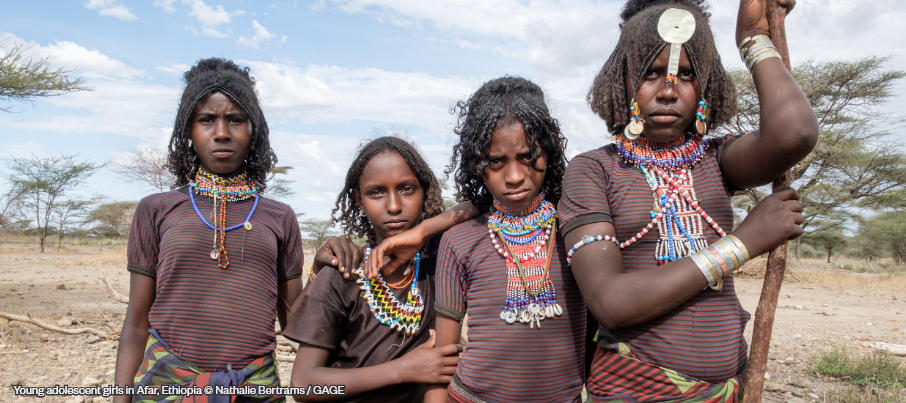
- Due to the ways in which gender norms shape not only the behaviours girls are expected to demonstrate daily but also the stability of the clan-based safety nets that have long protected families in times of need, opportunities for girls to make alternate choices that might broaden their capabilities are effectively non-existent in pastoralist Afar.
- A growing number of girls in Amhara are allowed at least some choice; however, girls' "choice" is often illusory, with many arranged marriages driven by parents' need to ensure that family honour is protected by controlling girls' sexuality.
- Not only is child marriage becoming more common in Oromia, but the age of marriage is dropping - with several complicated narratives surrounding the drivers of this putative change.
- Many of the impacts of child marriage on adolescent girls' broader capabilities reflect regional diversity. In Amhara, for example, where it is becoming more common for students to attend secondary school, married girls can sometimes negotiate with their parents to continue their schooling. In Oromia and Afar, where relatively few girls transition to even upper-primary school (e.g., Grade 5), negotiation at this critical life juncture is not possible.
Following the GAGE conceptual framework, the article next explores programmatic efforts at the individual, household, service, and systems strengthening levels and highlights specific openings by location. Some change strategies:
- Empowering girls: Starting in Grade 5 (approximately age 12), many girls, especially in Amhara, have access to school-based girls' clubs, which reinforce messaging about the multi-dimensional risks of child marriage for girls. Yet in Afar, not only does custom limit girls' voice and agency, but club leaders admitted they are afraid to contravene local norms because doing so might provoke conflict.
- Engaging with boys and young men, families and communities: Community-wide messaging was more common than efforts to engage boys and young men. In Amhara, messages are creating visible change; in Oromia and Afar, change is more nascent. In the latter, community key informants admitted that messaging is not resonating, as the community is unwilling to abandon traditional practices and allow girls input into their own lives.
- Delivering adolescent-friendly services: Teachers in Amhara, particularly those who lead girls' clubs, provide adolescents with a safe way to report planned marriages (their own and those of siblings and friends) in time to have them cancelled. Oromia and Afar are again quite different from Amhara. A constant across all locations was how rarely systems-level approaches are brought to bear.
Thus, while underscoring the need to recognise and tailor for diversity, the research also highlights that across contexts, Ethopian girls' life-course trajectories remain circumscribed by both socio-cultural norms and practices and economic realities. Thus, messaging around the risks of child marriage needs to be paired with policies "that support alternative pathways for girls and their families. Supporting girls to seek independence and adult status in ways other than marriage and parents to feel pride in and accrue social standing through the expansion of their daughters' broader capabilities rather than the control of their sexuality, requires...that secondary schools be both locally available and free, that parents are able to bear the opportunity costs of educating their daughters beyond primary school, that girls are supported to use contraception to prevent the pregnancies that would interfere with their future-seeking and that decent employment options are vastly expanded so that girls (and their parents) see that education is worthwhile and that girls can be economic assets rather than liabilities."
Progress in Development Studies, vol. 20 issue 4, page(s): 296-311. Image caption/credit: Young adolescent girls in Afar, Ethiopia © Nathalie Bertrams / GAGE
- Log in to post comments