










































FactShala India Media Literacy Network
"Online misinformation is hard to stop. It's easy to pass along a rumor, even easier to believe one. But understanding when an online piece of information is false, or meant to cause harm, requires critical thinking skills and awareness."
FactShala is a news and information literacy initiative that seeks to tackle the problem of misinformation by empowering communities in India with the skills required to critically analyse online content and navigate the information overload they are often subjected to online. In a context where millions of users from smaller cities and rural areas are coming online each year, the initiative involves training journalists, fact-checkers, media educators, non-profit workers, and community radio representatives to teach media and information literacy skills to communities living in remote villages and smaller cities. The initiative was launched in 2020 by Internews in collaboration with DataLEADS and with support from Google.org and the Google News Initiative.
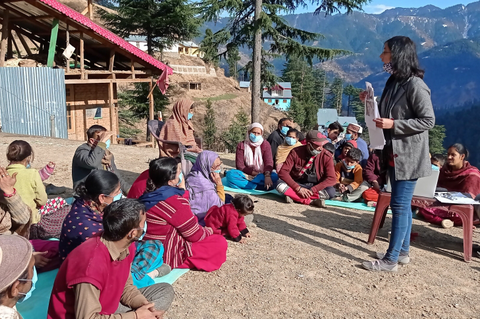
FactShala, envisioned as a classroom for facts, has its origins in the word pathshala, meaning "place of learning" in Hindi. The programme is driven by a network of community trainers using a train-the-trainer model. In 2020, FactShala trained a core team of 253 trainers: journalists, fact-checkers, academics, non-governmental organisation (NGO) workers, and local community body leaders. Each selected trainer is then required to reach at least 200 people in and around their city, focusing on marginalised and underserved communities and those that are most disadvantaged.
Trainers receive ongoing mentorship from experts and a stipend/honorarium for workshops they organise. The sessions are held in local languages or dialects and often in the comfort of the participants' homes, schools, offices, and shops. The training content covers: misinformation, understanding information neighbourhoods, verification through simple keyword searches and other techniques, and concepts such as gatekeeping, filter bubble, and echo chambers. The examples are contextualised as per local needs and sensibilities. By using local trainers, who adapt the training to local circumstances, the programme ensures that training is relevant and valid for its community.
The training is based on a curriculum that was developed in consultation with media literacy educators, academia, radio community professionals, news industry experts, and fact-checkers. The Factshala Resource Center has also designed Tip-Sheets to help trainers and participants with the key concepts of media literacy.
In 2020, in the midst of the COVID-19 pandemic, the trainers organised over 370 trainings and reached more than 18,000 people across rural India. Trainees included: women's self-help groups; aanganwadi (childcare) workers; community reporters; medical workers; farmers, refugees; lesbian, gay, bisexual, and transgender (LGBT) community members; pensioners; housewives; environmental activists; tea garden workers; religious leaders; rural school and college teachers; and college students. Training sessions were held both online and in person.
Experience showed that arranging the trainings was not always easy. It involves talking to local village headmen, convincing people about the need for misinformation training, and facilitating the trainings often in the absence of electricity and internet connectivity. Even when trainers are able to get an audience, people are not always immediately open to listening to strangers or accepting they may be duped by misinformation.
In addition to community groups, over 60 community radio stations (broadcasting in over 15 languages) teamed up with FactShala to create and broadcast a series of episodes on news and information literacy and to organise in-person group discussions in villages.
A series of five webinars in five Indian languages were also held to help people learn how to navigate the COVID-19 "infodemic" and find trustworthy news and facts in this critical time. Click here to access these webinars.
Media and Information Literacy
India has the second-largest internet population in the world, with over 687 million regular internet users, of which the majority are mobile-only, first-time internet users. The smartphone user base is projected to increase to 829 million by 2022. Over the last few years, the country has also become the largest user base for social media platforms like Facebook and WhatsApp, with 324 million and 400 million active users respectively as of 2020.
Over the last few years, India has witnessed a steady rise in the number of internet users coming online for the first time from semi-urban and rural areas. There has also been a spike in the number of instances where false information circulated online has resulted in confusion, social disharmony, and, at times, even loss of life. During the pandemic, these problems became more glaring than ever, as misinformation about COVID-19 spread like wildfire.
The initiative was informed by a baseline exploratory study that sought to understand how end-users assess various types of online messages and what makes them believe or reject certain messages. The research showed that the respondents did not question sources, verify information from other sources, or look for verifiable evidence in information. They lacked strategies to spot and evaluate misinformation. The research revealed some clear patterns about why people fall for misinformation.
Internews, DataLEADS, Google.org, and the Google News Initiative.
Internews website, FactShala website, and Factshala User Study Executive Summary: Baseline Status of Internet Users in India [PDF] - all accessed on April 22 2021. Image credit: FactShala, Village Tapri, Bhaderwah, Doda, Jammu & Kashmir
- Log in to post comments