










































Health Belief Model, Theory of Planned Behavior, or Psychological Antecedents: What Predicts COVID-19 Vaccine Hesitancy Better Among the Bangladeshi Adults?
University of Dhaka (M.B. Hossain, Alam, Sultan, Faysal, M.A. Hossain, Al Mamun); Jatiya Kabi Kazi Nazrul Islam University (Islam); Ovibashi Karmi Unnayan Program (Rima)
"...findings can be used to design targeted interventions to reduce vaccine hesitancy and increase vaccine uptake to prevent COVID-19."
The world - including low- and middle-income countries (LMICs) such as Bangladesh - witnessed a surge of vaccine hesitancy during the COVID-19 pandemic. To date, studies that have been conducted to understand vaccine-hesitancy-related behaviour in Bangladesh either did not use any theory or used only the health belief model (HBM). Understanding, through theory, which psychological drivers determine the delay or refusal of the vaccination can inform targeted interventions to reduce vaccine hesitancy and increase vaccine demand. Therefore, this study aimed to examine the predictability of not only the HBM but also the theory of planned behaviour (TPB) and the framework of the 5C psychological antecedents of vaccination to understand vaccine hesitancy. The ultimate goal is to help the Government of Bangladesh design a campaign to increase uptake of the COVID-19 vaccine.
In brief:
- The key argument of the HBM is that the likelihood of an individual adopting a particular health behaviour (e.g., getting a COVID-19 vaccine) is determined by the perceived susceptibility and severity of illness or disease (e.g., COVID-19), along with the belief in the effectiveness of the recommended health behaviour (e.g., COVID-19 vaccination). Thus, the model is comprised of, as applied to COVID-19 and its vaccine, perceived severity of and perceived susceptibility to COVID-19, perceived benefits of and perceived barriers to getting a COVID-19 vaccine, and cues to action, which include implicit or explicit incentives or situations that serve to motivate vaccination, such as information from mass media.
- The TPB argues that behaviour is driven by the intention to carry out the behaviour, ultimately determined by an individual's "belief structure". As applied to the context of the COVID-19 vaccine, belief structure is comprised of attitude toward COVID-19 vaccine (i.e., its perceived necessity, benefit, and effectiveness), subjective norms (i.e., whether significant others support getting a COVID-19 vaccine), and perceived behavioural control (i.e., to what extent COVID-19 vaccination is perceived to be within the individual's control).
- The 5Cs model includes confidence (trust in vaccine effectiveness, safety, and necessity and in the system that delivers it), complacency (perceiving the disease as low risk), constraints (e.g., perceived low vaccine availability, affordability, accessibility), the calculation (analysis of the pros and cons of vaccination), and collective responsibility (willingness to take the vaccine to protect others via herd immunity).
The researchers extracted data for this study from a survey conducted to explore the attitude toward acceptance regarding the COVID-19 vaccine and associated factors among Bangladeshi adults. The final sample stood at 1,497 for the analysis; most respondents (86.9%) were Muslim. Both online and face-to-face interviews were conducted to collect data from all eight administrative divisions of Bangladesh.
This study used the following two 6-point Likert-type items to measure COVID-19 vaccine hesitancy among the respondents: (i) If you get the chance of getting a COVID 19 vaccine for free, what will you do? and (ii) If your family or friends think of getting COVID 19 vaccine, what will you do?
The researchers found a 41.1% prevalence of COVID-19 vaccine hesitancy among the study respondents. After controlling the effects of socio-economic, demographic, and other COVID-19-related covariates, they found that the TPB has the highest predictive power, followed by the 5C psychological antecedents of vaccination and the HBM in terms of explaining total variance in the COVID-19 vaccine hesitancy among the adults of Bangladesh. More specifically:
- 43% of the variance in COVID-19 vaccine hesitancy was explained by the TPB, with all four components of the TPB being significant predictors of COVID-19 vaccine hesitancy. For example, vaccine hesitancy tended to decrease with the increase of familial support in favour of vaccination regarding the TPB's subjective norm.
- Taken together, these findings suggest that an intervention to increase the COVID-19 vaccination uptake should circulate the message that it is better to get vaccinated than regret not doing so later. In addition, alternative measures should be devised to reduce the barriers related to COVID-19 vaccination - e.g., requiring online registration to get the COVID-19 vaccine is inconvenient, especially for older persons, people living in rural areas, and those who do not have internet access.
- The 5C psychological antecedents framework explained 32% of the variance in COVID-19 vaccine hesitancy. For example, respondents who had a sense of collective responsibility to vaccinate against COVID-19 were significantly less vaccine hesitant.
- Taken together, these findings suggest that public confidence in the vaccine and the health system that delivers the vaccination service are crucial. Widespread misinformation, conspiracy beliefs, and superstitions regarding the COVID-19 vaccine and its potential health hazards have been found to diminish public trust; these issues need to be addressed through proper communication.
- The HBM constructs explained 31% of the variance in COVID-19 vaccine hesitancy. Perceived susceptibility, perceived severity, perceived benefits, and perceived barriers were the significant predictors of COVID-19 vaccine hesitancy. The only cues to action construct that was found to be significant in predicting COVID-19 vaccine hesitancy was this one: Respondents who heard about the COVID-19 vaccine from social media (e.g., Facebook) or online news portals were less vaccine hesitant.
- Taken together, these findings suggest that imparting adequate and proper information about the COVID-19 vaccine to the public, along with solid evidence of the safety, efficacy, and benefits of the COVID-19 vaccine, can reduce vaccine hesitancy and increase its demand and actual uptake. In that case, social media and online news portals may act as more effective means than printed newspapers to disseminate COVID-19-related information.
In conclusion: "This study provides evidence that theoretical frameworks like the TPB, the HBM, and the 5C psychological antecedents can explore the psychological determinants that influence a person's vaccination decision-making process."
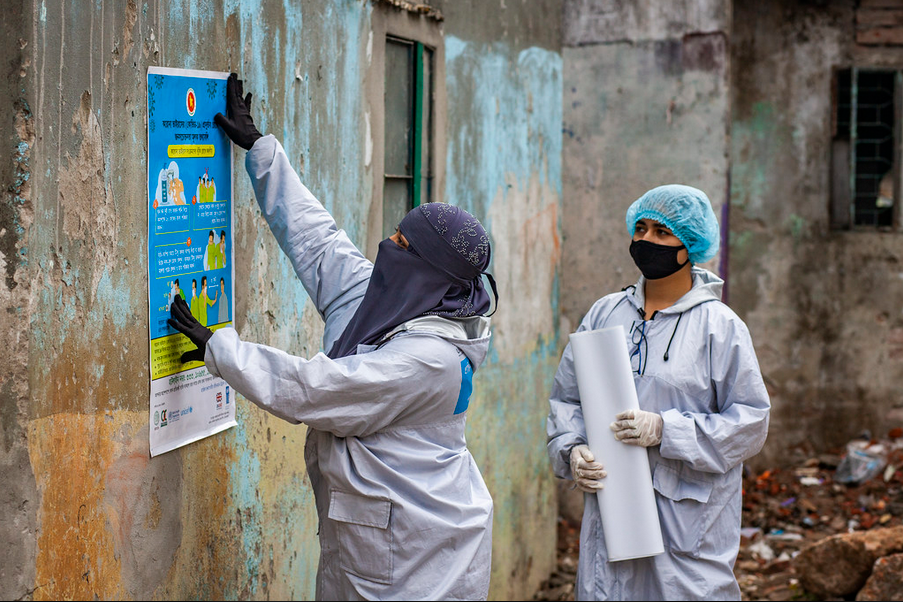
Frontiers in Public Health, 16 August 2021 | https://doi.org/10.3389/fpubh.2021.711066. Image credit: UN Women/Fahad Abdullah Kaizer via Flickr (CC BY-NC-ND 2.0)
- Log in to post comments