










































Society For Integrated Developmental Activities, Research & Training (SIDART)
SIDART designs its activities from the perspective that local wisdom, knowledge, and resources can be harnessed to develop appropriate trainings for capacity building, carry out action research, mobilise the community, and initiate sustainable community-based and community-owned projects. The organisation seeks out local assistance (material and financial) before seeking external support.
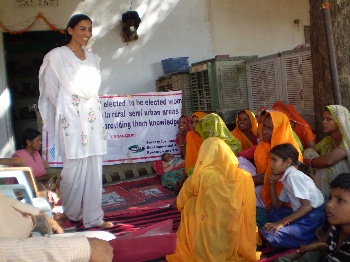
One central area of focus is women's empowerment, particularly for economic development. Women and women's collectives set the pace, priorities, format, and content of many project activities. For example, SIDART supports small organisations headed by women in the areas of training capacity building, strategic planning, and policy review. One goal is to promote the social and political leadership among women and other disadvantaged sections. To that end, SIDART has formed 27 women's self-help groups involving 408 women. SIDART facilitates access to credit in order to increase women's participation in income generation and, ultimately, to give them confidence in their abilities to develop access to and control over resources. For example, it linked 60 women from the self-help groups in Jaipur City with income generation training for a period of 4 months involving gem cutting and polishing. SIDART also organised a local fundraising campaign in June 2003 by mobilising 1000 women to contribute their old newspapers, magazines, and books. The proceeds were given to economically poor women to enable them to take up self-employment schemes. The idea was to enable women to equip themselves with the resources necessary to take part in decisions related to community development. SIDART also organises sessions such as a November 2009 seminar for village volunteers on women's empowerment in rural and semi-urban areas of Rajasthan about Panchayati Raj and civic systems.
SIDART's activities have also focused on issues like the environment, sanitation, and appropriate technologies. Here are a few examples; for additional/updated details, visit the SIDART website:
- Organised various training sessions for teachers, mineworkers, and adolescents on issues like leadership style and qualities, legal rights and practical needs such as child-care, nutrition, health, hygiene, sanitation, and safe delivery;
- Helped 80 economically poor families develop sanitary habits by extending financial assistance for technical guidance about constructing low-cost latrines;
- Provided free medical care to slum dwellers with the assistance of doctors and organising four health camps;
- Established 25 non-formal education centres for 500 child labourers with the assistance of voluntary social workers and teachers in the community;
- Distributed plants and saplings to various schools and organisations in order to create awareness among citizens and children about environment conservation;
- Organised an environmental awareness campaign;
- Organised a tuberculosis awareness campaign for mineworkers;
- Set up 3 non-formal education centres for 150 underprivileged and minority children with community support;
- Initiated a project at Ramgarh block of Alwar district on early childhood care with the United Nations Children's Fund (UNICEF) support in an effort to ameliorate the malnourished status of the children with community support;
- Facilitated state- and district-level trainings for facilitators working in the areas of adolescent girls and maternal child health and nutrition;
- Indigenously developed a tool for monitoring of immunisation programme at village level, drawing on community participation, and submitted it to the Ministry of Panchayati Raj department;
- Undertook research into the current level of awareness of HIV/AIDS among Rajasthan school and university students. Obtained input from youth about how to effectively address the problem; and
- Organised crash courses on computers for school children and housewives.
SIDART also uses networking and partnership to empower like-minded non-governmental organisations (NGOs) working in Rajasthan state. In 2004, SIDART organised a network of NGOs for combined action and facilitation; so far, 18 NGOs have joined. SIDART provides technical support to its members and keeps them updated about programmes and partnerships.
Women, Children, Gender, Natural Resource Management, Environment, Health, Education, Economic Development, HIV/AIDS, Democracy and Governance.
SIDART is headed by 16 volunteers who have worked in various government departments and voluntary organisations. The members of SIDART and personnel play a facilitative/supportive role and not a directive role (women and women's collectives are the true leaders). The organisation has a decentralised management structure that features participative decision making and the sharing of responsibilities. Major funding sources include membership fees, donations from the community, and grants from voluntary organisations.
Hanns Siedel Foundation, Apollo Foundation, Department of Medicine and Health (Government of Rajasthan: State AIDS Control Society), Bharat Petroleum Corporation Limited (BPC), Art Action Singapore.
Emails from Pramila Sanjaya and Neeraj Kumar to The Communication Initiative on July 1 2003 and November 11 2009; and SIDART website, November 13 2009.
Comments

keep up the good
keep up the good work!!!!!!!!!

- Log in to post comments