











































Discovery Channel Global Education Partnership
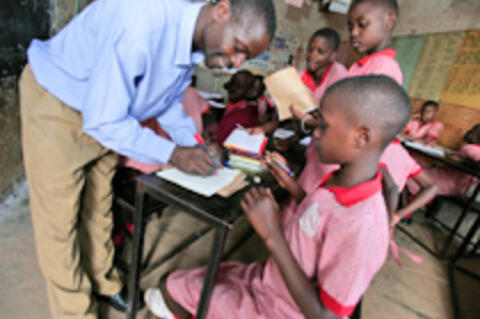
This initiative draws on information and communication technologies (ICTs) - in particular, television - in an effort to enhance learning and understanding, share new ideas, honour traditions, and stimulate a sense of community at a local and global level. Television is envisioned by the DCGEP as a powerful tool in that it: reaches large groups of people at one time and in their own language, communicates effectively to young children and illiterate adults, conveys information simply and accurately, and is easy to operate and sustainable over time.
DCGEP's core approach for providing ICT tools for education- and community-based learning and exchange is attention to local context. As part of the process of providing these tools to foster access to knowledge and information, DCGEP begins its work in a new country by meeting with national and local education officials and other community stakeholders to plan the establishment of Learning Centers in a way that will most appropriately address the needs of that particular community. These Learning Centers are established in existing structures, such as in a school or community centre, a clinic, library, or mobile van. Locations are selected and set up to suit the context; for example, DCGEP worked with local organisation Rural Libraries for Resource Development (RLRDP) to set up a Learning Center in Zimbabwe in a donkey-drawn cart. Since it can difficult for vehicles to travel in some parts of Zimbabwe, RLRDP has been using donkey power to bring information and education to schools and communities in Matabeleland North since 1990; DCGEP helped RLRDP to modify its cart design to hold a solar-powered TV and VCR in addition to library books. RLRDP and DCGEP train cart drivers to facilitate learning through literature and TV/video resources. Surrounding communities have shared the resources by developing a circuit for the donkey carts and a timetable for school and community use.
In addition to providing actual ICT equipment, DCGEP offers original educational video programming, which is developed collaboratively with each community to complement local educational curricula. In developing this programming, language customisation (translation into local languages) is key, and DCGEP includes footage from local communities, private and public organisations, and government agencies; the idea is that familiar words and images can help make programming more accessible and relevant to local audiences. That said, in an attempt to bring subjects such as science, nature, history, and geography "to life" in a vibrant (yet still relevant way), the programming is designed to expose participants to that which is new and different, such as by experiencing other lands, other cultures, and even parts of their own countries to which they may not otherwise have access. DCGEP also provides additional sources of programming, such as free-to-air local television, satellite services, and videos from a range of local and international organisations.
Face-to-face capacity-building and monitoring activities - which also draw on participatory strategies - are thought to be central to the sustainability of the Learning Centers. DCGEP offers 3 years of teacher training and monitoring, which is regularly modified based on collaboration with local community members and education experts. The goal is to prepare teachers to use video interactively and creatively as part of a student-centred approach, as well as to help them tie the programming to their daily curricular objectives. Locally-adapted teacher resource guides help instructors use the programmes in support of their teaching objectives. Training is also designed to equip educators to draw on television to support specific community interests. For example, in Peru and Mexico, videos used during the day for students have reportedly stimulated discussions during parents' workshops on family values, parenting, government, and a variety of other topics. Regular monitoring is offered in an effort to encourage educators to develop their own ideas for using the technology and programming, and to work toward creating a sustainable community resource.
Education.
By providing access to television technology, a "wide array of locally relevant programming and three years of teacher training, DCGEP is opening new doors to learning in 331 schools [statistics from September 2010] in Africa, Latin America, and Eastern Europe. Over 832,000 students and 13,000 teachers benefit from the initiative. Countries served include Angola, Brazil, Egypt, Ghana, Kenya, Mexico, Morocco, Namibia, Nigeria, Peru, Romania, South Africa, Tanzania, Uganda, Venezuela, and Zimbabwe." To read about specific local Learning Centers in more detail, please visit the DCGEP's online interactive project map.)
DCGEP offers the following independent evaluation information on its success. The evaluation found that in schools with the project:
- "Teachers increase their effectiveness in the classroom through their use of video as a teaching tool.
- Students show improved cognitive skills and motivation, and enhanced language skills.
- Community members conduct workshops on HIV/AIDS and other public health and social issues. In addition, the schools become important centers of community life, where people view news and entertainment programs after school hours and on weekends, resulting in greater community interaction and cohesion."
Click here for a list of the individuals and organisations who have supported DCGEP.
Discovery Channel Global Education Partnership brochure; DCGEP website; and emails from Ellen Henderson-Madhavan to The Communication Initiative on April 5 and April 6 2007, on October 31 2007, on March 20 2008, on September 18 2008, on February 19 2009, August 13 2009, and September 20 2010.
Comments

commendation and suggestion
my name is francis y mensah a volunteer cordinator-ST.PETER'S R/C J.H.S. KUMASI GHANA W/A of DCGEP.I hereby wish to commend you of such wonderful services being offered to many school going people all over the world.In fact this project is helping my work as a teacer and the students in general.Thank you.But I want to plead that the suppliers of the various gadgets/equipment are ensured to provide qualilty and original kinds.Thank you.
- Log in to post comments