










































2018 Assessment Report of the Global Vaccine Action Plan
"2017's outbreaks are a sobering reminder that no country can take its eye off the ball: effective national immunization systems require ongoing nurturing, political commitment and public support."
The Strategic Advisory Group of Experts (SAGE) Working Group (WG) facilitates a yearly SAGE independent review of the implementation of the Decade of Vaccines (DoV) Global Vaccine Action Plan (GVAP) and assessment of progress. In addition to reviewing progress against GVAP targets and objectives, the 2018 report suggests a pathway towards the development of a post-2020 strategy, building on lessons learned during the Decade of Vaccines. It also reflects on the key contextual factors and themes that will shape a successor global immunisation strategy.
The report opens with highlights of the year. For example, the number of under-vaccinated children fell by over 1.8 million between 2010 and 2017, but dirculating vaccine-derived poliovirus was detected in 3 regions, and only 7 countries reported no vaccine hesitancy in 2017. A series of graphics summarises the current status of key coverage and other indicators in 2017.
In exploring elements of the fragile gains, SAGE looks at some communication-related factors, including the dependency of the development of effective national immunisation systems on high levels of political commitment. It is important, SAGE says, that this commitment is not merely symbolic, but that it translates into concrete strategies and action plans. Central to country ownership are functioning National Immunization Technical Advisory Groups (NITAGs), which showed encouraging growth in 2017. There is a need to move beyond process indicators to assess the effectiveness of NITAGs and their contribution to national policymaking and practice.
With regard to demand and hesitancy issues:
- SAGE notes that stimulating demand - the active seeking of services - requires attention to multiple issues, including community engagement, service quality and accountability, and responses to adverse events or other challenges. A range of stakeholders, including communities, frontline health workers, civil society organisations (CSOs), and "immunisation champions", have roles to play in fostering demand. For example, engaging with CSOs can help to generate a positive environment for immunisation, while framing immunisation as a basic human right and central to the development agenda can be a driver of political accountability.
- Working to stimulate demand can prevent hesitancy. Hesitancy linked to lack of awareness/knowledge continues to decline, and risk/benefit concerns remain the most often-cited reason for hesitancy (but represent less than 30% of the total responses, illustrating the wide diversity of issues underlying hesitancy. For instance, in some cases, vaccine refusal is being driven by extreme political agendas that prevent populations from being immunised. In addition, social media accounts have been used to provoke debate about immunisation safety to undermine trust in national authorities.). SAGE indicates that further work is needed to understand hesitancy issues at national and sub-national levels, as many hesitancy issues are highly context-specific.
- To meet the need for more evidence on the factors affecting uptake and demand for immunisation services, the United Nations Children's Fund (UNICEF) is working with the World Health Organization (WHO), the United States Centers for Disease Control and Prevention (CDC), and the Bill and Melinda Gates Foundation to establish a Hub for Vaccination Acceptance and Demand. The Hub will harness the expertise and resources of a wide range of immunisation stakeholders, building a global resource for addressing demand-related challenges and coordinating technical support to countries.
Because a Strategic Objective of the GVAP is that the benefits of immunisation should be equitably extended to all people, the assessment report looks at issues of equity. SAGE notes that a growing set of toolkits are available to increase coverage in underserved populations and pockets of unvaccinated children in remote districts. In addition, UNICEF and the Bill and Melinda Gates Foundation have established a high-level Equity Reference Group (ERG) to review innovative ideas, new approaches, and best practices and to make recommendations for guidance, policies, and programming to reduce inequities. Also, CSOs have a potentially critical role to play in expanding access - e.g., by playing key advocacy roles locally and nationally and by holding governments and delivery partners accountable.
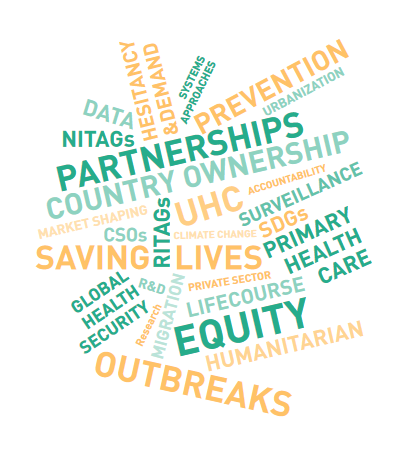
Looking to the future, post-2020, SAGE offers a strategy that involves elements such as these (see the full report for more):
- The next chapter of immunisation must be one of integration, with immunisation positioned as a central pillar of universal health coverage, at the heart of primary healthcare, health security, and the Sustainable Development Goal (SDG) agenda.
- The global immunisation community needs to recognise the importance of shared interests and work towards common goals. Multiple opportunities exist to engage with additional sectors and potential partners. Effective global models of collaboration have been established to tackle complex problems, supporting enhanced access and coordinated research.
- All countries need to see immunisation as core to their health systems, and all citizens need to see immunization as a basic human right. This will mean efforts to strengthen national immunisation systems, build demand, and tackle hesitancy where it exists.
- A future immunisation strategy must build countries' capacity for community engagement, demand promotion, and trust building - activities that should be fully integrated into national immunisation systems. Countries need to be prepared to effectively respond to vaccine-related events that can quickly undermine public trust and disrupt national immunisation programmes.
- Equity must continue to be a strong driver, to ensure that everyone enjoys the benefits of immunisation, particularly the most disadvantaged, marginalised, and hard-to-reach populations - including those affected by conflict, natural disasters, and other humanitarian emergencies.
- Enhancing the granularity of immunisation data collection and data quality will be fundamental to improved planning and decision-making. Exploiting the potential of data will require investments in information technology (IT) infrastructure and data management and analysis, as well as integration with other relevant national ehealth initiatives.
- In addition to the development of new vaccines, research must help deliver and expand innovations that enhance access and acceptability, and continually improve vaccine services to reach the economically poorest, most marginalised communities. Much of this work needs to be led at a country level, emphasising the importance of building immunisation research capacity in low- and middle-income countries (LMICs).
- A future immunisation strategy should focus on people and communities. By involving communities in the design, implementation, and monitoring of services, such services are likely to be more sustainable, more acceptable and more appropriate to the needs of those that need services the most.
The report closes with a set of recommendations - for example, nurturing individual and community demand for immunisation should be given high priority within countries.
Immunization Action Coalition Express #1394, World Health Organization (WHO) website, November 14 2018, and TechNet-21, April 11 2019.
- Log in to post comments