










































Access, Demand, and Utilization of Childhood Immunization Services: A Cross-sectional Household Survey in Western Area Urban District, Sierra Leone, 2019
Centers for Disease Control and Prevention, or CDC (Feldstein, Jalloh, Kulkarni, Conklin, Wallace); Mailman School of Public Health (Sutton, Parmley, Lahuerta, Akinjeji, Mansaray, Eleeza); Sierra Leone Ministry of Health and Sanitation (Sesay)
"...actionable data to guide the Sierra Leone Ministry of Health and Sanitation (MoHS) to improve access, demand, and utilization of immunization services by tailoring and strengthening immunization services in Freetown and other similar urban settings in the country."
Along with numerous health-systems-related setbacks caused by the Ebola outbreak, suboptimal routine vaccination coverage is a major public health concern in Sierra Leone. Informal settlements and slum communities within urban areas have populations with generally low socioeconomic status, which may result in gaps and inequities in the uptake of health services, particularly for childhood immunisations. This cross-sectional household survey sought to explore, among other factors, the relationship between a child's residence (slum and non-slum) and their vaccination status in Western Area Urban (WAU) district.
The researchers conducted a household survey with eligible caregivers of children aged 12-36 months in WAU district, Sierra Leone, from March 4 to April 8 2019. The final analysis included data from 444 caregivers and 460 children (240 children from 236 households in slums and 220 children from 207 households in non-slums). The researchers interviewed caregivers near their households, using a tablet-based respondent questionnaire. Data from the child's vaccination card were gathered; caregiver recall was used in cases of children without cards.
Among the findings:
- Caregiver access to and utilisation of routine immunisation did not differ significantly between slum and non-slums. For example, caregivers in both areas reported similar travel time from their home to vaccination sites and similar wait times - often, "too much time" - at vaccination sites. Half of all caregivers reported having to pay healthcare workers for routine immunisation services, even though services are supposed to be free. One in 10 caregivers reported attending a vaccination site but having to return home without their child being vaccinated. The 3 main reasons reported for missed opportunities for vaccination were: "not enough children to open a vaccination vial", "vaccines were not available", and "it was not a scheduled vaccination day".
- 90% or more of caregivers in both slum and non-slums reported they believe vaccines are good for their children, are safe, and protect their children against diseases.
- Less than 80% of caregivers in both areas reported that parents and trusted leaders in the community "very much" approved and valued childhood vaccinations.
- Very few caregivers self-reported refusing recommended vaccinations for their child (2%-6%); however, 36%-37% of caregivers self-reported delaying vaccination for their child. Of the 17 caregivers who self-reported vaccine refusal, 10 cited fear of vaccination side effects. Of the 163 caregivers who self-reported vaccine delay, the top 3 reasons were: lack of time to take child, child or caregiver was sick, and fear of vaccination side effects.
- 62% of caregivers in slums and 75% of caregivers in non-slums received information about childhood vaccinations from health facilities. However, only 43% of caregivers in slums and 47% of caregivers in non-slums reported that health facilities were their preferred source of information; caregivers in both areas reported they would have preferred household visits, radio programming, or community-based events.
- According to caregiver recall, 54% of children in slums and 53% of children in non-slums received all recommended vaccines in the national routine schedule; however, according to vaccination card data, only 33% of children in slums and 29% of children in non-slums did.
- In bivariate analyses, failure to complete the pentavalent vaccination series (from vaccination card only) was significantly associated with second or higher birth order of the child, paternal education of primary school or less, living in a house without a flush or pour toilet, and living in a house with natural floor, roof, and wall materials. Failure to complete this series was significantly higher among children with caregivers: who knew a child in their family or community with vaccine side effects in the last 12 months, who self-reported delaying recommended vaccinations for their children, who less frequently perceived that their spouses and household members "very much" approved of childhood vaccination, who less frequently reported being confident in their ability to take their child for vaccination visits, and who less frequently perceived they lived in a community where people valued childhood vaccination and approved of childhood vaccination.
- Children who were age-eligible but had incomplete measles vaccination were more likely to have a mother and father who reported being Muslim. They were also more likely to live in a house without amenities including electricity, a television, radio, mobile phone, refrigerator: 70% (95% CI = 52%-83%) compared to 43% (95% CI = 33%-55%). In addition, children whose caregivers delayed their vaccination were more likely to have incomplete measles vaccination coverage (34%, 95% CI = 23%-47%) compared to 11% (95% CI = 5%-22%).
- In a multivariate analysis, the following covariates were most closely associated with incomplete pentavalent vaccination series: being born second or later (adjusted odds ratio (aOR) = 4.5, 95% CI = 1.4-14.9), living in a household where a spouse, partner, or household member does not approve of childhood vaccinations (aOR = 7.55, 95% CI = 1.52-37.38), caregiver self-reporting delay of child receiving recommended vaccinations (aOR = 4.8, 95% CI = 1.0-22.1), and living in a household made of natural or rudimentary materials (aOR = 3.5, 95% CI = 1.2-10.6).
Although the study did not find any differences in vaccination coverage between slum and non-slums (a result the researchers call "surprising"), the findings show that overall, almost 1 in 4 children had not received the first dose of measles-containing vaccine (MCV1), and only 1 in 3 children received MCV2 vaccination. Based on the results of this survey, barriers to accessing and utilising routine immunisation services in both areas fell into 4 categories: (i) sociodemographic characteristics of the family, (ii) caregiver perceptions of family and community beliefs, attitudes, and behaviours toward vaccination, (iii) vaccination session scheduling, and (iv) facility-based experiences and missed opportunities for vaccination.
Reflecting on the results, the researchers point to the fact that approximately one-quarter or more of those surveyed reported that parents and trusted leaders in their community were not likely to approve of childhood vaccinations and that the caregivers would not be likely to encourage other caregivers to get their child vaccinated. "Further qualitative research could help shed light on how to improve confidence among caregivers to get their children vaccinated and to increase support for routine vaccination among members in the community."
Recommendations for improving vaccination coverage in this urban setting of Sierra Leone include:
- Use simple language when developing all communication and education messages regarding routine immunisation, and test them to ensure caregivers with varying degrees of education understand.
- Engage not only mothers and fathers but all household members and community members in vaccine-related dialog through communication channels that caregivers report preferring (household visits, radio programming, community-based events, and health facilities).
- Educate people about why vaccines are important (not just for the first born) and how they protect against severe diseases, and design risk communication strategies that address adverse events following immunisation.
- Identify trusted local leaders (formal and informal) within diverse urban social networks, and engage them to support and role-model positive vaccination attitudes and behaviours in the community.
- Consider strengthening ties between health facilities and local places of worship, particularly mosques, to reinforce vaccination messaging and provide vaccination reminders after prayer services.
- Ensure routine immunisation services are free of charge, increase the number of vaccination days, modify hours, and explore different types of outreach activities to ensure caregivers have flexibility as to when and where they bring their child for vaccination. (For example, because the majority of caregivers reported that maternal occupation was "petty trader", the marketplace could be targeted for vaccination outreach activities and demand promotion.)
- Create a national policy to support healthcare worker education that vials should be opened despite wastage and to ensure a steady supply of vaccines.
- Strengthen defaulter tracking and use local community health volunteers to help ensure caregivers return at a later date with their child.
- Encourage clear and positive communication between the provider and caregiver during vaccination sessions, which can ensure that the provider has fully addressed any vaccine barriers or hesitancy, such as vaccine side effects.
As a next step, the Sierra Leone MoHS and global health partners will collaborate on implementing key interventions to address identified challenges to childhood vaccination in WAU.
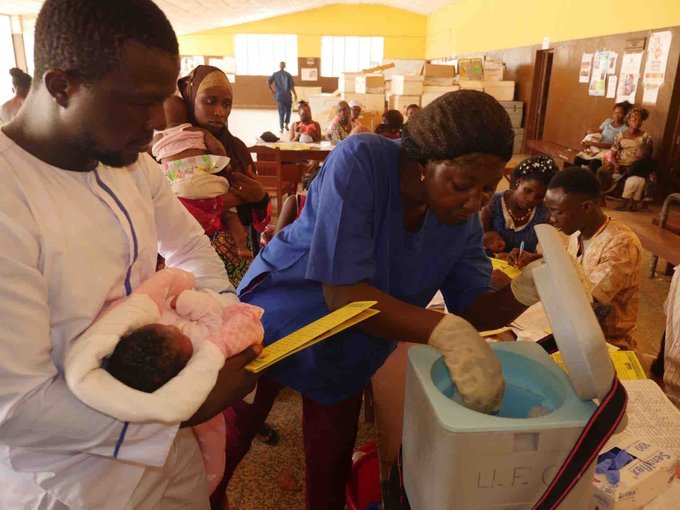
Journal of Global Health (JOGH) 2020; 10: 010420. doi: 10.7189/jogh.10.010420. Image credit: World Health Organization (WHO) Sierra Leone
- Log in to post comments