










































Community Engagement and Integrated Health and Polio Immunisation Campaigns in Conflict-Affected Areas of Pakistan: A Cluster Randomised Controlled Trial
Centre of Excellence in Women and Child Health, Aga Khan University (Habib, Soofi, Ahmed, Ali, Bhutta); London School of Hygiene & Tropical Medicine (Cousens, Bhutta); Peshawar Medical College (Anwar, Haque); Trust for Vaccines and Immunization (Tahir); Centre for Global Child Health, The Hospital for Sick Children, Toronto (Bhutta)
"...the provision of polio vaccines as part of a package of health services might be a better way to engage local communities and religious leaders than a polio-specific programme."
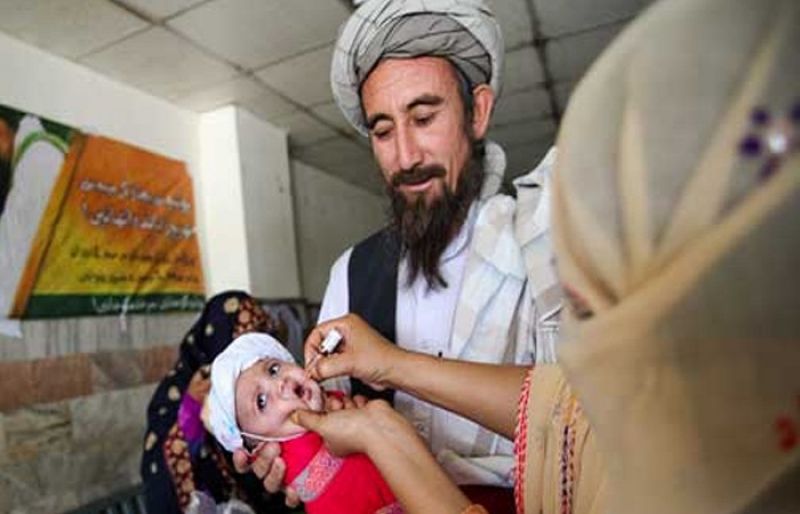
This study aimed to evaluate the acceptability and effect on immunisation coverage of an integrated strategy for community engagement and maternal and child health immunisation campaigns in insecure and conflict-affected polio-endemic districts of Pakistan. Although routine childhood immunisation services should provide 4 doses of oral polio vaccine, or OPV (at birth, 6, 10, and 14 weeks of age), repeated, concerted door-to-door immunisation campaigns, called supplementary immunisation activities (SIAs), have been used to try to increase OPV coverage. SIAs have been particularly challenging in parts of the country affected by insurgency and insecurity, with groups such as the Taliban limiting access to populations, disinformation leading to refusal of OPV, and attacks targeting polio workers. An important issue in many areas is insufficient community buy-in for the SIAs and general fatigue with the repeated rounds of household OPV administration.
In that context, the researchers conducted a community-based 3-arm cluster randomised trial in healthy children aged 1 month to 5 years that resided within the study sites in 387 insecure areas in 3 districts of Pakistan (Bajaur, Karachi, and Kashmore) at high risk of polio. Clusters were randomly assigned to receive routine polio programme activities (control, arm A), additional interventions with community outreach and mobilisation using an enhanced communication package and provision of short-term preventive maternal and child health services and routine immunisation (health camps), including OPV (arm B), or all interventions of arm B with additional provision of inactivated polio vaccine (IPV) delivered at the maternal and child health camps (arm C).
Specifically, a community mobilisation plan and information, education, and communication (IEC) materials - a pictorial booklet and counselling cards - were prepared during the inception phase. The IEC materials contained information on maternal health, nutrition, hygiene and sanitation, immunisation, polio, and health camps. Teams of two female and one male community mobilisers were recruited and trained to deliver the information contained in the IEC material and were provided with an IEC booklet and counselling cards as job aids. Each team covered four clusters and delivered these key messages through individual sessions with parents and group sessions with male groups, female groups, and health-care providers at cluster level. Although the study team did not make direct contact with local militant leaders and Taliban commanders, community elders were closely consulted who might have communicated with such individuals.
The community mobilisation teams also promoted health camps offering maternal and child health immunisation services during the scheduled supplementation immunisation strategies, including missed OPV doses. Promotion was limited to provision of information regarding services being offered at health camps and encouraging use of those services. Additional information about the availability of IPV for coadministration with OPV (as needed) in the health camps was only provided in clusters of arm C. To avoid potential contamination between arms, the community mobilisation teams informing communities in arms B and C about health camps also provided colour-coded invitation cards required for visiting the health camps, and vaccine allocation (additional IPV) was made as per the colour codes.
An independent team conducted surveys at baseline, endline, and after each round of SIA for acceptability and effect. The primary outcome measures for the study were coverage of OPV, IPV, and routine extended programme on immunisation vaccines and changes in the proportion of unvaccinated and fully vaccinated children. Between June 4 2013 and May 31 2014, 387 clusters were randomised (131 to arm A, 127 to arm B, and 129 to arm C). At the end, there were 23,334 children younger than 5 years in arm A, 26,110 in arm B, and 25,745 in arm C. The estimated OPV coverage was 75% in arm A compared with 82% in arm B (difference vs arm A 6.6%; 95% confidence interval (CI) 4.8-8.3) and 84% in arm C (8.5%, 6.8-10.1; overall p<0.0001). The mean proportion of routine vaccine doses received by children younger than 24 months of age was 43% in arm A, 52% in arm B (9%, 7-11), and 54% in arm C (11%, 9-13; overall p<0.0001).
A consistent pattern across sites and across rounds was observed of higher coverage in the 2 intervention arms (B and C) than in control arm (arm A; figure 3). The interventions were well accepted, with the health camps accessed by families with more than 50,000 child visits. Furthermore, the high coverage achieved with IPV in intervention arm C suggested that the strategy of delivering IPV alongside OPV and other vaccines through fixed health camps is both feasible and acceptable.
The researchers note that this trial occurred before the initiation of military operations against the Taliban and other militant groups in Federally Administered Tribal Areas (FATA) and inaccessible areas of Karachi. (The military operation by the Pakistan Army in the high insurgency areas of FATA, such as North Waziristan, Khyber Agency, and Tirah valley has since opened the opportunity to reach hitherto inaccessible populations.) "The community participation and acceptance of the intervention reflected the widespread unmet needs for maternal and child health and immunisation services in these areas. In fact, the community mobilisation and advocacy strategies focused on promoting general maternal and child health and immunisations without the singular focus on polio vaccination."
The researchers assert that their experience has implications for other geographies facing resistance and limited community engagement. "Efforts at polio eradication in Pakistan have accelerated rapidly since our study and our findings have been made available to policymakers developing response strategies in high-risk areas. The holistic approach of community mobilisation and establishing regular health camps, focusing on maternal and child health and immunisation services has since been widely implemented in high-risk union councils of Karachi, as well as Khyber Pakhtunkhwa and FATA and is beginning to yield results....This approach is now being expanded to high-risk areas in Baluchistan with persistent poliovirus circulation. This experience also has implications for addressing the challenges in the three residual pockets of polio globally, which also happen to be geographies affected by conflict and insecurity."
In conclusion, the results of the study show that, despite insecurity due to militancy, and hesitancy in receiving OPV doses at home during SIAs, an approach centred around community mobilisation combined with delivery of maternal and child health and immunisation interventions through temporary health camps during SIAs can be effective in increasing coverage of OPV and other childhood vaccines.
Lancet Global Health 2017; 5: e593-603 - sourced from "Study shows how to run successful anti-polio campaign in Pakistan", by Faiza Ilyas, Dawn, May 9 2017 - accessed on March 28 2018. Image credit: suchtv.pk
- Log in to post comments