










































Country Case Study: Cambodia - Support to Media Where Media Freedoms and Rights Are Constrained
"Pockets of protest and resistance exist within Cambodian society, but a range of social and political barriers prevent more widespread and inclusive debate on issues facing Cambodians and their country. The CPP [Cambodian People’s Party] exercises tight control over information flows within the country, and the majority of the Cambodian media has political affiliations."
This case study is part of a series of BBC Media Action research papers, including 5 case studies and a synthesis, discussing reasons why the media in each of the countries featured is constrained and how outside agencies and donors support free and independent media. Commissioned by Swedish International Development Cooperation Agency (SIDA), they are designed to describe the media landscape and media development (countries include Syria, South Sudan, Cambodia, Bangladesh, and Uganda) and set out best practice for donors to sustainably fund and support media internationally.
This document describes Cambodia’s transition over two decades since its period of conflict with the Khmer Rouge and its progress towards achievement of the Millennium Development Goals (MDGs), particularly poverty reduction. According to the report, its economic development and single party rule have been marked by increasing corruption, such that: "Profit (and therefore entertainment) and politics drive media content and audience engagement in Cambodia, not public service values."
As stated in the Executive Summary: "China has become the largest foreign donor to Cambodia and, increasingly, the CPP is shunning Western development assistance and the expectations of the international community in relation to governance and the protection of Cambodians’ rights....Significant donor investment over the past 20 years has sought to redress the balance and overcome... challenges to improved governance in Cambodia. This investment has included a focus on media and communication as a primary mechanism to achieve change, with very little research on its actual impact.
This case study seeks to examine this investment in the context of evolving power structures and the media and communication landscape of Cambodia. It concludes that donors would be wise to continue to invest in impact research, maintain a strong focus on governance in their support, and pay greater attention to young audiences and the Internet as a growing source and focus of public dialogue."
The current media situation includes the following:
- "Television reaches more people than any other media, ...All main television stations are known or believed to be linked to the Cambodian People’s Party (CPP)....a substantial amount of content is imported from China and South Korea and dubbed into Khmer. Soap operas, action movies and music entertainment shows are now the staple of local TV. Karaoke video compact discs (VCDs) and films are also popular in areas where media access is severely limited....
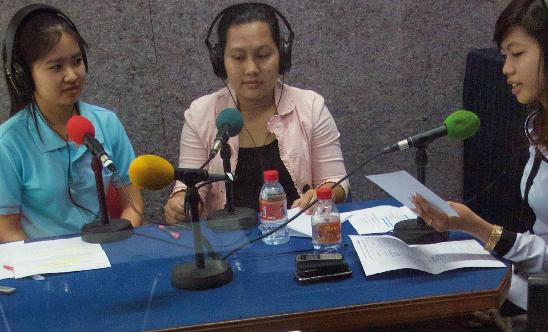
- Radio is largely controlled by the State through the granting, denial or withdrawing of licences. A few nongovernmental organisations (NGOs) are, however, trying to use radio to offer different political viewpoints....
- Only 8 per cent of the population gets its information from a newspaper and only 3 per cent from a magazine.
- In contrast to the steady but comparatively low growth of Internet access, mobile telephony is almost universal."
Current initiatives of a small subset of donors include attempting to combat journalist self-censorship and corruption while encouraging citizen journalism, avenues for public discussion, and journalist training and professional associations. Both donor fatigue and donor refocusing are occurring. Support for democratisation includes focusing on youth and civil society, including media development, capacity building, audience engagement, and support directly to Cambodian media organisations. Research is ongoing: "Taken as a whole, there seems to be increasing acknowledgement of, and support for, research in this area in Cambodia, albeit within the context of limited support overall to media and governance interventions. This is a promising development, with the potential for a wide range of donors, media support organisations and other NGOs to benefit from an increased understanding of both the drivers and barriers to constructive and inclusive public dialogue."
The document concludes with recommendations for continued investment in research, keeping governance on the agenda, and taking public dialogue on-line.
Email from Aoife Allen to The Communication Initiative on September 4 2012 and BBC Media Action website, September 12 2012.
- Log in to post comments