










































Gender Transformative Approaches to Engaging Men in Gender-Based Violence Prevention: A Review and Conceptual Model
University of Washington Tacoma (Casey); University of Kansas (Carlson, Two Bulls, Yager)
Noting that engaging men and boys as participants and stakeholders in gender-based violence (GBV) prevention initiatives is an increasingly institutionalised component of global efforts to end GBV, the authors of this paper offer a conceptual model that captures and organises a broad array of men's anti-violence activities in 3 distinct but inter-related domains: 1) initial outreach and recruitment of previously unengaged males, 2) interventions intended to promote gender-equitable attitudes and behaviour among men, and 3) gender equity-related social action aimed at eradicating GBV, inclusive of all genders' contributions. They also review empirical literature in each of these domains. They critically assess the degree to which gender transformative principles (focus at least in part on a critical examination of gender-related norms and expectations, particularly those related to masculinity, and on increasing gender-equitable attitudes and behaviours) inform efforts within each domain, offering implications for the continuing conceptualisation and assessment of efforts to increase men's participation in ending GBV.
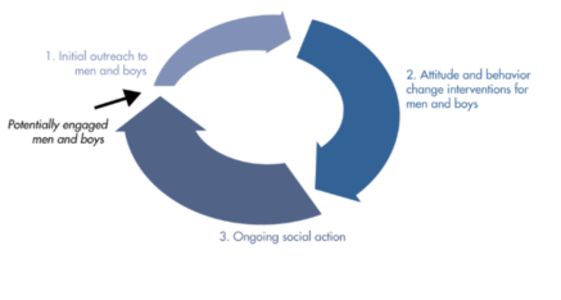
In summarising the knowledge base regarding engaging men and boys in prevention through a gender transformative lens, the authors' aim is not to elevate men's participation as an end unto itself. Instead, they argue for the importance of males in violence prevention as one integral component of comprehensive efforts to end violence globally and ultimately, to promote gender justice. The project of engaging men requires careful thinking about how to appeal to men without reinforcing notions of gender hierarchy, they argue. As noted, efforts to increase men's anti-violence involvement are myriad and include, but are not limited to, one-time community events, standardised interventions aimed at violence-related attitude and behaviour change, and a range of community outreach, education, mobilisation, and social action efforts. In addition to their heterogeneity, activities under the umbrella of "men's engagement" encompass a temporal dimension. To that end, Figure 1 depicts a proposed conceptual model, in which initial recruitment of men and boys provides a conduit to formalised prevention events and interventions, which, in turn hold promise for fostering activism and integration into larger GBV prevention efforts and, more broadly, gender justice movements. Subsequent activism (in addition to potentially addressing structural factors that support gender GBV) can generate new spaces in which initial outreach to previously unengaged men may occur.
Using this model as a starting point, the authors critically evaluate the ways that gender transformative principles have informed efforts within each domain. To do so, they first explore the rationale for a gender transformative lens in engaging men and boys. In Domain 1 (initial outreach to men), the authors reflect on 12 peer-reviewed articles and one book to look at factors including:
- Recruitment through social networks: The role of credible messengers and role models - recruiting through connection tended to be described in two ways: 1) reaching men through their existing individual relationships, and 2) mobilising community-specific ambassadors or role models. The findings from studies they review suggest the utility of outreach approaches that reach men one at a time in tailored ways through existing social relationships and by individuals who are trusted, credible members of local communities. For example, Casey et al. (2016) describe findings from a global survey of 392 men who had recently attended a violence prevention event or become involved in GBV prevention work. Over half of men in this sample reported being encouraged to initiate involvement by someone close to them.
- Recruitment through context: Culturally and community-specific strategies - In one example of a community-specific approach to engagement, men and women in several post-conflict communities across 5 African and Asian countries were invited to participate in creating videos documenting gender-related issues of concern to their communities (Gurman et al., 2014). Resulting videos were therefore highly relevant to the many small communities from which they emerged and were effective avenues for generating conversation about sensitive issues among other community members who viewed the videos at "playback" sessions.
- Recruitment through a personal, emotional connection - For example, in their qualitative study of precipitates to involvement for male anti-violence allies, Casey & Smith (2010) found that a variety of "sensitizing experiences", or opportunities to make emotional connections to issues of violence, were catalysts for joining anti-violence work for most men in the study. These experiences variably consisted of witnessing victimisation in their own families or hearing disclosures of abuse from loved ones, thereby centring the reality and relevance of violence to their own lives. The relationship between men's multiple and intersectional identities, men's own experiences of marginalisation (e.g., that based on class, race, and/or sexual identity), and relevant GBV prevention recruitment strategies is an emerging line of inquiry.
- Recruitment through hopefulness: A positive approach to men - Findings from various studies suggested the importance of approaching men not as potential perpetrators but, rather, as loving, caring individuals who want to help stop violence against people they love, and of explicitly communicating an understanding of men's violence as something learned rather than inherent.
- Recruitment through "hooks": Starting with relevant conversations - For example, in their global study of anti-violence organisational representatives, Carlson et al. (2015) note that several organisations reported focusing some of their early conversations with men not explicitly on violence but on topics related to men's concerns about fatherhood, sexual health, experiences of power and powerlessness, etc.
The authors note that, across reviewed studies, factors associated with men's recruitment were largely not explicitly conceptualised through a gender transformative lens. They describe challenges such as this: getting men into the door of GBV prevention events (outside of mandating their presence) requires reaching out in inviting, positive ways that minimise potential barriers, including those created by defensiveness. However, they say that the accumulating evidence supports the potential importance of more clearly operationalising a gender transformative lens for initial outreach and recruitment strategies, and/or of more explicitly describing the ways in which some current outreach efforts already embody gender transformative traits. Adding this lens may be a matter of, as Dworkin et al. (2012) argue, crafting messaging that is simultaneously informed by men's locally and culturally specific experiences of masculinity but avoids appealing to the stereotypical or "hegemonic" masculine ideals associated with risk for violence. Drawing from the principles summarised above, this is perhaps best done by ambassadors and respected members of men's social networks who can explicitly model gender equitable attitudes and behaviours.
With regard to the second domain, interventions aimed at promoting gender-equitable attitudes and behaviours among men, the number of evaluation studies documenting the effectiveness of these interventions is fairly small. Eight of the 10 studies in this review were published since 2013, the year of Dworkin and colleagues' systematic review of gender transformative HIV and violence prevention interventions with heterosexual men. (This review found evidence of their effectiveness in changing attitudes and behaviours, such as reported use of violence, gender norms, increase in care or domestic work, and social acceptance of interpersonal violence, or IPV.) Table 2 outlines the intervention components of the 10 studies, including the participants, geographic location, intervention approach and components, and summary of the 4 outcomes reviewed. In brief, the interventions took place in a variety of countries, with the majority of interventions being implemented in Africa. The contexts of the different interventions in this review varied widely including: informal settlements (South Africa: Jewkes et al. 2014), conflict areas (Cote d'Ivoire: Hossain et al. 2014), heavily populated city centres (Addis Ababa, Ethiopia: Pulerwitz et al., 2015; Mumbai, India, Miller et al, 2014; Kampala, Uganda, Abramsky et al., 2014 and Kyegombe et al., 2014), and online with college students (United States: Salazar et al., 2014). For example, the latter intervention, Real Consent, drew on Social Norms and Social Cognitive Theory as well as bystander-based approaches to support participants in, among other things, critically examining masculine gender roles and building skills related to respectful sexual negotiation and intervening in situations that could lead to a sexual assault.
The next section briefly summarises each programme in terms of its operationalisation of a gender transformative approach and the concrete interventive components used to deliver the gender transformative content. Three of these programmes used a community mobilisation approach, either alone or in combination with other intervention components. The remaining programmes used small group discussion and/or one-on-one delivery formats. Included outcomes were: an increase in gender equitable attitudes, a decrease in reported IPV, an increase in care or domestic work, and a decrease in social acceptance of IPV. Out of the 8 studies assessing gender equitable attitudes, 5 showed statistically significant increases, with an additional 2 demonstrating a trend in this direction. None of the studies documented significant negative results, such as increased IPV, also bolstering the case that gender transformative approaches, on balance, show a trend toward effectiveness. Moving forward, there is room for greater specificity around the content and the delivery approach that are most related to the effectiveness of "gender transformative" interventions, as well as of core aspects of desired gender equitable norms that might be relevant across contexts. The authors propose additional directions for future research in the discussion section on this domain.
The final proposed domain of men's engagement is social action aimed at the eradication of GBV, and more generally, at pursuing gender justice. Cataloguing the largely descriptive literature regarding the enormous range of influential social action efforts globally is beyond the scope of this review. However, the authors cite Peacock and Barker (2014), for example, who suggest that core elements of broader social action of men's anti-violence engagement include: 1) coalition-building between governmental, private, and regional organisations in ways that formalise and institutionalise funding and support for GBV prevention programming, 2) gender-equitable policy advocacy that is coupled with community organising and public education campaigns to foster an accurate understanding of the benefits of GBV-related policies and that attempts to minimise backlash, and 3) mechanisms for macro-level accountability in which gender justice organisations publicly contest media, policies, or behaviour on the part of political, spiritual, and economic leaders that promotes or excuses GBV. The authors argue that social action - defined here as efforts to address structural, social, and political contributors to GBV - should both inform and subsume any conceptualisation of the purpose of men's anti-violence involvement. They also suggest that as a critical and more holistic domain, social action is inclusive of all genders' and communities' efforts and is therefore the point at which "men's engagement" ceases to be a separate consideration or goal. "Much more work is needed to assess not only what most effectively pulls men into GBV prevention programmes and work, but on the longer term impact of programs on men's identity as activists as well as the ways that these programs support and feed into larger gender justice social change efforts."
The authors note that, across domains of men's engagement in GBV prevention, tailoring programming to local context and culture in ways that account for men's various social positions, is likely to contribute to effectiveness. At the same time, similarities in outreach and intervention strategies can be seen across regions, highlighting the importance of cross-region information sharing and collaboration. "Given the leadership of the global South in developing and implementing gender transformative strategies, particularly by countries in Africa, South Asia, and South America, cross-regional learning and fertilization may be critical to bolstering the successful conceptualization and uptake of gender transformative-informed prevention, in service of the broader goals of global gender justice."
- Log in to post comments