










































Herd Immunity Communication Counters Detrimental Effects of Selective Vaccination Mandates: Experimental Evidence
University of Erfurt
"...communicating (vs. not communicating) about herd immunity had a significant positive effect on the intention to get vaccinated...emphasizing the social benefits of vaccination has great value in vaccine communication."
In many countries, vaccine hesitancy hinders immunisation efforts, resulting in regular outbreaks. In an effort to counter low vaccine uptake, policymakers sometimes propose laws requiring only one specific vaccine or a subset of recommended vaccinations. Yet there is concern that introducing selective mandates could have a negative impact on the overall vaccine uptake, given that people feel reactance - a feeling of anger that elicits the motivation to reassert the constricted freedom - and, as a consequence, opt out of further voluntary vaccinations. This study investigated a communication strategy that could diminish potential negative psychological and behavioural effects of selective mandates: emphasising the concept of herd immunity.
With herd immunity, a sufficient proportion of a population is immune to an infectious disease, making it unlikely to spread from person to person; this immunity is usually achieved through vaccination. Research has found that valuing the collective benefit of vaccination is related to higher individual empathy; thus, emphasising the collective benefit of vaccination may elicit enough perspective-taking empathy to counter the detrimental effects of selective mandates. Individuals who care for the wellbeing of others could be especially sensitive to the prosocial rationale of herd immunity communication. Confidence in vaccination may play a role as well.
A total of N = 576 participants from the United States (US) completed a preregistered 2 (policy: selective mandate vs. voluntary decision) × 2 (communication: herd immunity explained yes vs. no) factorial online experiment. All participants were presented with 2 identically constructed scenarios: In each, a fictitious disease was described, with a vaccination available for those 3 years old or more. The fictitious vaccine also had some side effects, so that the participants had to weigh the pros and cons of vaccination, one of the pros being the protection of others.
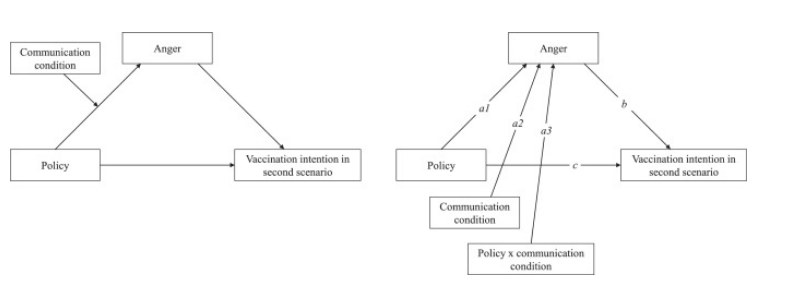
Participants in the herd immunity communication condition were presented with an interactive simulation that enabled participants to move back and forth in time to see the advantage of herd immunity induced by high vaccination rates. Participants in the selective mandates policy condition were informed that the government had recently introduced mandatory vaccination for the disease and that they were going to be vaccinated by their doctor during the next regular check-up. Individuals in the voluntary vaccination policy condition were informed that the vaccination was voluntary but recommended by the government. The researchers measured the level of anger as a proxy for reactance, represented by the mean of ratings of how angry, irritated, and annoyed participants felt after having learned about the selective mandate or voluntary vaccination policy.
In short, herd immunity communication generally increased vaccination intentions; this effect occurred independently of participants' communal orientation and whether herd immunity was expected to be relevant to them because their children could not get vaccinated. Selective mandates did not have the expected overall negative effect on the intention to receive another voluntary vaccine, and there was no mitigating interaction effect (policy × communication). However, selective mandates led to increased anger when herd immunity was not explained, leading in turn to lower subsequent vaccination intentions. Also, higher levels of anger had a negative effect on the intention to get vaccinated in the scenario of voluntary vaccination. Thus, information about the social benefits of herd immunity buffered the negative effect of the selective mandate.
In addition, analysis revealed that, for people low in confidence, the introduction of selective mandates resulted in especially high reactance. Notably, the herd immunity communication worked equally well in these participants. The researchers suggest that further studies explicitly focus on individuals who hold negative attitudes toward vaccination (or have low vaccine confidence), assessing the impact of herd immunity communication in these especially vulnerable populations. Assessing its effectiveness given different antecedents and barriers of getting vaccinated could also be instructive, as well, thus including not only confidence but also complacency, calculation, and constraints.
Also in the area of future study, the researchers recommend conducting a field study about the effects of introducing selective vaccination mandates. For instance, in the wake of Germany's passage of the Measles Protection Act, which came into force in March 2020, it could be instructive to monitor any detrimental effects on the acceptance of still-voluntary vaccinations against, for example, meningococcus, pneumococcus, or human papillomavirus (HPV). The buffering effect of herd immunity communication revealed in this study could be investigated under real-life conditions.
The researchers recommend that the introduction of selective vaccination mandates be accompanied by public information campaigns highlighting the social benefits of vaccination, hopefully thereby triggering prosocial motives and reducing reactance effects. The prosocial benefits of vaccination should be highlighted on information sheets that explain the rationale of the mandate, increasing transparency in public policy. Descriptions of the principle (i.e., protecting young children or individuals suffering from immunodeficiencies) should be easy to understand and ideally supported by an interactive simulation. The researchers stress that dialogue between healthcare personnel and patients plays a crucial role as well in communicating vaccination's role in protecting others - loved ones, friends, the community, and society as a whole.
In conclusion, "communicating the social benefits of herd immunity is a crucial communication measure, especially when introducing selective vaccination mandates. Without it, vaccination uptake for other diseases may decline, putting public health at risk."
EClinicalMedicine 22 (2020). https://doi.org/10.1016/j.eclinm.2020.100352
- Log in to post comments