










































Implementing the Communication for Development Strategy to Improve Knowledge and Coverage of Measles Vaccination in Western Chinese Immunization Programs: A Before-and-After Evaluation
Fudan University (Lu, Y-B Zhou, Jiang); Chinese Center for Disease Control and Prevention (Chu, Yu, Y-Q Zhou, Su, Duan, Zhang, Cui, Wang); UNICEF Beijing Office (Scherpbier, Zhu)
"C4D activities helped to increase caregiver immunization knowledge, encouraged caregivers to actively seek immunization services, and improved immunization coverage levels. Tailored communication strategies, based on insights gained in situation analyses, can make a significant difference to the behaviors of targeted populations."
Communication for development (C4D) is a strategy promoted by the United Nations Children's Fund (UNICEF) to foster positive and measurable changes at the individual, family, community, social, and policy levels of society. Starting in April 2013, the National Health and Family Planning Commission of China, in collaboration with UNICEF, conducted a one-year project called "Communication for Development of Immunization Programs" in the Inner Mongolia, Guangxi, Chongqing, Guizhou, Tibet, Shaanxi, Gansu, Ningxia, and Qinghai provinces. This study of the project evaluates the association of C4D with changes in parental knowledge of immunisation services, measles disease, and measles vaccine, as well as changes in their children's measles vaccine coverage.
The researchers explain that, in recent decades, the Chinese government's implementation of the Expanded Program on Immunization (EPI) has led to significant decreases in the incidences of vaccine-preventable diseases (VPDs). But, with the decline of VPDs, rare adverse events following immunisation can become more apparent. Combined with inaccurate information about vaccine safety, the relative invisibility of a disease can lead some parents to be hesitant, or even refuse, to vaccinate their child. Loss of confidence in vaccines appears to materialise in every province of China, including in less-developed central and western regions and in economically poor rural areas. Coverage rates are less than 90% in half of the western province townships; "[b]arriers to vaccination need to be addressed in China’s immunization program, particularly in remote and undeveloped areas where the immunization system is weaker."
In this context, the project under evaluation had the purpose of improving immunisation professionals' capacity: to disseminate health knowledge, to enhance public awareness and acceptance of vaccination, to help caregivers make informed decisions about vaccinating their children, and to improve coverage levels of EPI vaccines. The researchers selected 1 county at random from each province, and C4D activities were conducted in 7-10 townships selected at random from each of the selected counties. Based on challenges and characteristics of pilot areas that were identified in a situation analysis conducted with provinces prior to the C4D intervention, provincial Centers for Disease Control and Prevention designed specific plans for C4D activities and organised a series of activities that adhered to local culture. Specific C4D activities were tailored for different regions according to intended population characteristics; this, the researchers say is crucial and is the essence of implementing a C4D project."
One example of the importance of tailoring: The baseline survey revealed that many ethnic minorities had their own beliefs and trusted some religious leaders more than others. In the Ningxia Autonomous Region, people often go to mosques for religious gatherings, and they tend to listen to imams very carefully. Therefore, when planning C4D interventions, immunisation professionals first showed imams that vaccination is an effective public health method to prevent certain infectious diseases and then taught them how to disseminate relevant knowledge. The imams used opportunities of religious gatherings to give talks about immunisation. This strategy may be more effective than utilising immunization professionals to disseminate the same content to the local population.
Sample activities: household publicity conducted during the spring festival when migrant workers came back home for family reunions; religious leaders mobilising followers for the immunisation programme during gatherings or public activities; dissemination of material about immunisation in both Mongolian and Chinese in Inner Mongolia and in both Tibetan and Chinese in Tibet; talks and discussions for pregnant women; peer education and face-to-face communication; publicity activities in kindergartens, with the help of education departments during the school entry check for vaccination status. The following key messages were disseminated in all locations: vaccination can prevent relevant infectious diseases; a vaccination check will be required for entry into kindergarten and primary school; migrant children are eligible for free vaccination; and measles vaccine can stop and prevent measles outbreaks.
In the 9 provinces, which together contained approximately 1.5 million persons to reach: 59 training activities were held that had more than 4,300 attendees; 3,000 C4D activities consisting of personal communications were held; mass communication methods, including radio broadcast, TV promotion, and display boards and banners, were used more than 800 times; posters and leaflets were distributed at approximately 1,400 settings; provinces distributed more than 200,000 leaflets and brochures about vaccination and measles prevention and control; and 20,000 environment-friendly shopping bags, more than 20,000 daily use items such as calendars and towels, and approximately 25,000 pieces of educational material were created.
Surveys were conducted in participating townships before and after the C4D interventions. A total of 2,107 households were included in the baseline survey and 2,070 households were included in the endline survey. Selected findings:
- Knowledge about vaccination increased by more than 20 percentage points between the baseline and evaluation surveys. After conducting C4D activities, in all provinces, 95% of caregivers were aware of the vaccination record check for entry into kindergarten and primary school, and 80% of caregivers were aware that migrant children were eligible for free vaccination. Overall, more than 70% of caregivers indicated that measles is a respiratory-spread infectious disease, and 90% of caregivers responded correctly to questions about symptoms of measles.
- After conducting C4D activities, caregivers in all provinces were more willing to have their children vaccinated, with the percentage of active vaccination increasing from 51.3% at baseline to 67.4% in the evaluation survey. The rate of active vaccination in Chongqing was over 90% after C4D, but rates of active vaccination in Guangxi, Gansu, Tibet, and Inner Mongolia remained low, at less than 60%.
- Coverage with at least one dose of measles-containing vaccine (MCV) was 83.8% at baseline and increased to 90.1% after the implementation of C4D intervention activities. Coverage rates of the first dose of MCV were more than 95% in Guangxi, Shaanxi, and Gansu, but coverage was less than 80% in Tibet.
- The 3 most popular C4D activities of respondents were house-to-house communications, distribution of leaflets and posters, and lectures on immunisation. Acceptance rates for these activities were 91.6%, 64.8%, and 49.9%, respectively. The majority (97.5%) of the respondents indicated that participation in C4D activities was helpful to understand components of the immunisation programme; 82.0% considered that C4D activities could help them understand vaccines better.
The researchers say that, "although coverage increased, vaccination rates for two doses of MCV were still less than 90%, which is below the coverage threshold of 95% for the elimination of measles and maintenance of measles elimination status...Therefore, despite the increase in coverage associated with C4D, we believe that improving immunization coverage to such a high level cannot rely solely on communication activities and that additional interventions, financing increase on routine service, training and supervision of routine immunization program, are required." That said, they do recommend that C4D should be implemented on a larger scale in China, and that selected communication activities should be organised in regions with low vaccination coverage. "C4D has the potential to help the public understand the importance of protecting children through vaccination and may be able to increase the demand for immunization services."
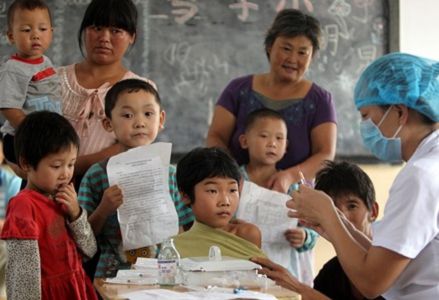
Infectious Diseases of Poverty (2017) 6:47. DOI 10.1186/s40249-017-0261-y. Image credit: Reuters
- Log in to post comments