










































Meena Communication Initiative (MCI)
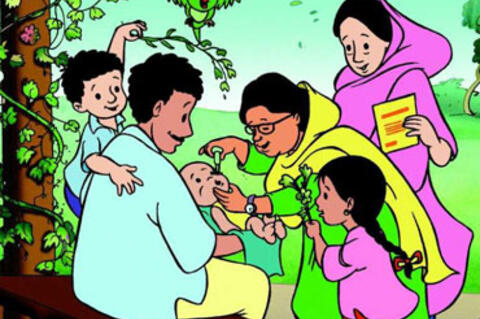
Conceived in 1990 and launched in 1998, this multimedia initiative is based on the story of a young spunky South Asian girl who braves the world (efforts to go to school, to fight the social stigma surrounding HIV/AIDS in her village, etc.). She is meant to be a role model. The United Nations Children's Fund (UNICEF) project includes a film animation series along with related supporting materials (posters, comic books, flipcharts, educational packages, facilitators' guidelines for organising group discussion, child-to-child activities, and a radio series produced in collaboration with BBC World Service). The purpose of MCI is to change perceptions and behaviour that hamper the survival, protection, and development of girls in South Asia.
The MCI is an entertainment-education endeavour that arose from a need to "find culturally appropriate ways to communicate messages that address the empowerment of girls in one of the world's most challenging gender environments. Showing a healthy, personable child who can engage constructively with her family and her community to help overcome serious issues has proved extremely popular." According to UNICEF, "Meena is widely recognised and appreciated in most South Asian countries, and is a successful advocacy and teaching tool for girls' and children's rights." UNICEF carried out 8 years of research in the region since the initial conceptualisation; for instance, script solutions came from South Asian people themselves, through in-depth formative research (e.g., consultation with children and adults - both in rural and urban environments), with the intention of making the films more acceptable, culturally relevant, and entertaining to the intended audiences. Drawing on such research, UNICEF selected the name Meena is one that spans the different cultures in the region. A cast of carefully researched characters was created for Meena's family and community.
The stories revolve around the adventures of Meena, her brother Raju, her pet parrot Mithu, and members of her family and village community. The stories cover issues such as education, health, gender equity, and freedom from exploitation and abuse. For example, a story called "Fair Play for Girls" was developed in conjunction with the Asian Cricket Council, and, recently, the Government of Japan helped UNICEF produce an episode that helps teachers and children deal with the shocks and trauma of natural or human-made disasters.
The core materials (comic books, animated films, posters, discussion and teachers' guides, and a radio series) are in 5 languages: English, Bangla, Hindi, Nepali, and Urdu. These have been translated or dubbed into many other South Asian languages as well as European languages. Designed to reach young people between the ages of 11 and 14 (an age where they are prone to drop out of school), each 15-minute Meena Radio programme includes a story, a song, and a game designed to entertain schoolchildren while encouraging them to think. Student discussions after the broadcast reinforce its messages on education, nutrition, hygiene, sanitation, health, child marriage, and child labour. Click here for a list of the full Meena comic books and films. ("The publications or parts of it may be reproduced for educational or non-profit purposes without permission from the copyright holder, providing acknowledgement of the source is made. Permission in writing is required to use the publications for any commercial purposes.")
Examples of how the materials have been used in practice:
- In Bangladesh, Meena stories have been incorporated into the formal and non-formal school curricula. UNICEF Bangladesh introduced the Meena Media Awards in 2005: an initiative aimed at promoting excellence in media regarding stories for and about children.
- In Pakistan, the MCI has been systematically integrated as a communication resource into the work of the education, health, and girl/child rights promotion sectors.
- In India, the Meena series has been integrated as a communication tool within ongoing nationwide education and communication programmes. For instance, state-owned radio and television channels have aired spots promoting girls' education featuring Meena. In Uttar Pradesh (UP), the State Education Department established more than 19,000 girls' groups called "Meena Manch" that were designed to ensure age-appropriate enrolment, regular attendance, and completion of primary education up to class five by all girls in the area.
- "In Nepal, Meena is used as a key resource in initiating community discussion and reflection on child health, development and gender issues, helped by the strong partnership that has been built with the media and other partners."
- In Bhutan, in collaboration with the Bhutan Post, UNICEF designed and printed 10,000 sheets of Meena postage stamps and 5,000 Meena posters with the message "Educate Every Girl and Boy".
- "In Sri Lanka, Child Rights Education programme and Mine Risk Education programmes use Meena as the role model for educating children, with a spillover effect to adult education."
In 2016, UNICEF Bangladesh launched the 'Meena Game' as a digital platform created for children to learn issues related to their own well-being through entertainment. The interactive game can be downloaded for free from Google Play or the Apple App Store. It is designed to help children address a specific problem or to learn a certain skill related to health, nutrition, education, gender equity, protection, and/or disaster response.
Children, Education, Gender, Rights
"The MCI has been linked to education, health and social development programmes undertaken by UNICEF partners in government, NGOs [non-governmental organisations], the media and the private sector. Meena has proven to be an effective messaging device when implemented alongside other programme interventions, and has enhanced perceptions of girls. Many children have wanted to either emulate Meena or have adopted her as a figurehead for their own efforts to change their worlds."
UNICEF, the Norwegian Government, South Asia Association for Regional Cooperation (SAARC), IKEA Social Initiative, the UP Government, All India Radio, and BBC World Service Trust.
- Log in to post comments