










































Meena Ki Duniya: The Production Process
Developed to capture the process of producing an entertainment-education (EE) radio programme for children in South Asia, this production book can be used as a guiding framework to replicate similar initiatives by other organisations and institutions seeking to help children "lead the way to positive sustainable social and behavioural change."
In the 1990s, the United Nations Children's Fund (UNICEF) launched the Meena Communication Initiative (MCI), aimed at changing perceptions and behaviours that hamper the survival, protection, and development of girls in South Asia. (Described here and in Related Summaries links below.) The MCI used stories in various media - print, audio, and video - to induce interpersonal communication (IPC) and dialogue on gender issues. At the centre of the initiative is Meena, a 9-year-old spirited girl with a brother named Raju and a pet parrot called Mithu. "In her world, the boy child is often sent to school and given a larger share of food. The girl child however stays at home, tends to cattle, does household chores, fetches water, brings fodder, helps in cooking, etc. Meena's creativity helps to come up with solutions while motivating other children and persuading the community to think about changing the situation of children. Gradually, she wins over the family opinion and induces dialogue, even in the village community."
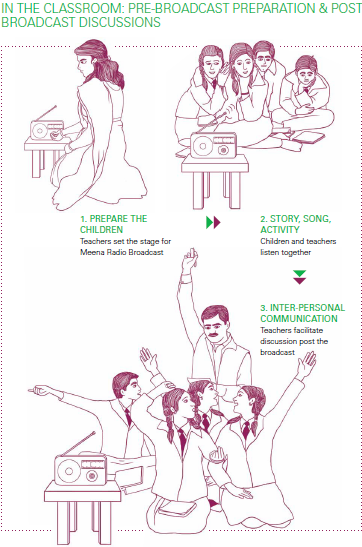
As part of MCI, in 2010, UNICEF developed the radio series Meena Ki Duniya (Meena's World) in Hindi. Comprised of 160 standalone episodes, the programme promoted child rights, life skills, gender and social inclusion, children's (and especially girls') education, and child-friendly schools, using an EE approach. The overview and opening chapter of the report explain how this radio series came to be in Uttar Pradesh, India, the first state where Meena Ki Duniya was aired. Broadcast on All India Radio during the school day, each episode consists of the story, the song, and the activity. Each of these components was designed to engage children and to communicate messages around health, child development, nutrition, protection, education, and hygiene and sanitation. Life-skills-based education was the overarching methodology, with stories demonstrating ways of problem solving, decision making, critical thinking, communication, negotiation, coping with emotions and stress, self-assessment, conflict resolution and management, and relationship skills such as empathy. Teachers were provided with guidance on leading post-programme discussions. Also, the State Education Department established more than 35,000 girls' groups called "Meena Manch" (Meena Platform) in upper primary schools. Members of these groups mobilise families to ensure age-appropriate enrolment, attendance, and completion of primary education, especially on the part of girls. In many schools, "Meena Cabinets" were also formed, with two children representing each class. After the broadcast of Meena Ki Duniya, these groups mobilised social action, fostered by the radio show.
Chapter 3 of this production book provides an overview of the process of creating Meena Ki Duniya, beginning from UNICEF's circulation of a request for proposals (RFP) to identify a partnering agency; Sesame Workshop India (SWI) was selected from the 7 applicants. As explained here, SWI leads Galli Galli Sim Sim (see Related Summaries, below), "an educational initiative that harnesses the power of multimedia to help children prepare better for school and life." The entire process of creating Meena Ki Duniya (Meena's World) is described, including the way various project teams interacted (in short, "UNICEF guided the entire process, while SWI managed the development - from script to submission of final episode - ensuring a continuum of participation and oversight through a complex, multi-step process.") To cite only one component: SWI carried out formative research in order to understand the intended audience's media (specifically, radio) usage, stages of behaviour change, and associated motivators and barriers related to the topics likely to be part of the programme.
In that same chapter, there are 6 separate sub-sections in which the process steps and associated challenges, adjustments, and lessons learned, with detailed examples of situations encountered during the production of Meena Ki Duniya are documented. (One entire sub-section, for example, focuses on the role of research). "Though many of the team members had worked on E-E projects in the past, the process of making Meena Ki Duniya deepened their understanding of producing media with social messages for young people." Some of their memorable experiences are shared in the book, along with synopses of certain episodes. One lesson learned: It is "imperative that effective, relevant and contextual messaging coupled with elements of entertainment become integrated within such [EE] initiatives.
According to the book, "Meena Radio has been proven to be an effective social and behavioral change communication initiative. Research from the implementation in Uttar Pradesh has shown that:
- 100% of children who listen to Meena Radio recalled at least one message spontaneously;
- 96% of students who listened to Meena Radio reported new information gained;
- On an average 7.6 messages were recalled with 127 different varieties of messages recalled, out of which messages on WASH [water, sanitation, and hygiene], nutrition, health, protection, gender, and life skills were prominent."
Furthermore, feedback from Meena's audience "has shown the impact of Meena's stories on the lives of many children, who have used Meena's example for themselves to become change agents in their families and communities."
As noted here, in Andhra Pradesh, Meena Ki Duniya was recreated into Telegu with the aim of reaching over 20,000 schools. Similarly, in Madhya Pradesh, 30,000 schools have begun incorporating Meena Ki Duniya as part of their curriculum, and there are plans for schools across Maharashtra to do the same.
Click here for the 56-page book in PDF format. "The publication or parts of it may be reproduced for educational or non-profit purposes without permission from the copyright holder, providing acknowledgement of the source is made. Permission in writing is required to use this publication for any commercial purposes."
Emails from Alka Malhotra to The Communication Initiative on November 3 2014 and December 1 2014.
- Log in to post comments