










































Nigeria Experience on the Use of Polio Assets for the 2017/18 Measles Vaccination Campaign Follow-up
National Primary Health Care Development Agency (Oteri, Adamu, Shuaib); Technical Assistance Consultant, Global Alliance for Vaccines and Immunisations (Dieng); World Health Organization (WHO), Country Office, Abuja, Nigeria (Bawa, Terna, Baptiste, Braka); Global Public Health Solutions (Nsubuga); University of Ibadan (Owoaje); United Nations Children's Fund (UNICEF) Country Office, Abuja, Nigeria (Kassogue)
"[W]ith integration and collaboration with other programmes, polio assets can be leveraged on and contribute to the achievement of expected programme targets for measles elimination and control."
Nigeria attained wild-polio-free status on August 25 2020. Based on the decades of experience that led to that certification, the polio eradication initiative (PEI) offers multiple resources, assets, and lessons learned that could be transitioned to other public health challenges, including improving the quality and vaccination coverage of measles campaigns. This paper documents the polio legacy and assets used to support Nigeria's national measles campaign in 2017/2018; the summary below focuses on the communication elements of the effort.
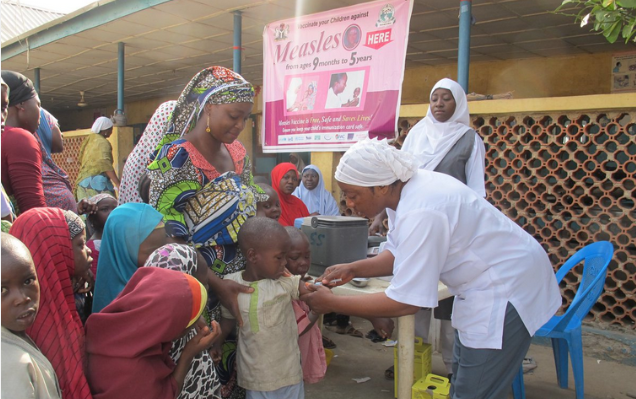
The Government of Nigeria and partners, with Gavi support, planned and implemented a follow-up national measles vaccination campaign (MVC) with supplementary immunisation activities (SIAs) designed to reach children aged 9-59 months in 2017/2018. To enhance the quality of the MVC and to try to meet the programme target of 95% vaccination coverage, the National Measles Technical Coordinating Committee (NMTCC) coordinated with the polio emergency operation centre (EOC) at national and state levels for planning and implementing the measles SIAs. The national polio EOC facility accommodated the NMTCC, providing a secure, dedicated workspace with consistent power, internet access, and communication capability. The NMTCC members adopted the polio EOC structure in dedicating 100% of their working time to the committee, meeting daily at the EOC premises, and instilling a sense of emergency in MVC operations. The polio EOC WGs also provided some mentoring and support to the measles teams.
Examples of specific communication-centred polio strategies and assets that were incorporated into the MVC include:
- In its work, the EOC undertakes activites such as mobilising specific states, local government areas (LGAs), partners, traditional and religious leaders, international partners, civil society, the media, and the general public as required to ensure high-quality polio eradication activities - that is, advocacy. Based on their areas of expertise, NMTCC members and partners were assigned to work within specific working groups (WGs), such as Advocacy, Communication, and Social Mobilisation (ACSM), similar to those of the polio EOC.
- Polio immunisation strategies such as those designed to reach hard-to-reach (HTR)/security-compromised areas, voluntary community mobiliser (VCM) networks (a focused initiative that recruits and trains local women from the community as social mobilisers and vaccination workers), and house-to-house (H2H) mobilisation were utilised for the MVC.
- The ACSM WG prepared an advocacy, social mobilisation, and communication strategy that leveraged strategies and tactics used by the PEI, especially those related to demand creation and for reaching vulnerable populations in security-threatened areas. Strategic advocacy of high government officials at national and sub-national levels, including the engagement of the Nigeria Governors' Forum with a signed agreement to support the MVC, reportedly led to the ownership of the programme and participation by government officials.
- The MVC built on lessons learned from the polio EOC's experience to develop its own methods to improve and enhance planning and implementation monitoring to address these challenges. Examples were the use of geographic information system (GIS) technology for vaccine team planning and distribution and an open data kit (ODK) for real-time data collection/independent monitoring and supervision.
The value added by the adoption of these strategies is reported in the paper (see Table 1 and Table 2, which present key challenges of previous campaigns, the polio EOC strategy or MVC innovation applied to overcome them, and the related outcome). In short, all 36 states and the Federal Capital Territory (FCT) used the polio EOC structure and resources in Nigeria for the MVC 2017/ 2018. The 11 polio high-risk states deployed the use of GIS for the microplanning process, while daily call-in data were tracked in 99.7% of the LGAs, and 70,846 reports were submitted real-time by supervisors using the ODK. The national coverage achieved was 87.5% by the post-campaign survey, with 65% of states reporting higher coverage in 2018 compared to 2015.
In conclusion, the strategies and resources used by Nigeria's polio EOC for polio eradication are similar to those needed to mount effective measles SIAs - i.e., communication and social mobilisation networks, campaign planning and monitoring, partnership and coordination, advocacy and resource mobilisation, and use of accountability frameworks. "This approach may have resulted in better MVC outcomes and contributed to Nigeria's efforts in measles control and elimination."
Vaccine https://doi.org/10.1016/j.vaccine.2021.04.040. Image credit: UNICEF Nigeria on Twitter
- Log in to post comments