










































Parental Perceptions, Attitudes and Acceptance of Childhood Immunization in Saudi Arabia: A Cross Sectional Study
University of Hail (Alshammari, Subaiea, Hussain, Moin); King Saud University (Alshammari); Saudi Food and Drug Authority (Alshammari); King Faisal University (Yusuff)
The requirement of an evidence of childhood vaccination as a prerequisite for school admission appears to be a strong contributing factor to immunisation rates in Saudi Arabia that are comparable to developed countries. However, this requirement may provoke parental vaccine aversion and non-compliance. In light of the fact that a high vaccination rate is an inadequate predictor for the absence of parental concerns or misperceptions, this study assesses the perceptions and attitudes regarding routine childhood immunisation among Saudi parents. The hope is that such an investigation may provide insights useful for developing interventions in other parts of the Islamic world, where rumours that vaccination programmes are covert attempts to cause harm, often spread by religious clergy, threaten vaccine uptake.
A cross-sectional interview of 467 randomly selected parents of children under the age of 5 was conducted between February 1 2016 and February 1 2017 in the Hail region of Saudi Arabia using a pre-tested 18-item questionnaire. Hail is a cosmopolitan city of 600,000 residents with diverse socio-economic backgrounds. The validated questionnaire consisted of 3 sections that collected information on participants' demographics, parents' awareness of vaccine benefits, and parents' practices regarding the immunisation of their children.
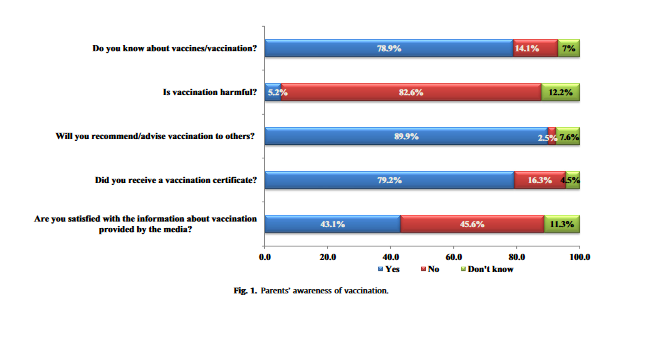
The study found that the majority of the respondents were aware of childhood vaccinations (78.9%), completed vaccinations mandated for children up to 5 years (86.2%), encouraged other parents to do so (89.9%), and had easy access to vaccines (90.5%). Sixty to ninety percent of the respondents were knowledgeable regarding the health benefits of vaccinations in children. All the participants (100%) expressed that childhood immunisation is not prohibited in Islam.
Healthcare professionals were the most frequent source of parents' vaccine-related information (65.2%), followed by friends and relatives (61.8%), a Ministry of Health (MoH) mobile vaccination reminder (57.5%), and mass media (53.2%). Approximately half of the participants (45.6%) were not satisfied with the vaccination-related information gleaned from the mass media. To describe one of these sources further: The mobile messaging service provided by the MoH is dedicated to vaccine education, counseling, and reminders about routine vaccinations. The researchers suggest that this service may also serve as a platform allowing professionals to remain in regular contact with parents, filter any vaccine-related information gleaned from the lay media and friends/relatives, and alert parents about any probable misinformation/misconceptions.
According to the researchers, the high parental acceptance of childhood vaccinations appeared to result from different factors, including the observation that 9 of every 10 parents sampled were knowledgeable regarding the protective role of vaccinations against potentially fatal childhood diseases. Furthermore, the majority of the parents did not encounter any challenges accessing childhood immunisation services, and the trends observed in the demographic profile of the parents sampled may have contributed to this. (The majority of the respondents had received a formal education (94.1%), were gainfully employed (62.9%) and had a regular monthly income (73.3%).) For instance, a high educational level appears to be strongly linked to better health literacy and understanding of vaccine-related information and to education and counseling provided at the interpersonal and institutional levels by healthcare professionals and at the societal level during public health education campaigns. This knowledge may enhance informed parental decision-making, acceptance, and compliance with vaccinations against childhood infectious diseases.
In conclusion, some participants might not be convinced about the safety of vaccination, as 5.2% believed that vaccination could be harmful. However, overall, confidence in and acceptance of childhood vaccinations, perceptions of vaccine-related health benefits, and ease of access to immunisations appeared to be quite good among Saudi parents. Suggestions include:
- Approximately 2 in every 10 parents sampled reported that their children experienced minor adverse events following vaccination, of which 23.2% required doctors' visits. This finding is unsurprising, but parents need to be well informed about the possibility of such events and appropriate measures to mitigate discomfort. This information could be incorporated into the vaccination messages from the MoH mobile reminder service or through specific vaccine-related public awareness programmes presented by the mass media. Furthermore, an institutionalised system for monitoring, detection, and analysis of such events may serve a bulwark against vaccine misinformation.
- The parental acceptance of vaccinations in Saudi Arabia, despite its entirely Muslim population and its preeminent role in Islam, may prove useful in public enlightenment to close probable vaccine confidence gaps caused by misinformation in other countries with large Muslim populations.
Vaccine Volume 36, Issue 1, Pages 23-28. https://doi.org/10.1016/j.vaccine.2017.11.050
- Log in to post comments