










































The Power of Straight Talk: The Independent Monitoring Board of the Global Polio Eradication Initiative
Center for Strategic and International Studies (CSIS)
"Over its five-year tenure, the eight-member panel of experts in the fields of epidemiology, global health governance, program management, communications, and health systems has become a transformative voice in the [polio] eradication effort. With refreshing candor, clarity, and readability, IMB reports have taken to task management at every level of the GPEI."
This report analyses the work of the Independent Monitoring Board (IMB) of the Global Polio Eradication Initiative (GPEI). It emerges from a research project carried out by the CSIS Global Health Policy Center (GHPC) in summer 2015 whose purpose was to examine the IMB's history, processes, and future. GHPC interviewed 23 individuals, including: IMB members and staff, officials from GPEI donor organisations, GPEI core partner officials, current and former country officials, academics, and global health experts.
The authors, Bristol and Millard, begin by briefly summarising the polio eradication effort to date - including setbacks such as new outbreaks that occurred in Nigeria in 2003, when public figures in northern Nigeria suggested the polio vaccine was unsafe, scaring parents away from the GPEI and leading to the wild polio virus (WPV)'s spread to 20 other countries. The report then explores the rationale behind the GPEI's decision - at the urging of polio programme supporters, who were "[d]issatisfied at the lack of progress and seeking greater transparency in GPEI operations" - to set up the IMB, whose first meeting was held in December 2010. Bristol and Millard describe how these meetings are carried out and how the discussion tends to flow in the combination of open and private sessions. For example, countries with ongoing polio outbreaks give presentations on their situation.
Three weeks after each meeting, a report is produced, sent to the heads of core partner agencies, and then made public. (Editor's note: These reports are summarised on The CI website. Simply type the following phrase in the "search" box, exactly like this: report of the "independent monitoring board".) The tenor and content of these reports are summarised, with descriptions such as this: "In contrast to many monitoring documents in public health, the IMB uses strong, direct, jargon-free language that clearly assigns responsibility for program deficiencies and their resolution. Reports include cleverly designed graphics that simply and succinctly convey the major elements of each issue.... They command the attention of GPEI management and country officials and have increased the urgency with which program managers approach their work." These IMB assessments also "help fuel international political pressure on countries that are lagging."
Various adjustments were made throughout the years in order to create a balance between ensuring the IMB's independence and yet also engaging with GPEI officials in order to understand the pressures implementers are facing. Also, while the IMB initially planned to proactively engage with the media, they decided that, because the reports tend to focus on where the eradication programme is weakest (e.g., by directly challenging national polio programmes in frank language and by commenting pointedly on GPEI management structures and leadership), the media might get a skewed sense of progress (or lack thereof). That said, the reports, as stated above, are public and are often cited by the media at a national and international level.
Bristol and Millard reflect on the IMB's impact, noting that the IMB's "independent stature and willingness to comment boldly and publicly on GPEI shortcomings...[has been] able to raise the visibility of important program dysfunctions and foster improvements in program management." They give several examples of issues the IMB has highlighted, such as:
- The need for the World Health Assembly (WHA) to declare polio eradication a public health emergency in order to raise awareness of the effort and to encourage countries to take eradication more seriously. Citing recommendations from the IMB and the Strategic Advisory Group of Experts on Immunization, the WHA indeed passed a resolution in May 2012. According to the Centers for Disease Control and Prevention (CDC), which is one of the GPEI core partners, the move to emergency status is credited with leading to "substantial progress toward global polio eradication." Amongst other outcomes: Nigeria and Pakistan established polio national and regional Emergency Operations Centers to improve coordination and information dissemination.
- The importance of ensuring that the GPEI's motto of "Every Last Child" is actually leading to addressing the issue of what the IMB termed in its June 2012 report "Every Missed Child". The IMB sought to keep the issue of the fact that, as of that report, 2.7 million children in persistently infected regions had not received a single dose of oral polio vaccine (OPV).
- The value of engaging the World Health Organization (WHO)'s International Health Regulations Expert Review Committee to call for polio vaccination checks in Afghanistan, Nigeria, and Pakistan. WHO Director-General Chan issued a recommendation in May 2014.
- The importance of honouring front-line staff by engaging them, training them, and motivating them.
- The need for the GPEI to engage parents, create demand for polio immunisation, and step up its social mobilisation and communication strategies and activities.
- The absence of a multiyear polio "endgame and legacy strategy" that would provide donors with a sense of next steps and also lay out plans for transitioning polio assets and networks to other development projects, post eradication. In response, the GPEI developed the Polio Eradication & Endgame Strategic Plan 2013-2018.
- The need for increased financial transparency coupled with better donor engagement.
- The weakness in anticipating and responding to outbreaks. The IMB urges greater attention to a "Red List" of countries vulnerable to polio outbreaks, such as Syria, Ukraine, Yemen, and South Sudan.
- The need to resolve a long-standing debate within the GPEI centred around how and when to introduce the inactivated poliovirus vaccine (IPV).
Bristol and Millard move on to assess IMB strengths, which they say include:
- Leadership: "Sir Liam Donaldson...is credited with organizing effective meetings that allow program implementers to present their materials, while simultaneously encouraging pointed questioning from board members so they can gain a clearer picture of program realities. He is described as a good listener who ensures that all board members' viewpoints are considered. He has the stature in the global health community to command the respect and credibility necessary for the IMB to have maximum impact."
- Effective reports
- Membership independence and credibility
- Longevity (the majority of IMB members have been on the panel since its inception).
There are, according to Bristol and Millard, some areas for improvement. For instance, it could be useful to add members to the board who can help the IMB better understand the cultural, security, and political environments under which country programmes are operating. Another recommendation: "A more definitive response-assessment mechanism would better show whether and how program implementers are reacting to IMB critiques....For the IMB to be most effective in monitoring progress toward purposeful polio resource transitions, the GPEI would need to develop clear milestones against which progress could be measured."
"This report concludes that an IMB-style monitoring mechanism would be beneficial to other global development endeavors if the board had (1) strong leadership, (2) defined milestones against which to judge progress, (3) the willingness to speak boldly about program shortcomings, and (4) was charged with monitoring a program that was open to constructive criticism....As global partnerships increasingly become the norm for large- scale health initiatives, monitoring mechanisms modeled after the IMB could, under the right circumstances, improve the effectiveness and efficiency of global health management."
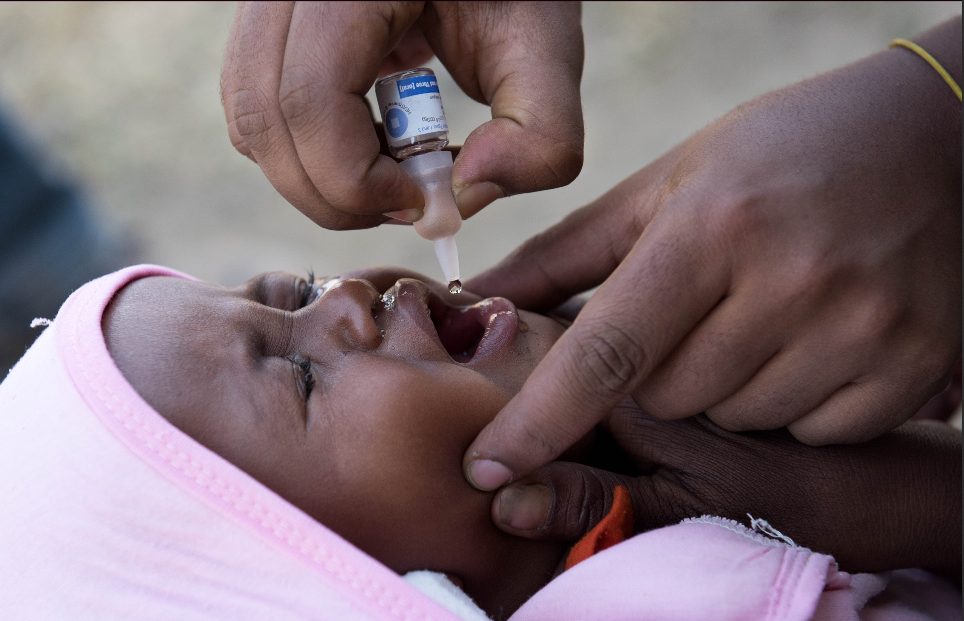
Email from Nellie Bristol to The Communication Initiative on November 3 2015. Image credit/caption: ©UNICEF Ethiopia/2014/Tsegaye. "Rotary International advocacy visit to Ethiopia to support the polio eradication efforts and participate in the National Polio Immunization campaign."
- Log in to post comments