










































Promoting Change in the Reproductive Behavior of Youth: Pathfinder International's PRACHAR Project, Bihar, India
Pathfinder International
This 28-page resource offers a case study of Promoting Change in Reproductive Behavior in Bihar (PRACHAR), a Pathfinder International programme implemented in India that promoted major attitude and behaviour changes in youth - as well as their parents and influential community members - related to delaying a first child and spacing subsequent children. Specifically, through an intensive, broad-based community approach, PRACHAR sought to motivate villagers to reexamine customs of early marriage, to delay childbirth until a woman is 21 years old, and to space subsequent children for the health of both mother and child. As indicated in this report, the programme was successful: PRACHAR was able to reach and influence more than 90,000 adolescents and 100,000 influential adults in 452 villages; "the acceptance of the messages and subsequent change in behaviors (particularly the increased use of family planning) was substantial."
PRACHAR sought to arm young couples with information and skills related to the "true concept" of "planning a family" - molding their own lives by working together to build a strong spousal bond and partnership at the beginning, planning their families, and building a financial base before taking on the responsibilities of childbearing. Organisers reasoned that, to achieve substantial cultural and behavioural change along these lines, a wide spectrum of the community - especially parents of young couples and influential community members - had to be actively engaged in the conversation. They had to be reached with messages and information in culturally sensitive forms, and in language appropriate to local levels of education delivered by trusted and respected members of the local community. Project behaviour change communication (BCC) messages would have to be developed, tested, and repeatedly refined to produce a set of trainings and cultural presentations that address the real concerns and needs of the community in a manner that could be accepted and integrated into the lives of local villagers. To that end, a large ceremonial community meeting launched the project in each village to provide information about the project and its goals, and to seek community acceptance and involvement. District and village government officials, teachers, landlords, medical providers, and others with community stature - including religious leaders - were invited.
Pathfinder provided 30 local non-governmental organisations (NGOs) in Bihar with training, supervision, and resources to attain new levels of capacity and sustainability, particularly in maintaining and developing programmes in reproductive health (RH)/family planning (FP). Face-to-face training was also used as a tool for enhancing the quality of basic maternal and child care and RH/FP services delivered by community-based traditional birth attendants (dais) and informal rural medical practitioners (RMPs). Due to their valued role in the community and access to women and others in need of health care, Pathfinder sees them as potentially effective conduits of information and as powerful voices for the elimination of popular myths and misconceptions about RH/FP and other medical issues. To elaborate on training of the dais, groups of 15-20 women (selected by implementing partners) attended 5-day residential programmes led by teams of two female government auxiliary nurse midwives (ANMs), who had been trained as trainers by Pathfinder. Local languages and dialects were emphasised; special emphasis was placed on developing and enhancing personal, emotional, and physical support. Trained dais were expected to share much of their new knowledge with other dais.
The strategy of mobilising broad local participation was also evident in the community resource mapping component of PRACHAR. Following intensive training, members of the community called "change agents" surveyed the 25-30 villages of their districts covering a population of approximately 35,000 people. Through door-to-door canvassing, they introduced themselves and the project to the community and gathered the names, ages, and other specifics about adolescents, about-to-be-married young people, newlyweds, and young couples with one child. Among the lessons learned through this experience was that "many villagers believed that project change agents were conducting yet another government survey related to the distribution of welfare benefits such as ration cards. In anticipation of material benefit, villagers inflated numbers of household members by as much as 10-15 percent...Change agents learned the need to clarify their identity, make their role and purpose clear, and clearly separate themselves from government projects."
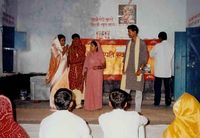
Edutainment activities were also integrated into the PRACHAR approach. Pathfinder-trained Cultural Teams visited villages once every 6 weeks. These teams (formed through a rigorous application and training process) were charged with writing their own scripts for songs and plays. Trainers offered feedback, but left the teams to develop material appropriate to their cultural contexts. Following this process, the teams presented plays, songs, and puppet shows dramatising the hazards of early childbearing and promoting the advantages of FP and child spacing.
The final portions of the report focus on evaluation methodology and outcome. As explained here, 14 key indicators were selected to measure changes in knowledge, attitudes, and behaviour of specific demographic groups. Five methods of measurement were used, including
- Baseline and endline surveys
- Project records and service statistics
- Longitudinal analysis of project records and service statistics
- Pre- and post-training tests
- A survey to measure the effectiveness of BCC messages
The table of indicators shows that PRACHAR has improved the knowledge and attitudes of community members in the intervention areas about RH/FP issues. The contraceptive use rate among young married women increased nearly four-fold, from 9.7% to 38.1%. There was an increase in contraceptive prevalence in young married couples for delaying first birth, and for spacing the second; for instance, the percentage of newlyweds who use contraceptives to delay their first child more than tripled, from 5.3% to 19.9%. The proportion of couples adopting contraception early, either within 3 months of consummation of marriage or within 90 days of the birth of the first child, increased significantly. The median interval between consummation of marriage and first birth has also increased (from 21.3 months to 24 months). Age-specific fertility rates declined by 14.3% in the age group 15 to 19 years, and by 12.8% in the age group 20-24 years. Neither caste nor education had any significant effect on these changes.
In short, the evaluators conclude that PRACHAR's community-based, participatory methodology succeeded in improving both RH and demographic indicators by focusing on adolescents and youth and serving their felt needs. PRACHAR demonstrates that even in resource-poor rural settings that are shaped by traditional Hindu and Muslim beliefs and a deeply conservative social system, scale can be attained with carefully constructed implementation structures, the development of human capacity, and close programme monitoring.
Email from Pathfinder International to The Communication Initiative on February 15 2006.
- Log in to post comments