










































Report on the Meeting of the Technical Advisory Group for the Eradication of Poliomyelitis in Pakistan [March 2017]
"TAG recognizes and commends the full integration of communication activities within the overall operational framework of the programme and the role it has played improving capacity to identify and immunize children in the highest risk areas..."
This report summarises the discussions of the Technical Advisory Group (TAG) on Poliomyelitis Eradication in Pakistan, March 30-31 2017 in Islamabad. This TAG consultation occurred 2 months before the 2016–17 low transmission season draws to an end, providing the opportunity, at a highly critical time, to obtain an expert view and advice for the current situation. The report provides an analysis - in general, finding that Pakistan polio eradication remains on track - and offers recommendations.
Since the last TAG meeting in June 2016, steady progress has been made towards interruption of poliovirus in the country. Nine wild polio virus type 1 (WPV1) cases were reported for the remainder of 2016, and 2 between January and March 2017 (compared to 8 in this 3-month time period in 2016, a 75% decline). TAG notes that, programmatically and operationally, considerable progress was made in the last 9 months, particularly in key areas of acute flaccid paralysis (AFP) and environmental surveillance, expansion of community-based vaccination (CBV) in core reservoirs, detailed follow-up of missed children, and refinement of strategies for vaccinating high-risk mobile populations (HRMP). Since the last TAG meeting, all supplementary immunisation activities (SIAs) were implemented as per the National Emergency Action Plan (NEAP). The primary challenge to stopping WPV1 transmission now is circulation across the common southern reservoir stretching from Quetta to the banks of the Helmand river in southern Afghanistan. This extended zone has become the primary hub of WPV1 transmission and poses a threat to both countries.
TAG observes that government commitment and oversight has remained strong at all levels, from the National Task Force (NTF) and the Prime Minister's Focus Group (PMFG) over the network of emergency operations centres (EOCs) to the Deputy Commissioners that now lead all polio-related activities in their respective districts. For example, in Balochistan, TAG notes the continuous strong personal commitment of the Chief Secretary and his staff in leading the Polio Eradication Initiative (PEI). In fact, the TAG report examines progress and challenges in particular provinces, such as the pockets of persistent refusals in Khyber Pakhtunkhwa (KP).
TAG highly appreciates the continuing close coordination between Afghanistan and Pakistan programs. The general recommendations from the June 2016 meeting are still valid and include coordination at all levels, information sharing, joint risk assessment and response, and SIAs synchronisation. As eradication moves into the final stage, seamless coordination across the common epidemiological block becomes ever more critical to success in both Pakistan and Afghanistan.
While there are a number of challenges ahead for the programme, the principal ones described by the TAG are: 1) stopping transmission in the core reservoirs; 2) continuing pressure to maximise quality of SIA coverage in critical CBV and mobile team areas; and 3) identifying and covering HRMP to prevent further spread. Specific suggestions are offered, such as: Address the issue of refusals in South KP through coordinated efforts of social mobilisation and community engagement, coupled with good planning and execution in operations. Despite considerable efforts, the number of females in the programme - both in mobile teams and in CBV - remains rather low (19%). "TAG believes that getting the composition of the vaccination teams right - i.e. at least one local female in the team - will solve many operational issues such as otaque vaccination, identifying and vaccinating all children in each household, increased same day coverage and conversion of refusals."
TAG "looks forward to seeing how communication strategies will be developed to maintain public support for the campaign and routine vaccination in the post-interruption phase."
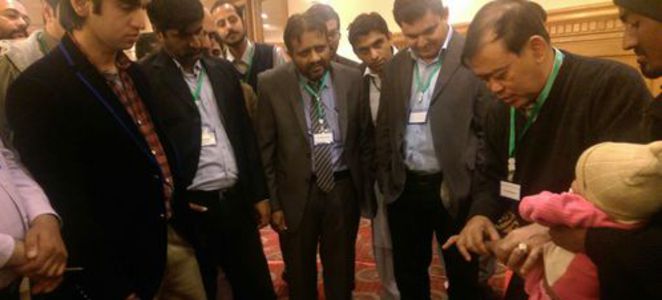
Email from Fatma Moussa to The Communication Initiative on May 25 2017. Image caption/credit: "Dr Raul Bonifaco, Punjab team leader, demonstrating how to examine a child with acute flaccid paralysis." © World Health Organization (WHO)
- Log in to post comments