










































What's in a Name? Unpacking 'Community Blank' Terminology in Reproductive, Maternal, Newborn and Child Health: A Scoping Review
University College Dublin (Dada, De Brún, Gilmore); London School of Hygiene & Tropical Medicine (Cocoman); World Health Organization (Portela, Tunçalp); Public Health Foundation of India (Bhattacharyya); London School of Hygiene and Tropical Medicine Faculty of Epidemiology and Population Health (Jackson)
"It is essential that RMCNH researchers and practitioners that engage in documenting and publishing on 'community blank' endeavours more adequately describe and share the content of the 'community blank,' its purposes, activities, actors and stakeholders involved."
Community-based interventions with components to engage or mobilise communities as actors to address reproductive, maternal, newborn, and child health (RMNCH) have been implemented in various contexts around the world. While evidence suggests these approaches are effective, terminology used to describe them (e.g., "community engagement [participation/mobilisation/collaboration]" or "social accountability") is often used interchangeably across published literature, contributing to a lack of conceptual clarity. The purpose of this review is to describe and clarify varying uses of these terms by documenting what authors and implementers report they are doing when they use these terms (referred to here as "community blank").
Seven academic databases (PubMed/MEDLINE, Embase, CINAHL, PsycINFO, Scopus, Web of Science, Global Health), two grey literature databases (OAIster, OpenGrey), and relevant organisation websites were searched for documents that described "community blank" terms in RMNCH interventions. Eligible items were published during the period just prior to the 1978 Alma-Ata Declaration, which promotes community participation as integral to health systems strengthening efforts, and subsequent decades - that is, between 1975 and October 1 2021. A total of 9,779 unique documents were retrieved and screened, with 161 peer-reviewed articles and 12 grey literature/reports selected for analysis.
The 173 included documents ranged in document type, study design (if applicable), and scope of implementation. (Table 2 in the paper provides key summary characteristics of the included documents.) The most common study designs were individually randomised and cluster-randomised control trials (n=36), qualitative studies (n=31), mixed-methods studies (n=21), descriptive case studies (n=20), and cross-sectional studies (n=12). The earliest published document was from 1979, and over half (n=102) were published between 2017 and 2021.
The researchers found that 24 distinct "community blank" terms were used across the documents, falling into 11 broader terms. Use of these terms was distributed across time and all six World Health Organization (WHO) regions, with "community mobilisation", "community engagement", and "community participation" being the most frequently used terms. The timeline of when "community blank" terminology is used illustrates the presence of "community participation" since 1975, with newer terms such as "community engagement" and "social accountability" joining the scene in 2006 and 2011, respectively. Although "community mobilisation" has been consistently present since the 1990s, use of this term has decreased in the past 5 years.
Overall, there is a relatively small body of literature that describes what is being done when these "community blank" terms are used. This is demonstrated by the fact that 123 articles were excluded at full-text phase because they provided no explanation of what was done, even though they included the terms of interest. However, the researchers did identify 48 unique activities described in the 173 studies. For certain terms, specific activities were reported more often. For example, reports of "community mobilisation" most often referred to recurring group meetings and discussions (n=39; 27 of which are specifically labelled as "women's groups" in 10 unique projects), awareness/communication campaigns (n=22), community meetings (n=16), and village or community health committees (n=9). Only 25 activities were mentioned more than twice, and 19 of these were attributed to at least three different "community blank" terms. This finding demonstrates little to no trend evident in activities used for specific "community blank" terms. The only exception is "social accountability", largely characterised by community score cards.
Most papers attributed some purpose for the conduct of "community blank". The purposes are classified into seven categories, including improving health outcomes, such as maternal and neonatal mortality and morbidity or preventing disease (n=73), increasing care-seeking (n=62), building knowledge (n=37), affecting health behaviours (n=23), improving the quality of care (n=16), and improving service delivery (n=11). Fifty publications described at least two purposes.
A range of stakeholders (the actors involved in "community blank" activities, as well as the intended beneficiaries) were examined across publications. Multiple beneficiaries are noted in 97 publications.
Thus, across the literature, there is inconsistency in the usage of "community blank" terms for RMNCH. The researchers recommend the following:
- Clarify and determine consistent operational definitions for "community blank" terms.
- Develop and align to standardised monitoring and evaluation indicators.
- Promote standardised reporting on the implementation of "community blank" procedures and processes in the peer-reviewed and grey literature bases, including reporting the intended audience, purpose, activities and the role of the community in "community blank".
In addition, the researchers point to the need for geographical diversity in research on "community blank" interventions for RMCNH. Namely, the literature base is limited by the dominance of 12 countries (Bangladesh, Ethiopia, India, Ghana, Kenya, Malawi, Nepal, Nigeria, Pakistan, Uganda, the United States, and Zambia) that returned 5 or more publications. "This gap in the evidence base contributes to the lack of clarity around 'community blank' terms, in particular the reporting on implementation. This has implications for the evaluation and translation of knowledge relating to 'community blank' across and within contexts."
In conclusion: "By clarifying our understanding of what we mean when we say we are doing 'community blank' and improving the documentation of 'community blank' practices, we can better share learning within and across communities to inform systematic changes and bring evidence-based practices to scale."
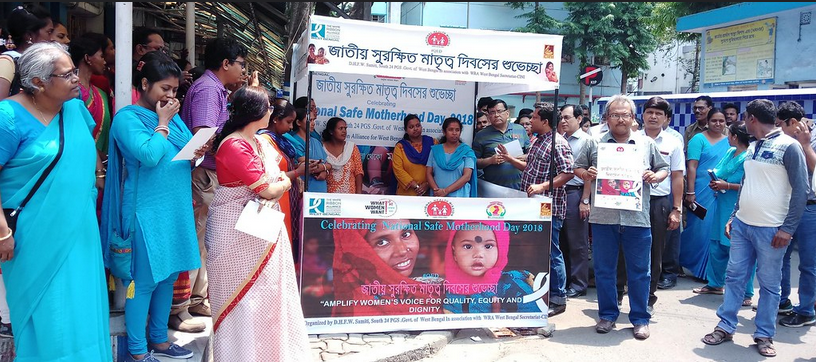
BMJ Global Health 2023;8:e009423. doi:10.1136/bmjgh-2022-009423 - sourced from email from Sara Dada to The Communication Initiative on February 15 2023. Image credit: The White Ribbon Alliance via Flickr (CC BY-NC-ND 2.0)
- Log in to post comments