










































I-TECH Ethiopia Billboard Project
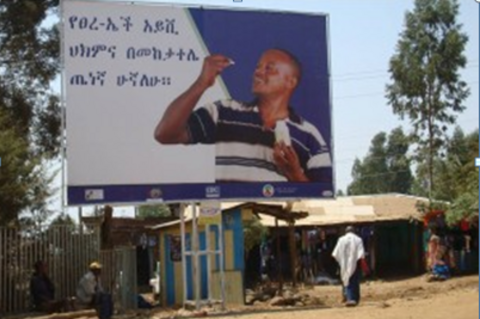
Developed by the the United States (US)-based International Training and Education Center for Health (I-TECH), a collaboration between the University of Washington and the University of California, San Francisco, this late 2010 initiative involved posting billboards in Ethiopia to remind the local community to use condoms. The I-TECH Ethiopia project, funded through US Centers for Disease Control and Prevention (CDC) includes creating or replacing such signs in an effort to promote positive health messages (often called "behaviour change communication", or BCC) in the Afar, Amhara, and Tigray regions of the country.
Late in 2010, I-TECH Ethiopia, through the CDC, was made responsible for establishing three respective regional task forces in the 3 regional health bureaus. The goal of the initiative was to identify HIV and AIDS prevention-, care-, and treatment-related IEC (information, education, and communication)/BCC challenges, and to identify ways to overcome these challenges and "get the word out". The task forces had to develop ways to communicate messages in the right places and in a way that would resonate with the people of each region.
To determine which messages would do the most good (promoting adherence to antiretroviral treatment? messages for new mothers and pregnant women about prevention of mother-to-child transmission of HIV? condom use?) and to select the best media, consultants working on behalf of I-TECH mapped the location of existing billboards. They also conducted a series of discussions with key informants selected from the regional health bureaus, regional HIV/AIDS prevention control offices, hospitals, and woreda/city administration health offices and health centres. Together, this group identified current local priorities and needs. After these discussions, the consultants went out to take a look at existing billboards and messages, and found that many of them were damaged, missing, or hard to read.
With this information in mind, I-TECH produced and mounted several new billboards. This time, they updated the messages and put them in bustling areas, such as hospitals and bus stations, where they had the potential to be seen by more people. I-TECH also produced other IEC/BCC materials regionally, including posters and an educational film.
HIV/AIDS.
Commenting on the message development process, Tariku Negatu, an I-TECH consultant, explained that the messages on the billboards and in other media were "selected and pre-tested [to be] socially, culturally and politically appropriate to the local specific contexts..."
I-TECH, CDC.
Comments

Time
you are great! you will be my idol!
- Log in to post comments