










































Women and Peace Building in Afghanistan: Building Local and National-Level Peace with the Meaningful Participation of Women
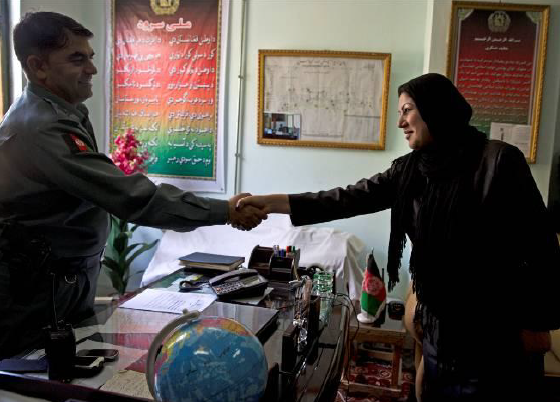
"Conflict has destroyed countless lives in Afghanistan. Searching for an elusive peace is a focus for many; but women have often been left with no voice, with the result that a fair and equitable end to conflict remains out of reach."
Starting in 2011, Oxfam's Within and Without the State (WWS) project has explored an approach to governance work in Afghanistan that works with women to support their meaningful participation in local and national-level peace building, with a firm rooting in local power dynamics and cultural norms. This report describes the thinking behind, and activities of, WWS as implemented in Afghanistan, sharing some outcomes and lessons learned.
Funded by the United Kingdom (UK) Department for International Development (DFID)'s Conflict, Humanitarian and Security programme, WWS is a 5-year global initiative (2011-2016) that has involved working with civil society to promote more accountable governance in conflict-affected and fragile contexts. With an emphasis on capacity building, Phase I of WWS in Afghanistan supported community-level women peace promoters (WPP) to participate in local conflict resolution mechanisms and provided strategic and financial support to the Afghan Civil Society Organisation Network for Peace (ACSONP) at the national level. During the first phase of WWS, there was an emphasis on working through the ulema (religious leaders) in order to engage in community-level peace building. WWS established contact between ulema and women peace activists, opening an enabling environment for women to interact with ulema who have legitimacy to shape public opinions and change the attitudes and perceptions of community elders to accept women's social participation. The violation of women's rights, community conflicts, and retributive justice were all highlighted as issues the programme needed to focus on. Before the second phase of community-level work began, the Empowerment Centre for Women (ECW), a grassroots organisation in Afghanistan, conducted a Gender and Conflict Sensitive Power Analysis to measure women's participation and role in the power and conflict dynamics of Kunduz province, which was to be the focus of the second phase of WWS. This showed that existing tribal, cultural, and ethnic enmities are compounded by discrimination against women. On reflection of the phase of WWS, it was decided by the project team that a more gender-sensitive lens had to be employed when viewing local conflicts. As a result, ECW planned to focus on training and coordination meetings with CPPs to support them in engaging with local power holders. Begun in 2014, WWS phase II at the local level broadened the concept of WPP at the local level to community peace promoters (CPPs) to better encapsulate the reality of needing to work with a cross-section of community members and engage in much more thorough power analysis as part of programme activities.
Specifically, ECW established 9 groups of CPPs comprised of women, elders, youth, ulema, teachers, and local officials. Each group of about 20 (roughly half of them women) is divided into 4 focus groups themed on health, education, security, and the resolution of conflicts. They work in different areas of Kunduz city with the aim of supporting the participation of women in local peace-building efforts. After establishing the CPP circles, ECW provided trainings on conflict analysis, conflict mediation, communication, networking, leadership, advocacy, ending violence against women, law and the United Nations (UN) Security Council 1325 Resolution, peace building skills, and women's rights from the perspective of Islam. They also covered marriage rights, inheritance rights, Mahr rights (payments by the groom's family to the bride), husbands' and wives' joint rights, and education rights. Interviews with CPPs demonstrated that, as a result of the project, women can play a greater role than men in mediating family disputes, especially disputes between women.
Having identified the key stakeholders, ECW organised monthly coordination meetings at the provincial level between CPPs, local police, local power holders, Provincial Peace Council members, and the relevant governmental authorities. These occurred in addition to quarterly peace hearings and the provincial peace campaign conducted by ECW. One example of a successful outcome was when ECW complained that a male police officer was representing the police at meetings of the Elimination of Violence Against Women (EVAW) Commission at the Women's Affairs Department. The protest was successful, and an agreement was reached where it was understood the police at such sensitive meetings should be represented by a women police officer. A local-level post-conflict peace hearing was held on November 24 2015 following the Taliban's September 2015 capture and holding of large areas of the city of Kunduz. This peace hearing paved the way for CPPs to access the authorities after the collapse of Kunduz and helped governmental authorities understand that there is a strong desire from civil society for better follow-up regarding government work for the improvement of security, social, and economic issues.
On December 24 2015, ECW conducted an open debate called "National Level Interaction" in a studio of the Saba TV network. Seventy people attended, including CPPs, representatives of political parties, university students, religious leaders, civil society activists, relevant ministries, and journalists. The panel, which included state and security personnel, publicly committed to work on more inclusive security planning for Kunduz province. The programme was broadcast nationally by Saba Radio and Saba TV, as well as by Roshani TV broadcasting only in Kunduz province.
In addition to working in Kunduz and using this as a pilot province to test the effectiveness of working with mixed groups of peace promoters and working with religious leaders to promote women's involvement, WWS has been working with ACSONP, a network of around 140 civil society organisations (CSOs). Its aim is for members to be able to effectively engage with formal and informal institutions and positively influence and support peace building efforts and CPPs. At the national level, WWS was reshaped in Phase II in the light of the new National Unity Government (NUG). In an effort to support analysis of the new stakeholders engaged in the national-level peace process and to explore entry points for civil society influence, Oxfam worked alongside ACSONP to organise a policy and power mapping workshop in August 2015 that brought together a diverse range of actors to discuss the challenges Afghanistan faces in building peace. These actors included the High Peace Council (HPC), representatives of the NUG, independent civil society and human rights activists, women's rights organisations (WROs) and CSOs, and several anti-government elements (which was seen as a major breakthrough, as these groups have not traditionally been involved in such face-to-face discussions, previously reverting to confrontational means to voice their opposition).
Following the policy and power mapping, ACSNOP held meetings between high-level presidency representatives, high peace council members, media, CSOs, women-led organisations, and social activists. The purpose was to highlight and discuss women's and youth problems (at the grassroots and local levels) in the peace process, to advocate for solutions at the national level, to advocate for the role of women and civil society participation in the peace process, and to identify influential people in peace building at both local and national levels. As a result, a volunteer Advocacy Group was set up, and positive suggestions and recommendations for changes in the peace strategy and policy of the HPC and government were put forward. At the end of the project, ACSONP signed an memorandum of understanding (MoU) between the HPC and the Administrative Affairs of the Presidency of the Islamic Republic of Afghanistan aimed at establishing a long-term collaboration. As a result of this, the Director of Political, Social and Cultural Affairs agreed to share the concerns of participants (the lack of women and CSOs' membership in the negotiation team of the HPC) with the President.
Lessons learned from this process are detailed, including:
- Adapt the programme to make the most of key moments in time - e.g., ECW made use of the fall of Kunduz to the Taliban to advocate more widely for the government to be held to account and to make commitments for a more inclusive planning for peace and stability in the future.
- Work with men to support women's involvement - e.g., the programme switched from just training women to training men and women so that men were supportive of women’s involvement; women were empowered to speak out in mixed groups as a result of the work ECW was able to do.
- Use detailed power analysis to shape activities - e.g., at the local level, a gender- and conflict-sensitive power analysis which formed the baseline for the project was essential to identify the blockers of women's involvement in dispute resolution and identify the key stakeholders to engage throughout the project.
- Work with unusual suspects in order to influence change - e.g., while initially the ulema were suspicious of women being empowered, they came to see they were enhancing their own role as change agents in their communities if they supported women, such as by conducting advocacy with community leaders regarding the role of women in local-level peace mediation.
- Work with the media to leverage wider influence - e.g., linking up with local and national broadcasters raised awareness of women's involvement in the search for peace and worked as leverage to engage powerful local and national actors in supporting women's role in the peace process.
- Develop more stringent systems for remote management - e.g., WWS chose to run an iterative real-time evaluation by external consultants to evaluate programme activities on the ground and support management to bring remedial actions but, at the time the project started, it was not anticipated that Oxfam would not be able to visit Kunduz throughout the duration of the project.
- Link local and national-level peace processes - e.g., linking the work of ACSONP and ECW enabled the 2 organisations to have more impact than if they were just working alone.
Oxfam Policy & Practice website, October 19 2016. Image credit: Ellie Kealey/Oxfam
- Log in to post comments