










































Public Health Response to the Silent Reintroduction of Wild Poliovirus to Israel, 2013-2014
Ministry of Health (Moran-Gilad, Kaliner, Grotto); Ben-Gurion University of the Negev (Moran-Gilad, Gdalevich, Grotto); South District Health Office, Public Health Services (Moran-Gilad, Gdalevich)
During 2013, circulation of wild poliovirus type 1 (WPV1) was detected in Israel through routine environmental surveillance without the reported occurrence of any clinical cases. This unusual presentation of reintroduction of wild poliovirus into a country exclusively using inactivated polio vaccine (IPV) for a decade and in the absence of paralytic poliomyelitis for over 25 years posed many public health challenges and generates lessons to be learned for polio eradication. This article reviews the polio incident in Israel by outlining its risk assessment, risk management, and risk communication aspects. Special emphasis is placed on the use of scientific data generated throughout the investigation to inform the public health response.
The article explores the response cycle to the polio incident. The risk assessment phase informed both risk management and risk communication, which also influenced each other. The entire process is iterative, as feedback from risk management and risk communication is used to fine-tune the risk assessment during the course of the response.
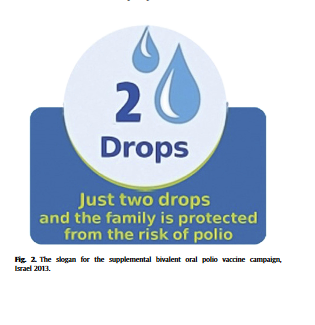
Looking specifically at risk communication issues, early in the course of the incident, several communication challenges were identified, including communicating the advantage of using oral polio vaccine (OPV) to halt WPV1 circulation in a community already highly immunised with IPV. That there were no paralytic cases made the decision to launch a supplementary immunisation activity (SIA) difficult for policymakers, and also altered the risk perception among members of the public. Notably, parents felt that OPV was a "social" vaccine that mainly protects the small percentage of the population that has not received IPV, and thought that administering OPV to IPV-vaccinated children is altruistic. Therefore, the risk communication to the public was that the vaccine will protect close family members and friends, and not only individuals or "society". In line with this message, the main slogan of the campaign was "Just two drops and the family is protected from the risk of polio".
The risk communication plan involved a variety of communication measures, such as a new designated official polio website, an existing official Facebook interface, an existing national call centre manned by over 20 staff members for several weeks reinforcing polio communications, print media (national and sectorial in various languages), electronic journalism, and also significant Ministry of Health presence in social networks, forums, and blogs. All were carried out in different languages to engage those communities whose first language is not Hebrew.
As reported here, the Israeli Ministry of Health communicated all findings related to the incident to healthcare professionals and the public in a consistent and transparent fashion to establish the Ministry as the most reliable source of information and to prevent rumours from spreading. In preparation for a planned SIA, a comprehensive communication plan was devised with two major campaigns, one focusing on hygiene before the SIA and the other on vaccination. The planning process addressed the achievement of consensus among the medical community regarding the need for an SIA in that peculiar epidemiological situation, building on medical opinion leaders in various disciplines, national medical societies and councils and professional networks, and briefings to frontline health professionals and administrators and also at government and political levels.
The researchers explain: "The intervention in this incident was to a great extent guided by generating public health evidence concerning the nature of virus circulation and its dynamics and epidemiology, which allowed a thorough risk assessment. Generation of such evidence required significant investment of time, resources and effort (e.g. comprehensive sample collection, development of new assays, communication) compared with empirical intervention but was perceived as more likely to be widely accepted in an argumentative public and professional environment and helped to increase public compliance with the campaign."
They offer these suggestions: "Reintroducing a live vaccine in SIAs in response to transmission of WPV or vaccine-derived poliovirus should be carefully considered and weighted close to the 'End Game' of polio eradication, especially if targeting the population at risk at a given scenario is feasible. Such circumstances require a comprehensive contingency plan that will support the generation of important public health evidence at the risk assessment stage, thereby allowing us to tailor the risk management approaches and underpin appropriate risk communication."
Clinical Microbiology and Infection 22 (2016): S140-S145. DOI: https://doi.org/10.1016/j.cmi.2016.06.018.
- Log in to post comments