










































Language and Digital Humanitarian Action: The State of Inclusion and Exclusion for Marginalised Language Speakers in Digital Humanitarian Services
"To start off any type of interaction, language is the first consideration. So, we need to be able to make services available in the language that people need." - humanitarian digital provider, Europe
This report, published by GMSA and CLEAR Global, shares the results of research to examine the state of inclusion and exclusion for marginalised language speakers within digital humanitarian platforms. It looks at the limitations of existing platforms in addressing the needs of crisis-affected individuals and the challenges and opportunities of integrating language technology into digital humanitarian services. The report concludes with recommendations that could contribute to more inclusive digital services that cater to the diverse linguistic needs of global populations affected by crises.
The research involved a detailed desk review, as well as online surveys and key informant interviews (KIIs) with three groups of participants: civil society organisations (CSO), international organisations commissioning and providing digital services with global insights, and language technology experts with insights into the feasibility and practicalities of specific applications.
As explained in the report, "Of the estimated 7,000 human languages, only a handful have a strong online presence and just a few hundred are available on digital platforms. These are broadly the dominant languages of the world's more economically and politically powerful nations. In this context, a language like Swahili, spoken by 100 million people, is marginalised globally. The digital marginalisation of most of the world's languages and their billions of speakers reflects the real-world marginalisation of language communities in their own countries... As digital services expand, minority language speakers are becoming more excluded. Digital content and support are concentrated in a fraction of the world's languages, with the most noticeable gaps in African languages and even major languages such as Bengali/Bangla and Hindi. Where digital content is available, it is often in an unuseable format for those who are not literate or whose language is largely unwritten. This can result in minority language speakers being more digitally excluded, including in crisis-affected communities. The risk of digital language exclusion is intersectional. Worldwide, women and girls, older adults, people with disabilities and minority ethnic groups have less access to education and the opportunities it presents to acquire literacy, numeracy, digital and second language skills. These same groups are consistently found to have lower levels of access to, and use of, digital technologies." In addition, factors driving digital exclusion are often compounded in crisis settings, meaning language-based digital exclusion leaves out many of the people humanitarian organisations want to prioritise in an emergency.
In discussing the barriers to providing digital humanitarian services in marginalised languages, the report makes the point that although many providers of digital humanitarian services recognise the importance of including marginalised languages, doing so is far from the norm. Although advances in language technology have been made recently, few marginalised language communities have reaped the benefits. Some of the reasons for this neglect that emerge from the research are: lack of awareness of the issue and lack of data on language use within certain communities; lack of prioritisation of the issue within organisations, which tend to prioritise the largest reach and scale to meet the needs of the greatest number of people; cost considerations; and a lack of inclusive technological solutions like speech recognition and machine translation that cater to marginalised languages.
Nevertheless, it is possible to create more inclusive digital humanitarian services for marginalised language speakers, but, according to the report, doing so will require shifts from across the sector. "All stakeholders will need to grapple with fundamental questions about how and why they use digital services, draw lessons from the (few) good examples of inclusive digital services and capitalise on untapped opportunities to expand access through collaborative and evidence-based practices."
Looking at examples of digital humanitarian services that meet the standard practice requirements of communicating in the languages, formats, and channels that marginalised groups are comfortable using, the report highlights some of the features and good practices they have in common. The features include user-centred design that, for example, helps identify keywords and concepts that users can relate to. The research also highlighted the importance of holistic approaches to language inclusion that take into consideration other types of digital exclusion that marginalised language speakers experience related to, for example, access to technology and user interfaces that are inclusive and take into consideration less literate or visually impaired users. The report also looks at good practices related to the need to consider informed consent and ethics around data privacy concerns when implementing digital technology services, especially for more marginalised communities. One example of dealing with this challenge is enabling users to opt out of sharing personal information.
The research spotlights two digital platforms making strides towards inclusion for marginalised language speakers. These platforms are briefly described in the report, with more detailed case studies available in separate accompanying publications (see links below). The case studies are:
- Mobile Vaani - a language-agnostic network of voice-based community media platforms that enables two-way communication on critical issues. The platform shares audio content with and from communities and partner organisations in user languages on topics like health, nutrition, and gender-based violence (GBV). The interface language is determined by partner organisations in the communities they want to engage with. Mobile Vaani works on both basic and smartphones, using voice to overcome literacy and digital skills barriers. Click here for the 4-page "Case Study: Mobile Vaani" in PDF format.
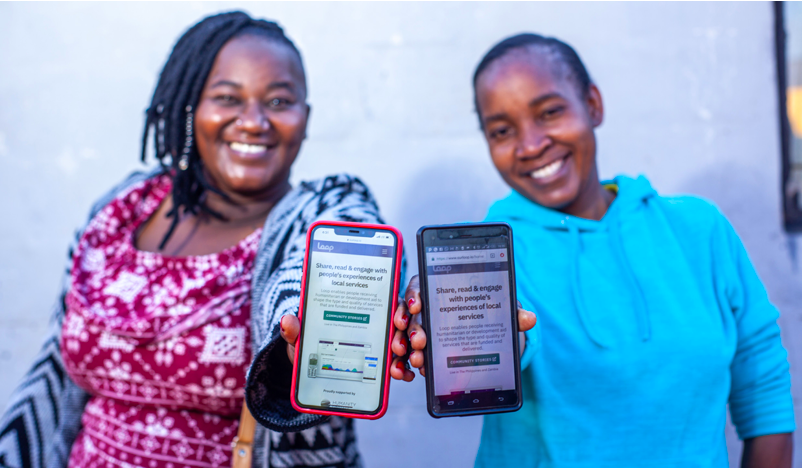
- Talk to Loop - a digital platform that enables people to safely provide feedback on the humanitarian and public services they receive and report abuse of various kinds through a range of channels, including a low-data website, WhatsApp, Facebook, and voice calls. Loop currently operates in 15 languages across Indonesia, the Philippines, Poland, Somalia, Ukraine, and Zambia. Arabic, English, French, and Spanish are available mainly for the staff of humanitarian organisations, while crisis-affected communities communicate on the platform in national and local languages. In each country of operation, Loop works through a network of local organisations that recognise the long-term value of the platform. Click here for the 6-page "Case Study: Talk to Loop" in PDF format.
Finally, the research identified several opportunities to make digital humanitarian services more inclusive for marginalised language speakers that, seemingly, remain untapped. They include working closely with marginalised language speakers and civil society to develop language technologies to ensure their quality, relevance, and sustainability. "Without that collaboration, the outcome may be wholly or partially irrelevant to members of the language communities concerned, who may have no interest in going online, may not want their language commodified for a global market or may prefer a second or third language for digital communication." Another opportunity identified in the report is forging use-case-focused partnerships for language technology. Applications are most useful if they build language and speech models that are based on use case-oriented data collection that focuses on specific domains (public health, GBV, cash assistance, etc.) and its intended users (age, gender, dialect, literacy, etc.). The pragmatic use of contact languages is another opportunity that should be tapped into more. The fact that many marginalised language speakers also speak a contact language or lingua franca to some degree should be considered when developing language technologies. To support this goal, the report notes that systematic efforts should be made to collect and share data on language use for specific marginalised language communities, as doing so would maximise the reach of digital services for users with some second-language capabilities and also help identify the most relevant contact languages to invest in.
The recommendations offered in the report, in brief, are:
- Conduct needs assessments for digital services (and other humanitarian services) in marginalised languages.
- Base communication and service design on research and monitoring beyond existing users.
- Support greater efficiency, impact, and sustainability on the part of donors by encouraging and supporting data sharing and collaboration between their partners.
- Encourage humanitarian organisations to apply existing good practices on inclusive communication to the greatest extent possible.
- Pursue a more consistent, user-centred approach for consent and data protection.
- Direct resources to develop language technology that meets the needs of marginalised language communities in crisis settings.
- Identify bottlenecks preventing humanitarian organisations from participating in collective use and improvement of language technology for marginalised languages.
- Establish a sector-wide, coordinated framework for language technology development among humanitarian donors, governments, and major language technology developers.
- Involve communities and civil society in decisions on language technology development for their languages.
- Consider targeted support for the most marginalised language communities to develop language data as the starting point for language technology.
- Invest in local digital services.
GMSA website on August 15 2024. Image credit: GSMA
- Log in to post comments