











































Mobilising Young people to Access Reproductive Health Care Facilities and Services
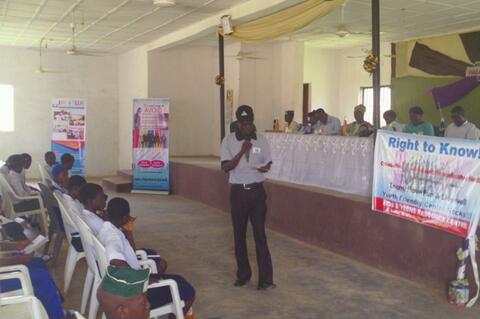
The Mobilising Young people to Access Reproductive Health Care Facilities and Services project is working to improve access of young people in Ondo State, Nigeria to sexual and reproductive health services and decrease associated morbidity and mortality. Led by Kids & Teens Resource Centre (K&TRC), the project uses social networks, radio programmes, peer education, and road shows to communicate information about sexual and reproductive health services. It is designed to mobilise youth and community stakeholders to develop programmes and activities for mitigating barriers that reduce youth's access to sexual and reproductive health services.
The project objectives are to:
- understand the context under which youth use or do not use sexual and reproductive health services in Ondo State;
- mobilise youths and community stakeholders to develop programmes and activities for mitigating barriers that reduce youth's access to sexual and reproductive health services;
- increase youth awareness and use of available youth friendly services within the public sector in the state; and
- advocate for sustenance of youth friendly services and use by vulnerable populations of youths, especially girls.
Following a baseline study and advocacy with stakeholders, the project used the following key strategies:
Youth Change Agents
Before commencement of the project, youth (mostly girls) participated in orientation training in adolescent reproductive health issues, including knowledge about which facilities and services are available. They subsequently meet monthly and work as change agents to catalyse behavioural change, raise awareness, and encourage other youth in their respective unions, associations, groups, vanguards, and communities to access health care facilities. A total of 360 young persons were recruited.
Youth Focused Town Hall Meetings
Youth focused town hall meetings were organised to create space for the youth to discuss how they can best access quality reproductive health services and facilities. These town hall meetings were organised and coordinated by the youth change agents and used to educate youth on issues around gender, importance of health care, check-ups, and HIV/AIDS. The first meeting held was used for disseminating the findings of the baseline survey and also to solicit the commitment of young people towards the utilisation of services in the state. A list of all youth friendly reproductive health care facilities in the state were also distributed during the meetings.
Awareness Campaign
In order to bridge the gap which affects service use, K&TRC carried out an awareness campaign through a road show featuring a musical show, dance competitions, and sensitisation through the distribution of social and behaviour change communication materials. The goal was to accelerate the demand for sexual and reproductive health and rights services through increasing awareness of available services in all the secondary health care facilities.
Social Media
According to the Kids & Teens Resource Centre, social media is the cheapest, easiest, and fastest means of information sharing. For this project, the organisation is using social media networks such as Facebook, Twitter, 2go, and Skype, to provide information about various Youth Friendly Health Services that are accessible in Ondo State. It is also being used to get feedback from young people on their views, opinions, and experiences on the Youth Friendly Services. Information gathered on this platform will go towards the monitoring and evaluation of the project, and will also be used for on-going learning. It will also build on the youth town hall meetings.
Live Radio programmes and Jingles
In order to reach a wider audience in the state, the team developed and aired jingles on two popular radio stations, one of them being the youth run Federal University of Technology Akure FM radio station listened to by over 200,000 young people from within the state. The team organises phone-in live radio programmes that enable youth and other members of the communities to call in and contribute to discussions on access to the reproductive health care services. A dedicated phone number and email is used to receive text messages, phone calls, and emails. This will also be used to do strategic surveys which will generate newspaper features for publication in local and national newspapers in future.
Youth Reproductive Health Fair 2013
K&TRC in collaboration with Ministry of Health are organising a three day fair on youth sexual and reproductive health and rights in the second year of this project. This is intended to showcase best practices relating to youth use of sexual and reproductive health facilities in the state, identifying gaps, and offering appropriate recommendations for scaling up.
Reproductive Health, Youth
According to Kids & Teens Resource Centre, the health status of Nigeria’s young people is poor, characterised by early sexual debut, low knowledge about reproductive health issues, low contraceptive use, high birth rates, and high rate of unsafe abortions. Furthermore, they have stated that 15 – 19 year olds make up 10% of Nigerian population and contribute 11% of maternal births. The highest prevalence of HIV is in the age group 15 -29. Complications of unsafe abortions account for 72% of deaths among female teenagers. 4% of 15-19 year olds are HIV positive. Poor knowledge of reproductive and sexual health issues accounted for most of the problems they face as young people. Early pregnancy often translates into a number of other problems. Pregnant girls who are 15 years old and under have a maternal mortality rate seven times higher than that of women aged 20 to 24 years old - thus the need for this sort of programme.
K&TRC has won several awards for outstanding approaches to meeting the needs of young people using diverse strategies at different areas. The strategies that have worked include young people’s involvement, which they say is critical to adolescent and youth health programming at every level.
Email from Martin-Mary Falana on February 25 2013.
- Log in to post comments