










































Mobilizing Communities for Health and Social Change: Facilitator and Participant Manuals and Toolkits
"Community mobilization is a capacity-building process through which community individuals, groups, or organizations plan, carry out, and evaluate activities on a participatory and sustained basis to improve their health, education, and other needs, either on their own initiative or stimulated by others."
This set of resources was developed by Breakthrough ACTION South Sudan as part of the Sawa Le Baad (Together for Each Other) programme's social and behaviour change activities. The manuals and toolkits are meant to help organisations apply sound community mobilisation approaches when designing, implementing, monitoring and evaluating their health programmes.
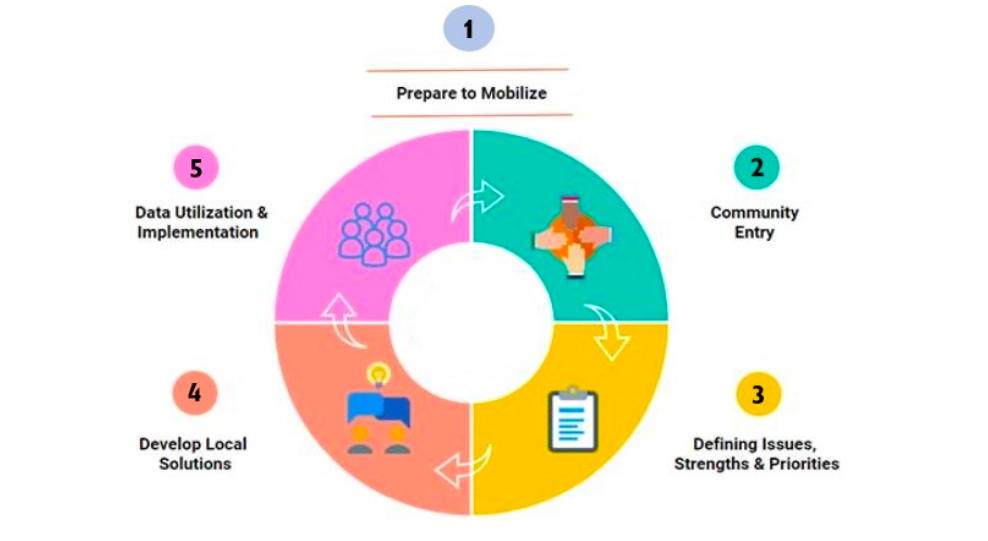
In particular, the five documents seek to provide guidance on implementing an adapted version (developed by Breakthrough ACTION South Sudan) of the Community Action Cycle (CAC) methodology that incorporates elements of the Partnership Defined Quality (PDQ) methodology. The CAC, which was developed by Save the Children, is a community mobilisation approach that consists of seven phases. These phases include the initially preparing to mobilise (phase 1), organising the community for action (phase 2), exploring the health issues and setting priorities (phase 3), planning together (phase 4), acting together (phase 5), evaluating together (phase 6), and preparing to scale up (phase 7). (See Related Summaries, below, for more information on CAC). PDQ is a methodology to improve the quality and accessibility of services with community involvement in defining, implementing, and monitoring the quality improvement process. It links quality assessment and improvement with community mobilisation. The combined model is designed to allow for the engagement of community members and health service providers by creating opportunities for discussion, both separately and then together, to identify issues around accessing and providing health care to communities and how to address these issues. The hybrid approach encourages community collective action and social accountability.
Each phase of the adapted CAC has detailed steps that are similar to the original CAC. They can be integrated into the health programme design, implementation, and monitoring and evaluation cycle. The phases and steps in this model are as follows:
Phase 1 - Preparing the Program Team to Mobilise Communities
Step 1. Put together a Community Mobilisation Team [CMT]
Step 2. Develop your CMT
Step 3. Gather information about community resources and constraints
Step 4. Develop a community mobilisation plan to guide you forward
Phase 2 - Community Entry
Step 1: Visualising positive change - community orientation and partnership
Step 2: Build relationships, trust, credibility and a sense of ownership with the community
Step 3: Invite community participation
Step 4: Ensure gender equity and diversity in community action groups
Step 5: Develop a 'core group' from the community
Phase 3 - Communities Defining the Issue, Exploring Strengths, and Setting Priorities
Step 1: Understand how to hold participatory meetings with communities
Step 2: Use participatory and HCD [human-centred design] tools to collect data from and with communities
Step 3: Conduct Root Cause Analysis and prioritisation of determinants
Step 4: Validate data and prioritise determinants with communities
Phase 4 - Communities Develop Local Solutions
Step 1: Determine who will be involved in planning and their roles and responsibilities
Step 2: Design the planning session
Step 3: Conduct/facilitate the planning process to create a community action plan
Phase 5 - Implementation and Data Utilisation for Decision Making
Step 1: Define your team's role in accompanying community action
Step 2: Strengthen the community's capacity to carry out its action plan
Step 3: Support community groups to monitor progress and utilise data to inform their
micro-planning and collective action
The facilitator and participant manuals and three toolkits were developed to support the implementation of this hybrid CAC process. The tools are meant to be used by Community Mobilisation Teams (CMTs) who work with Community Action Groups (CAGs). CMTs are composed of those actors who are working with the community to implement community mobilisation - for example a project or programme team, national and/or district health workers from the Ministry of Health, or members of a non-governmental organisation (NGO). CAGs are the core members of the community who will be working with the CMTs to carry out the activities of community mobilisation. These are members of the same community who would include community leaders (religious and traditional), members from women's and men's groups and youth groups, community health workers, and community development committees.
The facilitator and participant manuals were developed to assist community mobilisation trainers to train CMTs and other players, such as district health promotion committees and CAGs, on the community mobilisation process:
- Mobilizing Communities for Health and Social Change: The Adapted Community Action Cycle with a Toolkit for Community Mobilization Training of Trainers: Facilitator's Manual [PDF, 122 pages]
- How to Mobilize Communities for Health and Social Change: Participant Manual [PDF, 127 pages]
The following toolkits were developed to serve as guides for CMTs to assist in facilitating three of the phases of the CAC:
Publishers
Breakthrough ACTION website, August 30 2024. Image credit: Breakthrough ACTION
- Log in to post comments