










































National Emergency Action Plan for Polio Eradication 2020 [Pakistan]
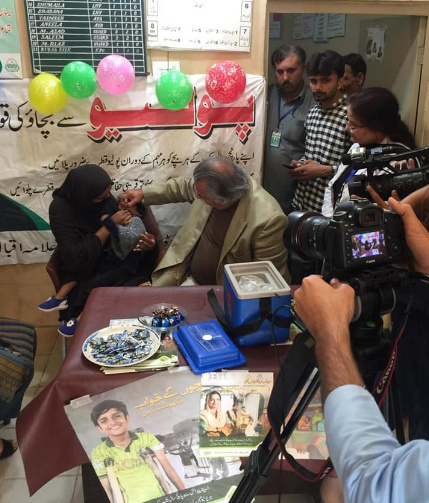
"Serious challenges must be addressed to build public confidence in the polio programme and OPV [oral polio vaccine]. Refusals, which remain in the hundreds of thousands, are impacting overall coverage and immunity levels."
Pakistan remains one of only two countries in the world still reporting wild poliovirus type 1 (WPV1), a position it holds alongside neighbouring Afghanistan. In 2019, community resistance to immunisation, alongside intense circulation of virus, especially in the Khyber Pakhtunkhwa (KP) province, resulted in 146 polio cases being reported. In addition, circulating vaccine-derived poliovirus type2 (cVDPV2) was detected in the country for the first time since 2016, with the number of children paralysed by it reaching 22 in 2019. In this context, the National Emergency Action Plan (NEAP) 2020 reflects a true emergency programme, whose goal is to halt all WPV1 and VDPV2 transmission in Pakistan. The NEAP is an annual document that outlines the eradication strategy of the Pakistan Polio Eradication Initiative (PEI) and its strategic priorities, main areas of work, and innovations, modifications, and improvements that may help the programme address persistent challenges.
Among the key barriers to efforts to ensure all children are vaccinated are: children missed due to inconsistent and suboptimal campaign quality in some areas; massive population movement within Pakistan and across the border with Afghanistan; inadequate delivery of essential immunisation (EI) services; and parent/caregiver refusal to vaccinate children during supplementary immunisation activities (SIAs).
To better understand vaccine hesitancy and caregiver refusals, the programme conducted technical and management reviews, including two independent communication reviews in April and May 2019. Analysis indicates a growing mistrust in vaccination and the PEI, which has been exacerbated by community concern - wherein communities deprived of many basic services (e.g., health, nutrition, and water, sanitation, and hygiene - WASH) grow weary of repeated knocks at the door for polio eradication activities. Frontline workers (FLWs) have limited time and training to develop rapport or cultivate trust with parents. In particular, the spread of misinformation and anti-vaccine propaganda promoted through social media has materialised as real community resistance to vaccination. In April 2019, propaganda against the polio programme in Peshawar resulted in a record number of refusals across Pakistan, particularly in districts of KP, and the country as a whole decided to interrupt campaign activities for the safety of FLWs and to revisit its strategy for more effective community engagement (CE) activities.
In this context, among the innovations introduced through the 2020 NEAP are the integration of polio eradication with the Expanded Programme on Immunization (EPI) and integrated service delivery (ISD) through development projects related to maternal and child health, nutrition, and WASH. The commitment on all fronts to strong partnerships, true CE, clear communication, and the capacity building, training, and empowerment of the workforce from the ground up are elements that are intended to carry through each area of work. These elements are being met with adjustments, such as the mapping of super-high-risk Union Council (SHRUCs) and a revised campaign schedule (especially to align with Afghanistan's vaccination schedule, as coordination between these two countries is critical to interrupting poliovirus within and across the shared epidemiological block). Officials opine that the 2020 NEAP shares a similar approach to Prime Minister Khan's flagship poverty alleviation programme called "Ehsaas" (Urdu for "empathy"), which includes more than 100 social protection policies. As many at the heart of the "Ehsaas" programme hail from polio-affected areas, there is thought to be a window of opportunity to align the two programmes to help rebuild community trust.
The NEAP discusses how the Emergency Operations Centre (EOC) will carry out these and other activities that are planned within the following five areas of work (AoWs): (i) programme operations: ensuring all vaccination activities reach all children; (ii) risk assessment and decision support (RADS): ensuring rapid detection and response to any WPV1 or VDPV2 case and ensuring programme decisions are data driven; (iii) synergy and integrated service delivery activities: ensuring better integration of EPI and expanded delivery of additional services; (iv) communications: ensuring provision of social and behaviour change (SBC) communication support to enhance vaccine acceptance; and (v) management: ensuring the programme is well-supported and coordinated with oversight and accountability for all.
Looking more closely at (iv) communications, the PEI intends to ramp up communication for eradication (C4E) activities to improve trust in the PEI and in vaccines. Strategies have been devised to engage stakeholders and influencers, dispel misconceptions around vaccine safety and efficacy, and address the root causes for parents and caregivers refusing the vaccine. To date, for example, the PEI's media and advocacy team:
- Reached on average 88% of intended populations in high-risk districts through mass and outdoor media campaigns focused on raising the risk perception of polio and reinforcing the need for repeated vaccination;
- Enhanced proactive social media presence and engagement through a dedicated social media cell (SMC), social media boosting, and partnerships for regulation of propaganda (with Facebook);
- Refreshed standard operating procedures (SOPs) on crisis communication and training of national and provincial spokespersons; and
- Launched initiatives to encourage an enabling environment post-Peshawar incident and in preparation for 2019-2020 low season, including the Perception Management Initiative (PMI), advocacy and high-level partnerships (e.g., Pakistan Polio Ambassador Wasim Akram), and the establishment of a 24/7 call centre designed to help parents in reaching out to the programme and reporting missed children, while also gathering data/insights.
In addition, the PEI's communication for development (C4D) team:
- Conducted influencer, CE, and interpersonal communication (IPC) activities focused on restoring trust in the polio programme and in the efficacy of polio vaccines during all 2019 SIAs. Activities were enhanced after the Peshawar event in April.
- Conducted "challenge mapping" processes with granular analysis and solutions to local-level issues in high-risk areas. Such processes contributed to resolving refusals, with generally 3 out of 4 refusals resolved in community-based vaccination (CBV) areas in the core reservoirs.
- Developed and rolled out the "Interpersonal Communication Plus" training package to build the capacity of FLWs in effective communication, polio eradication messaging, and key integrated family health practices.
- Developed and rolled out microplanning and Union Council (UC) profiling tools, aimed at enhancing data usage and integration of communication and operations personnel and resources.
Overall on the communication front, in the 2020 NEAP, priority will be given to approaches adapted for local contexts, ensuring that all CE actors (CBVs, the Communications Network (COMNet), religious support persons (RSPs), etc.) are better integrated and coordinated. To look at one specific CE actor, community mobilisers (CMs) are deemed critical resources at the street level in the SHRUCs. CMs are selected for their communication skills and local knowledge. Each CM visits 300 to 500 households before and during a polio immunisation round to provide (and collect) information, counter arguments against OPV, counsel pregnant women, and ensure no child is missed. The CM works with a network of influential local people, like medical practitioners, (retired) school teachers or religious leaders, who are encouraged to attend refusal houses with the vaccination teams to assuage the concerns of parents and caregivers. CMs are part of an improved human resource structure that includes the District Communication Manager, then the UC Communication Manager, and finally Area Communication Manager.
In 2020, the PEI's media and advocacy team plans to focus on: implementing the PMI, fortifying partnerships and advocacy strategies, and strengthening crisis communication to manage risks to the programme. Meanwhile, the C4D team plans to:
- Foster social mobilisation and CE through social/influencer and media outreach;
- Form key influencer alliances at the national and district levels;
- Initiate mapping, capacity building, and CE activities with district- and UC-level influencers;
- Implement mosque-based activities (e.g., announcements and Khutbahs);
- Implement school-based activities and other info-entertainment activities;
- Generate community goodwill and public favour through compelling media outputs and social media campaigns;
- Work to build caregiver and family knowledge, awareness, and confidence in the PEI and OPV through focus group sessions and/or individual parent counselling sessions (in cases of refusals or persistently missed children) and by identifying and mobilising role model parents to mobilise other parents;
- Develop communication strategies to reach mobile populations and travellers within the country and those crossing the Pakistan/Afghanistan border (e.g., by mapping key influencers in border areas, synchronising communication activities and multimedia content, and carrying out CE sessions with Pashtun communities in Sindh;
- Improve motivation and capacity-building of FLWs (e.g., by engaging motivational speakers, enhancing IPC skills, and developing mobile phone app for FLWs to provide key programme updates and information, education, and communication (IEC) material; and
- Develop and disseminate context-specific content on the C4E strategy (e.g., by enhancing integration and coordination of communication cadres at implementation level, with focus on COMNet and RSPs integration, and coordination between communications and operations teams).
To conclude with the words of Dr. Zafar Mirza, Special Assistant to the Prime Minister National Health Services, Regulation and Coordination (from the NEAP's Foreword): "Blessed with full commitment from the highest levels, including the Military and religious and social institutions, our message is clear: the people of Pakistan are best served when those in position to provide leadership unite in advocacy and action....Together Insha'Allah! we will make Pakistan and the world polio-free."
End Polio Pakistan website, April 22 2020. Image credit: Pakistan Polio Eradication Initiative via Facebook