










































Targeting the Last Polio Sanctuaries with Directly Observed Oral Polio Vaccination (DOPV) in Northern Nigeria, (2014-2016)
World Health Organization (WHO), Country Representative Office, Abuja, Nigeria (Korir, Bawa, Musa, Bashir, Isiaka, Ningi, Warigon, Banda, Braka, Nkwogu, Tegegne, Abdul-Aziz, Suleiman, Yehualashet, Vaz, Alemu); National Primary Health Care Agency (Shuaib, Adamu, Mohammed, Onoka); WHO Regional Office for Africa (Mkanda); Global Public Health Solutions (Nsubuga); United Nations Children's Fund (UNICEF) Country Office (Corkum)
"Directly observed polio vaccination strategy improved uptake of polio vaccines resulting in increased population immunity in high-risk areas that were potential sanctuaries for polio transmission."
The Polio Eradication Initiative (PEI) has faced numerous challenges in northern Nigeria, including noncompliance by parents and complicity of house-to-house vaccination team members with parents to fingermark children who had not actually been vaccinated with the oral polio vaccine (OPV). This study describes the rationale and processes used to implement directly observed polio vaccination (DOPV) in Nigeria to improve uptake of polio vaccines in settlements with chronically missed children.
The strategy is an intervention that involves vaccinating children under the direct supervision of an independent supervisor to ensure compliance, which is supported by community mobilisation efforts. Attractive incentives ("pluses", such as soap, milk sachets, sweets, noodles) are used to make parents willingly submit their children for vaccination or directly attract children to the vaccination teams or post.
Starting in August 2014, DOPV was implemented within the framework of the regular Immunization plus Days (IPDs) in 90 local government areas (LGAs) in 12 very high-risk states for polio in Nigeria. Exclusive outside vaccination was implemented in the first 2 days of the 6-day IPD exercise. The DOPV was conducted in streets, at transit points, and during social and religious events. The exercise continued with regular 4-day house-to-house vaccinations in conjunction with transit and health camp teams, including revisits and resolving noncompliant cases. Mop-up vaccinations were conducted soon after the regular IPDs, and all vaccination teams participated in reaching all pending households, working with traditional and religious leaders to resolve all pending non-compliance before the next round. All vaccinations during revisits and in non-compliance households were also done outside the household with direct observation by a supervisor.
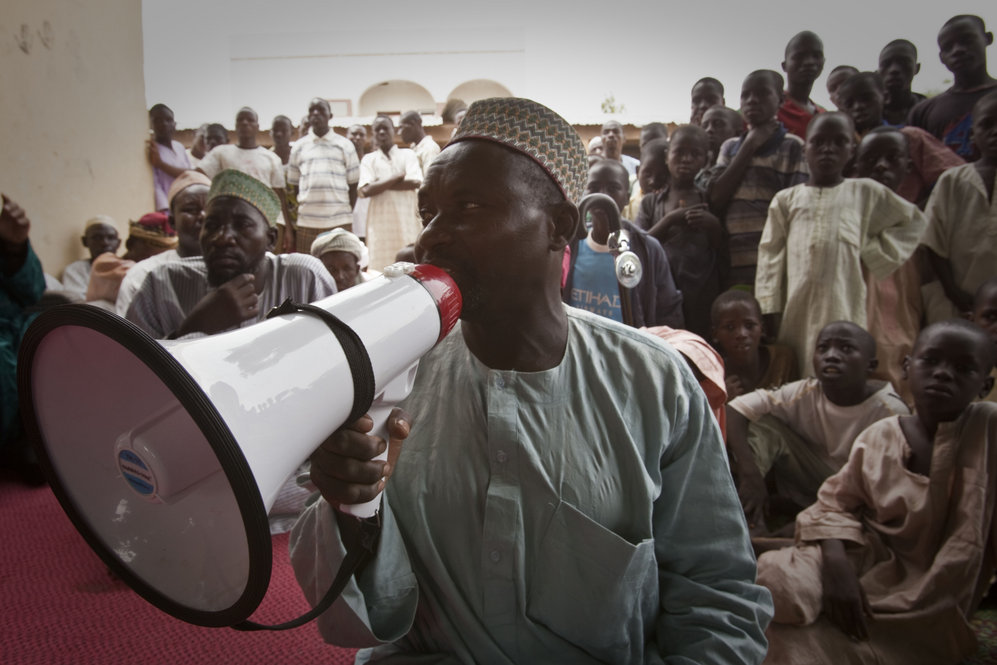
The DOPV team comprised one team supervisor, one vaccinator, one community leader and one mobiliser with a megaphone, to further attract children in addition to the pluses. In the security-compromised areas of Borno State, the state Emergency Operations Centre (EOC) involved the community-based security vigilante, the Civilian Joint Task Force (CJTF), to provide security and crowd control to the vaccination teams.
Members of the local government task force on immunisation, which comprise traditional leaders and other stakeholders, resolved to mobilise the communities to accept the incentives provided to children and caregivers during street vaccinations. "The engagement of the traditional rulers raised community awareness and improved the credibility of polio vaccination processes amongst previously reluctant communities."
There was a decline in the percentage of missed children in the 90 LGAs from 2014-16. The missed children due to child absent declined from 2.4% in August 2014 to 1.1% in May 2016. Similarly, the missed children due to noncompliance declined from 0.6% in September 2014 to 0.4% in May 2016. The number of states in which more than 90% of children received more than 4 OPV doses increased from 7 in 2013 to 11 states by July 2016. In Borno State, despite the security challenges, the state reported an increase from 75% in 2013 to 86% by July 2016.
Reflecting on the findings, the researchers note: "Implementation of directly observed oral polio vaccination required vigorous high-risk analysis of the area and adequate plans and engagement of community leaders and independent supervisors. The success was determined by the quality and drive of the supervisors coupled with ample supply of attractive child and adult pluses (incentives). Further, a daily implementation plan directing where and how the teams would move was essential, usually supported by the community leaders."
In all the LGAs where DOPV has been consistently implemented since September 2014, "community leaders have reported an increase in acceptance to polio vaccinations as previously noncompliant parents now readily present their children for vaccinations owing to the attractive incentives given to eligible children and parents. With systematic continued engagement with key stakeholders, community leaders now give permission for vaccination of all the children found outside their homes even without their parents and caregivers."
BMC Public Health 2018, 18(Suppl 4): 1314. https://doi.org/10.1186/s12889-018-6182-2. Image credit: Global Polio Eradication Initiative (GPEI)