










































Summary Report on the Technical Advisory Group Meeting on Polio Eradication for Pakistan [June 2014]
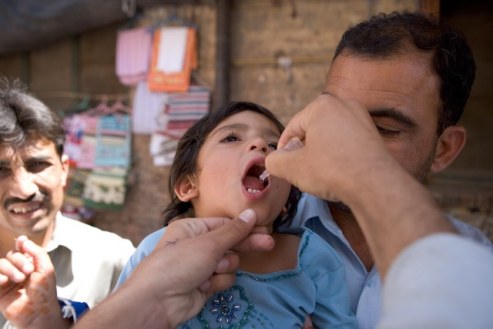
"The Technical Advisory Group on Polio Eradication for Pakistan (TAG) conducted a meeting on 2-3 June 2014, during a time when the Pakistan programme is at a 'critical crossroads'....In the four months preceding the meeting, 86% of global polio cases were in Pakistan."
From the World Health Organization (WHO), Regional Office for the Eastern Mediterranean, this report from the aforementioned meeting addresses the deep concern over the reservoirs of wild poliovirus type 1 (WPV1) in Pakistan, arguing that immunisation efforts need to involve:
- deepening government ownership and commitment at all levels,
- capitalising on support from regional and global partners,
- putting in place the structures required to take full advantage of the next low transmission season (first half of 2015), and
- developing a clear roadmap that utilizes these resources to immunise all children of Federally Administered Tribal Areas (FATA), addressing insecurity and chronic performance gaps in all reservoir and high-risk areas by the third quarter of 2014.
Prior to the articulation of these recommendations, the report provides background. In June 2014, the Independent Monitoring Board (IMB) of the Global Polio Eradication Initiative (GPEI) issued the report from their 9th meeting (See Related Summaries, below), identifying the situation in Pakistan as a "crisis". This was borne out by statistics such as the fact that, as of July 5 2014, Pakistan reported 90 cases due to WPV1 (compared with 22 at the same time in 2013).
In the context of the above recommendations - and while offering more specific suggestions in terms of the way forward - the TAG shares its findings about what is being done to address the challenges - some of which are communication-related - in particular parts of Pakistan. For example:
- At the federal level, advocacy has been playing a key role (e.g., the Prime Minister's directive to mobilise all sectors) and, according to TAG, must continue to do so. Specific ideas looking ahead include, for instance, establishing a multi-disciplinary team under the leadership of the Prime Minister's Focal Person and conducting, on a regular basis, national and provincial level cross-border meetings with a focus on coordination and maximum immunisation coverage of populations moving between Pakistan and Afghanistan.
- With regard to immunisation strategies, the TAG urges integration with social mobilisation efforts, amongst other strategies outlined.
- In FATA areas, the TAG welcomes advocacy efforts such as those on the part of the President of Pakistan and the Governor of Khyber Pakhtunkhwa (KP)/FATA to reach out to Parliamentarians and tribal and religious leaders. Amongst the suggestions: "Provision of security and protection for health workers through support of the army along with increased use of security assessment and information to guide operations, community engagement, and provision of broader health services."
- In KP, the TAG "congratulates the provincial government for the success of the 'Sehat Ka Insaf' initiative. The commitment and resolve from the highest authority to the local police officer and vaccinator, to provide OPV [oral polio vaccine] and other health services to the population of Peshawar while ensuring the safety of health workers is exemplary." One suggestion is development of a written, budgeted strategy for the remainder of 2014 for KP incorporating lessons learned and best practices identified through a systematic review and analysis.
- Noting an "apparent lack of high-level political ownership in Karachi and Sindh", the TAG suggests, amongst other things, "[r]e-invigoration of the Karachi operations centre, including a mechanism for full engagement and coordination of all parties and partners in Karachi and direct, regular, and scheduled participation of the Chief Secretary."
- In Balochistan: "Continued vigilance and active engagement in further programme improvement by the provincial government remains critical."
- In Punjab, the TAG "particularly notes the zero tolerance for poor performance and effective use of environmental surveillance data for action."
When addressing communication directly - aside from the advocacy and engagement strategies described above - TAG "commends the emergence of a systematic process for integrating communication strategies and plans into provincial operational planning and the development and implementation of specific communication strategies and plans in high-risk areas. TAG also supports the notion of integrating PEI [Polio Eradication Initiative] and EPI [Expanded Programme on Immunization] messaging to strengthen EPI to address health inequalities....The TAG encourages the increased use of real-time information in the field and frequent studies on knowledge, attitudes, practices and behaviour (KAPB) and other studies..." Other suggestions involve strategies such as: (i) continued development and implementation of specific communication strategies/plans in high-risk areas and realignment of social mobilisers from long-term polio-free areas to remaining reservoir and outbreak areas. (ii) Integration of communications and social mobilisation data and activities in planning and operations, including integrating an inactivated polio vaccine (IPV) training component into vaccinators' induction and refresher training. (iii) Joint presentations of the communications and operational components of the programme from provinces and the national level at the meeting of the next TAG.
Email from Chris Morry to The Communication Initiative on August 26 2014. Image credit: GPEI
- Log in to post comments