










































Report on the 17th Meeting of the Technical Advisory Group for the Eradication of Poliomyelitis in Pakistan [January 2016]
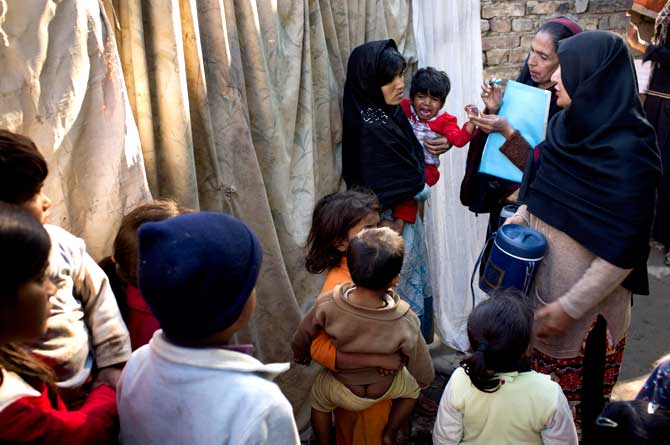
"The TAG appreciates the substantial integration of communication and social mobilization into all aspects of the programme and its focus on building community acceptance and demand. Full integration of operations and communications is critical to achieving the 'zero missed children' goal."
This report summarises the proceedings of the Technical Advisory Group (TAG) for the Eradication of Poliomyelitis in Pakistan, one of the 2 remaining countries with indigenous transmission (the other being Afghanistan). The Islamabad, Pakistan meeting took place halfway through the 2015-2016 low transmission season in an environment of improving programme performance. The TAG was asked to review progress towards the interruption of transmission of wild poliovirus (WPV) in Pakistan by May 2016, the goal of the national emergency action plan (NEAP).
Noting that the year 2015 saw the lowest number of polio in endemic countries and the fewest number of cases of confirmed WPV in recorded history, the TAG confirms positive progress in Pakistan. For instance: the proportion of environmental samples positive for WPV decreased from 35% in 2014 to 20% in 2015; the number of circulating clusters declined from 16 in 2014 to 8 in 2015; and, for the first time, WPV1 genetic diversity decreased during a high season (see Figures 2 and 3). The TAG describes "enormous progress" in the Federally Administered Tribal Areas (FATA) in the past 6 months. For example, "one major success story has been the implementation of continuous community protected vaccination (CCPV). This has been very critical in improving overall quality of campaigns by ensuring door-to-door vaccinations replace ineffective hujra vaccinations." (A hujra is a drawing room where guests are entertained in Pashtun areas of Pakistan.) In addition to community participation, collaboration and high-level engagement are credited for part of this success: "The improvement of the security environment, a prerequisite for good programmatic outcomes, would not have been possible without the leadership of the Pakistani government. The TAG deeply regrets the loss of life incurred among polio programme security support workers in Quetta City in January 2016, and notes the remarkable levels of commitment that saw vaccinators working again within hours of the incident. In addition, strong management, oversight and accountability across all government levels have contributed to the observed progress." At the prgramme level, the TAG notes the positive execution of a "one team" approach in terms of management: The programme is currently coordinated from national and provincial emergency operations centres (EOCs) and is fully supported by international and local staff from partner agencies.
However, surveillance data indicate persistent WPV circulation in the 3 remaining core reservoirs: the city of Karachi, Khyber-Peshawar (KP) Corridor, and Quetta block. Transmission in the second and third reservoir is heavily intertwined with transmission in the neighbouring Greater Nangarhar and Greater Kandahar areas of Afghanistan, respectively. The TAG urges that, to end the back-and-forth transmission between Afghanistan and Pakistan (see Figure 9), both countries: continue holding regular regional- and national-level cross-border meetings and monitor the implementations of agreed-upon actions; improve coordination, information sharing, and joint risk management at the micro level, especially between KP/FATA provinces of Pakistan and Eastern/South-eastern regions of Afghanistan and continue combined analysis of data for these areas; continue reviewing the supplementary immunisation calendar together and ensuring full synchronisation; treat tier 1 and 2 districts of Pakistan contiguous to low-performing priority 1 and 2 districts of Afghanistan as a single entity for high-focus interventions. "This should also include coordination of subdistrict level staff and communication strategies." It is noted that the switch from trivalent oral polio vaccine (tOPV) to bivalent OPV (bOPV) in Pakistan was slated for April 25 2016. The TAG recommends the programme closely monitor the preparation for the switch and synchronise the switch date with Afghanistan.
As the programme intensifies focus on the core reservoirs as described above, the TAG stresses that districts showing consistent poor performance need to develop and implement district-specific action plans to reach every child. "Integrated communication strategies are critical to ensuring that demand and acceptance remain high. The TAG recommends the continued adaptation and localisation of mass media messaging together with an intensified focus on community engagement for the purpose of reaching and vaccinating all remaining missed children. The programme also needs to ensure the consistent presence of frontline workers with an appropriate profile (defined as local, female, well-trained, supported and supervised) on the doorstep to sustain community and household acceptance and trust."
Another pressing need identified by the TAG concerns personnel: "Considering the need for well-motivated, local female frontline workers, the TAG notes with concern the lack of improvement in the proportion of females in mobile teams which has remained at 60% since March 2015. The TAG is troubled that gaps identified by the findings of the external surveillance review are yet to be fully addressed." Following a series of recommendations, the report concludes by looking ahead: The TAG anticipates that the new NEAP for 2016–2017 should be presented in the next TAG meeting, which is proposed for mid-2016.
Email from Poliomyelitis Eradication Programme, WHO/EMRO to The Communication Initiative on April 19 2016. Image credit: SAMAA
- Log in to post comments